Aletsch Glacier Panorama Trail
How would you rate Aletsch Glacier Panorama Trail?
Tap a star to share your experience and help other hikers.
Aletsch Glacier Panorama Trail: Glacier-Rim Day Hike
HikeList Score
Aletsch Glacier Panorama Trail scored 75/100 on HikeList's trail-quality metrics.
See score breakdownHide breakdown
- Ideal length 55
- Balanced challenge 100
- Scenery & wildness 98
- Varied terrain 59
- Accommodation 49
- Food & support 65
- Path quality 98
- Season flexibility 76
Computed from length, challenge, scenery & wildness, terrain variety, accommodation, food & support, path quality and season flexibility.
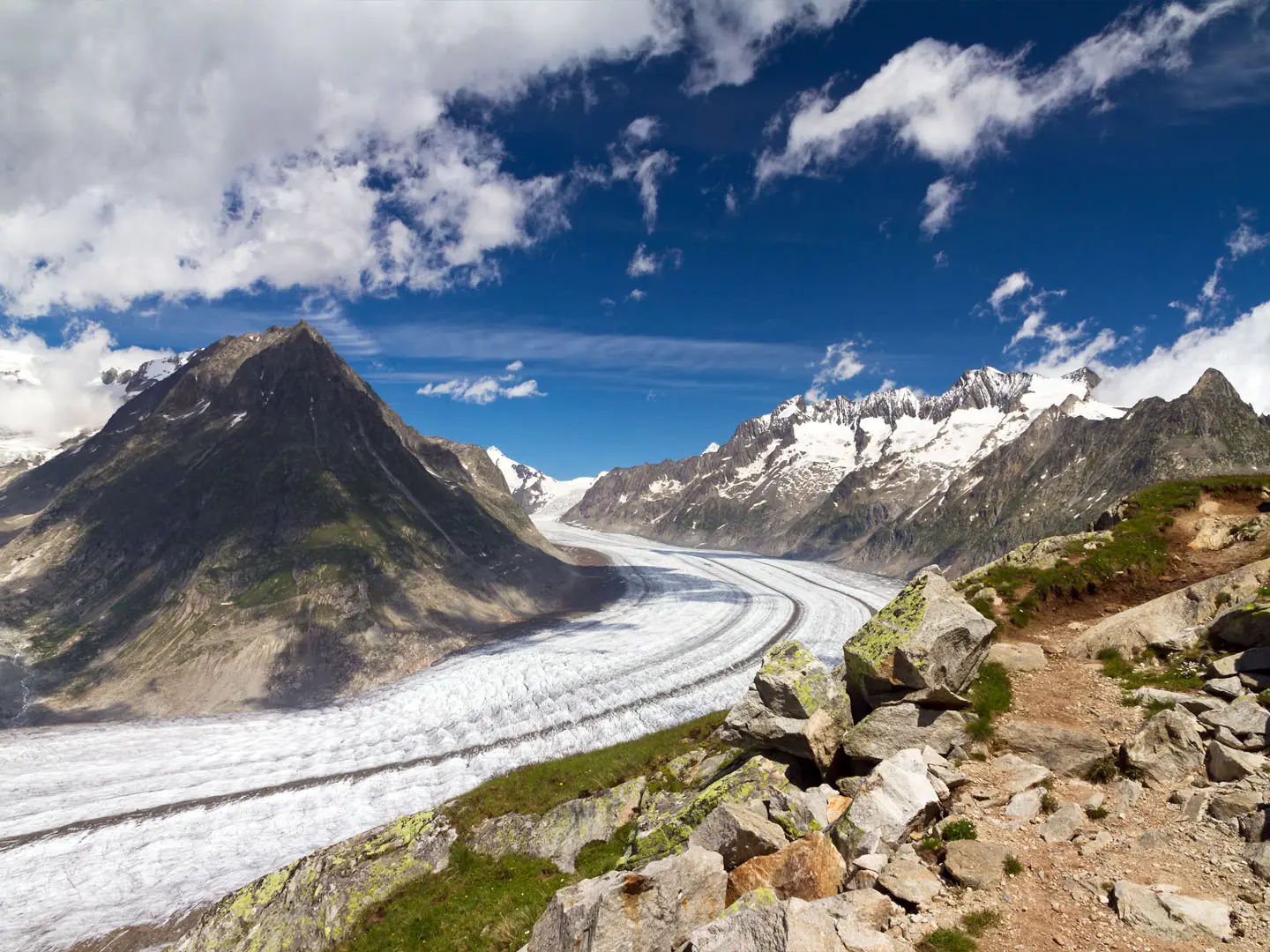
The Aletsch Glacier Panorama Trail is a 12.4 km point-to-point day hike in the Valais, Switzerland, from Moosfluh above Riederalp to Fiescheralp. It is a moderate Swiss T2 mountain walk, taking roughly 4–5 hours, with rocky and partly exposed alpine paths along the northern rim of the Great Aletsch Glacier. It suits confident hikers who want the glacier views of the Aletsch Arena without committing to the full 3-day Aletsch Panoramaweg 39.
Route Overview
Start at the Moosfluh upper cable-car station, reached from Riederalp, and walk east on the high traverse above the Great Aletsch Glacier. The route partly follows stage 2 of the official Aletsch Panoramaweg, SwitzerlandMobility route 39, passing the Roti Chumme glacier-edge traverse before reaching Märjelensee and the Gletscherstube mountain hut. Near the end, an illuminated tunnel cuts through the Tälligrat ridge, after which the path descends to the Fiescheralp upper cable-car station for the cable car down to Fiesch. This is a point-to-point hike; plan cable-car timings at both ends. For a related Aletsch route, see the Aletsch Glacier UNESCO Trail, or compare it with the Diavolezza Glacier Trail in the Engadin.
Aletsch Glacier and Aletsch Forest history
The Great Aletsch Glacier has attracted naturalists and walkers since the 19th century, when the Märjelensee glacier lake was a celebrated Alpine sight. The Aletsch Forest above Riederalp has been protected by Pro Natura since 1933. In 2001, the wider Swiss Alps Jungfrau-Aletsch area became Switzerland’s first natural UNESCO World Heritage Site. Today, this day hike uses part of the signposted Aletsch Panoramaweg route 39 network through the Aletsch Arena.
Notable highlights
Great Aletsch Glacier (about 23 km): The longest and largest glacier in the Alps, covering roughly 81.7 km². The trail gives sustained views across the ice stream as it curves between dark rock walls.
Konkordiaplatz (up-valley ice confluence): Four firn streams merge here, and the ice reaches a maximum thickness of about 905 m. You see the broader glacier system that feeds the Great Aletsch Glacier.
Moosfluh viewpoint: The panoramic starting balcony above Riederalp, known for the classic head-on view down the glacier. The surrounding slope is also a study site for slow rockslide movement.
Märjelensee and Gletscherstube: A glacier-edge lake where floating ice floes can appear in early season. The nearby Gletscherstube hut is the main place to pause or split the walk.
Aletsch Forest and Villa Cassel: Just beside the Riederalp/Moosfluh start area, the Aletsch Forest is a Pro Natura reserve with very old Swiss stone pines. Villa Cassel on the Riederfurka is now the Pro Natura Centre Aletsch.
Tälligrat tunnel: An illuminated rock tunnel near the end of the hike carries the path through the ridge before the descent to Fiescheralp.
Challenges to expect
Expect a high-altitude Swiss T2 mountain path, not a technical climb. The main challenges are rocky and gravel sections, stairs, some exposure along the glacier rim, and fast-changing alpine weather. Snow can linger before July, and the route depends on seasonal cable cars and the Gletscherstube opening period. Carry food, water and warm layers; there is limited resupply between Moosfluh and Fiescheralp.
HikeList Score
Aletsch Glacier Panorama Trail scored 75/100 on HikeList's trail-quality metrics.
See score breakdownHide breakdown
- Ideal length 55
- Balanced challenge 100
- Scenery & wildness 98
- Varied terrain 59
- Accommodation 49
- Food & support 65
- Path quality 98
- Season flexibility 76
Computed from length, challenge, scenery & wildness, terrain variety, accommodation, food & support, path quality and season flexibility.
 Switzerland
Show more data Show less
- Mountainous
- Dirt
- Gravel
- Rocky
- Huts
- Family Friendly
- Pet Friendly
- Restrooms
- Water Sources
- Shelters
Photos from hikers
Taken on the trail by people who've reviewed Aletsch Glacier Panorama Trail.
Take the cableway up to Moosfluh from Riederalp, then follow the high glacier-rim path past Roti Chumme towards Märjelensee and the Gletscherstube. Continue through the illuminated Tälligrat tunnel and descend to Fiescheralp for the cable car to Fiesch.
Reviews
How would you rate Aletsch Glacier Panorama Trail?
Tap a star to start your review — you could be the first.