Blekingeleden
How would you rate Blekingeleden?
Tap a star to share your experience and help other hikers.
Blekingeleden: A Complete Hiking Guide
HikeList Score
Blekingeleden scored 90/100 on HikeList's trail-quality metrics.
See score breakdownHide breakdown
- Ideal length 88
- Balanced challenge 100
- Scenery & wildness 82
- Varied terrain 87
- Accommodation 92
- Food & support 88
- Path quality 98
- Season flexibility 89
Computed from length, challenge, scenery & wildness, terrain variety, accommodation, food & support, path quality and season flexibility.
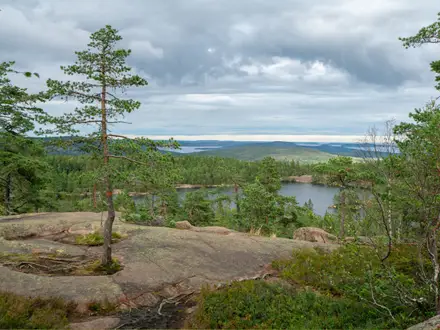
Blekingeleden is a waymarked 270 km point-to-point trail across Blekinge, Sweden, from Sölvesborg to Bröms/Brömsebro. It usually takes about 12–15 days to thru-hike all 15 stages. The walking is easy to moderate: lowland forest, lakes, pasture, gravel roads and Baltic coastal sections rather than mountains. It suits hikers who want a quieter southern Swedish long-distance route with shelters, campsites and frequent section-walking options. For other Swedish long-distance trails, compare the Hallandsleden or Bohusleden.
Route Overview
Blekingeleden runs west to east across Sweden’s smallest and most south-easterly province. The main western trailhead is Sölvesborg, a medieval town; the eastern finish is Bröms/Brömsebro on the county border, where the route continues as the Torsåsleden into Småland/Kalmar county. It is divided into 15 official stages, marked with orange poles and signs. Key waypoints include Grundsjön, Lake Halen, Mörrumsån, Järnavik, Ronneby Brunn, Alljungen, Kristianopel and Bröms. Stage lengths vary, with the longest verified stage being Skärsviken–Alljungen at about 30 km and the shortest sections near the eastern end about 9 km. No verified public-transport details are included here; check access for your chosen stage.
History of the Blekingeleden
Blekingeleden was inaugurated in 1982 to open up Blekinge’s varied lowland landscape — forest, farmland, lakes and Baltic coast — to walkers. It was also designed as part of a wider southern Swedish trail network: at the western end it links with the Skåneleden in neighbouring Skåne, and at Bröms/Brömsebro it continues east as the Torsåsleden. Brömsebro itself is historically important as the old Sweden–Denmark border area and the site associated with the 1645 Treaty of Brömsebro.
Notable highlights
- Sölvesborg medieval town: The western trailhead has a preserved medieval street grid around Stortorget and the 14th-century S:t Nikolai church, dedicated to the patron saint of sailors.
- Ryssberget viewpoint: Early on Stage 1, the trail climbs the Ryssberget ridge at about 150 m, with views over the drained former Lake Vesan and the Listerlandet peninsula.
- Mörrumsån: The route follows the Mörrum River, one of Europe’s best-known salmon and sea-trout rivers, through a mix of arable land and forest.
- Järnavik nature reserve and the Blekinge archipelago: Järnavik combines harbour, cliffs, broadleaf forest and coastal pasture, with boat links to the archipelago island of Tjärö.
- Ronneby Brunnspark: Stage 9 ends at Ronneby Brunn, a historic spa town with a late-19th-century landscaped park.
- Kristianopel and Bröms/Brömsebro: Kristianopel is a fortified coastal village founded by Danish king Christian IV; Brömsebro marks the old border and the eastern end of the trail.
Challenges to expect
The terrain is not steep, but 270 km over 12–15 days is still a commitment. Expect cumulative fatigue, wet forest paths after rain, and some route-finding attention on lowland tracks and woodland paths despite orange waymarks. Resupply, toilets and water vary by stage, so check current stage notes before setting off. The approximate total ascent is spread across rolling terrain, not concentrated mountain climbs. For a more coastal Swedish option, see the Bohus Coast Trail.
HikeList Score
Blekingeleden scored 90/100 on HikeList's trail-quality metrics.
See score breakdownHide breakdown
- Ideal length 88
- Balanced challenge 100
- Scenery & wildness 82
- Varied terrain 87
- Accommodation 92
- Food & support 88
- Path quality 98
- Season flexibility 89
Computed from length, challenge, scenery & wildness, terrain variety, accommodation, food & support, path quality and season flexibility.
 Sweden
Show more data Show less
- Lowland
- Forest
- Pasture
- Lakes
- Coastal
- Dirt
- Gravel
- Shelters
- Campsites
- Hostels
- Hotels
- Wild Camping Spots
- Family Friendly
- Pet Friendly
- Water Sources
- Campsites
- Shelters
- Picnic Areas
Download Our Full Guide to Blekingeleden FREE!
Get our comprehensive guide to this hike for free. Save it for later reading or print out at home.

In these collections
Photos from hikers
Taken on the trail by people who've reviewed Blekingeleden.
Blekingeleden: The Complete Guide
 i
Image by Björn
i
Image by Björn Blekingeleden is a quiet 270 km crossing of Sweden’s south-eastern province of Blekinge, running west to east from Sölvesborg to Bröms/Brömsebro. It suits walkers who want a long, well-waymarked journey through forest, lake country, pasture and Baltic coast rather than a high-mountain trek.
The route starts directly from Sölvesborg’s travel centre, climbs onto the wooded Ryssberget ridge, then settles into a steady rhythm of orange-marked paths, tracks and gravel roads. Early stages pass lakes and forest around Halen and Olofström before reaching the Mörrumsån, one of Europe’s great salmon and sea-trout rivers.
Further east, Blekingeleden threads through Långasjönäs, Järnavik and Ronneby Brunn, mixing broadleaf woodland, nature reserves and coastal sections near the archipelago. The final stages lead through Kristianopel and Högasand to Fredsstenen and the Brömsehus ruins at the old Denmark–Sweden border.
This is not technically hard walking, but it is still a serious long-distance route. Wet, root-laced forest paths, variable water and toilet provision, primitive wind-shelters and one notably long stage from Skärsviken to Alljungen mean each section needs proper planning.
This guide covers stages, days, accommodation, food, transport, terrain and the common mistakes to avoid on Blekingeleden.
Stage-by-Stage Guide
Distances below follow the 15 official Blekingeleden stages and are approximate. The official stage pages publish exact lengths, shelters, water points, toilets and current diversions for each etapp; check these before committing to a daily plan, especially if relying on a specific wind-shelter or bus connection.
Stage 1: Sölvesborg to Grundsjön — approx. 14 km
Blekingeleden begins at Sölvesborg central station/travel centre, making this the simplest stage logistically. The orange waymarks lead out from the medieval town and climb onto Ryssberget, the wooded ridge that forms the high point of the opening stage at about 150 m.
Underfoot, expect a mix of town-edge paths, forest tracks and woodland trail rather than technical mountain walking. After rain, the forest sections can be muddy and rooty, so waterproof footwear is useful even on this relatively short day.
The main highlight is Ryssberget, with views towards the drained former lake Vesan and the Listerlandet peninsula. This is also the first real sense of Blekingeleden’s character: quiet lowland forest, modest gradients and orange-painted posts rather than big upland landmarks.
Sölvesborg is the best place to buy food before starting. Do not assume meaningful resupply at Grundsjön; water, toilets and shelter availability for the stage should be checked before travelling.
Accommodation at or near the end is likely to be trail-camping led rather than town-based. Check the official stage information for nearby wind-shelters, rest places and water before deciding whether to stop at Grundsjön or continue.
Public transport is strongest at the start: Sölvesborg has rail access on the Blekinge Coast Line, served by Öresundståg. Transport from the Grundsjön end is less straightforward and should be checked with Blekingetrafiken before travelling.
Navigation is usually simple if following the orange posts, but the exit from Sölvesborg and the climb into the forest are worth tracking carefully on the official map. This is a good stage to confirm that waymarking style, map app and offline navigation are all working before heading into quieter country.
Stage 2: Grundsjön to Östafors — approx. 18 km
This stage continues the western forest-and-lake character of the trail. It is a moderate day in distance, with rolling lowland terrain rather than steep climbing.
Expect forest paths, tracks and possible wet sections after rain. The trail’s low altitude should not be mistaken for dry walking: shaded woodland and root-laced paths can hold water.
The main value of this stage is continuity through quieter inland Blekinge, linking the Ryssberget approach with the lake country around Olofström. Landmarks are more practical than dramatic, so keep an eye on stage-end logistics rather than expecting regular services en route.
Carry food from Sölvesborg or a previous resupply point. Water and toilet availability should be checked on the official stage listing before travelling, and a filter or treatment method is sensible if planning around natural water.
Accommodation is most likely to mean a wind-shelter, campsite-style stop or responsible wild camping under allemansrätten. Exact shelter locations and condition should be checked before relying on them.
Road access exists at stage ends across much of Blekingeleden, but bus usefulness varies by day and season. Check Blekingetrafiken times for Östafors before building this into a section-walk.
Navigation should be straightforward on the waymarked route, but forest junctions can look similar. Keep the official map to hand and avoid following unmarked forestry tracks away from the orange route.
Stage 3: Östafors to Halens camping (Olofström) — approx. 17 km
This stage carries the route towards Lake Halen and the Olofström area. It remains an inland walking day, with forest, lake edges and tracks typical of western Blekinge.
The walking is moderate rather than difficult. Muddy patches, roots and damp woodland are the main underfoot issues after wet weather.
The major destination is Halen, a long, narrow forest lake within the Halens naturreservat area. Reaching Halens camping gives this stage a clearer accommodation and service focus than many of the more remote stage ends.
Food planning is easier here than on purely rural stages because Olofström is near the stage end. However, opening times and the practical distance from the trail to shops or other services should be checked before travelling.
Halens camping is the obvious overnight base at the end of the stage. Campground availability, booking requirements and current facilities should be confirmed in advance, especially in the main summer season.
Public transport around Olofström is more useful than at smaller rural stage ends, but do not assume late or frequent buses. Check Blekingetrafiken for current services to or from the Halen/Olofström area.
Navigation is uncomplicated in principle, but the approach to a larger lake-and-camping area can involve more paths, access roads and local trails. Follow the orange waymarks rather than the most obvious lakeside path unless they coincide.
Stage 4: Halens camping (Olofström) to Tulseboda Brunnspark — approx. 16 km
This is a manageable stage after the Halen stop, continuing east through rolling inland terrain. The distance is moderate, but it is still a full walking day if carrying camping kit.
Expect forest paths and tracks, with damp or muddy ground possible after rain. The route is not mountainous, but repeated small rises and uneven woodland paths can still slow progress.
The stage links the Olofström/Halen area with Tulseboda Brunnspark. The brunnspark end point gives a named landmark, but services should not be assumed without checking current local provision.
Stock up before leaving the Olofström area if possible. Food and water access beyond Halen may be limited, so carry enough for the day and check the official stage page for water and toilets.
Overnight options at or near Tulseboda Brunnspark should be planned in advance. If using wind-shelters or wild camping, check the official map for suitable stopping places and observe allemansrätten carefully.
Regional buses may be useful for section-walkers, but service frequency can be limited outside main towns. Check Blekingetrafiken for the exact Tulseboda-area connection before relying on it.
Navigation remains based on orange-painted posts and signs. In mixed woodland and track country, take care at junctions where forestry roads may continue more prominently than the marked walking route.
Stage 5: Tulseboda Brunnspark to Mörrumsån — approx. 18 km
This is one of the more distinctive inland stages because it reaches the Mörrumsån, one of Europe’s best-known salmon and sea-trout rivers. The route follows the river through the deep, beech-clad Käringahejan nature-reserve ravine.
The terrain is still lowland, but the river-ravine setting makes the stage feel more enclosed and varied. Paths can be slippery after rain, particularly where roots, leaves and damp woodland ground combine.
The main highlight is the Mörrumsån corridor itself. Take time through the beech forest and ravine sections, as this is a clear change from the broader forest-and-lake walking of the previous stages.
Carry food from the previous resupply point. Water and toilet availability should be checked on the official stage information; river water should not be treated as automatically drinkable without proper filtration or treatment.
Accommodation at the Mörrumsån end needs advance planning. Check for official wind-shelters, rest places and any nearby services before choosing this as an overnight stop.
Road and bus access may be possible around the river corridor, but connections should be checked with Blekingetrafiken before travelling. This is especially important if using the stage as a day walk with a public-transport return.
Navigation along a river valley can feel intuitive, but the marked trail may leave the obvious waterside line at times. Stay with the orange posts and use the official map at path junctions and access points.
Stage 6: Mörrumsån to Långasjönäs — approx. 18 km
This stage moves on from the Mörrumsån area towards Långasjönäs, keeping to Blekingeleden’s typical mix of forest, lake country and tracks. It is a steady mid-length walking day.
Underfoot, expect woodland paths, gravel roads and forest tracks. Wet, rooty sections are possible after rain, and pace can be slower than the distance suggests if conditions are damp.
The stage is less about a single headline landmark and more about the gradual transition through inland Blekinge. Långasjönäs provides a natural end point in lake-and-forest surroundings.
Carry enough food for the full stage. Water and toilets are not guaranteed at convenient intervals, so check the official stage page before travelling and plan treatment if using natural sources.
Accommodation near Långasjönäs should be checked in advance. Across the route, Blekingeleden is built around primitive wind-shelters and camping-style stops, but exact provision varies by stage.
Public transport options should be checked with Blekingetrafiken. As with much of the interior, a road may be near the stage end without providing a convenient same-day bus for walkers.
Navigation should be manageable with the orange waymarks, but keep the map visible through forest-road sections. Long straight tracks can make it easy to miss a marked turn.
Stage 7: Långasjönäs to Persgärde — approx. 18 km
This is another moderate inland stage through lowland forest and lake country. It suits a standard one-stage-per-day itinerary, though there may be limited services between the endpoints.
The walking is generally on forest paths, tracks and gravel roads. Expect soft or muddy ground after rain, particularly in shaded woodland and lower-lying sections.
The stage continues the quieter central part of Blekingeleden. Persgärde is primarily a practical stage end rather than a major town, so treat this as a self-sufficient day.
Food should be carried from the previous reliable resupply point. Check the official stage information for water, toilets and rest places, and do not plan on shops or cafés unless current local information confirms them.
Accommodation needs checking before arrival. Wind-shelters and responsible wild camping are part of the trail culture, but the exact stopping options around Persgärde should be planned using the official map.
Transport access for section-walkers may require a bus connection or pre-arranged lift. Check Blekingetrafiken before travelling, as rural services may be infrequent.
Navigation is mostly about discipline at junctions. Follow the orange markers and avoid drifting onto forestry roads that appear to head in the right general direction.
Stage 8: Persgärde to Järnavik — approx. 18 km
This stage brings a clear change in feel as Blekingeleden approaches Järnavik and the edge of the Blekinge archipelago. After several inland days, the coast becomes a more prominent part of the route experience.
Expect mixed terrain: forest paths and tracks, with broader coastal influence near Järnavik. The Järnavik area includes broadleaf forest, cliffs and coastal pasture, so surfaces and gradients can feel more varied than on some inland stages.
Järnavik nature reserve and harbour are the key highlights. In summer, a ferry runs from Järnavik harbour to Tjärö island nature reserve, but Tjärö is off-route and should be treated as an optional side trip, not part of Blekingeleden.
Carry food unless current opening times at Järnavik suit the itinerary. Water and toilets should be checked on the official stage information and through local visitor information if planning to stay near the harbour.
Accommodation around Järnavik should be booked or checked in advance during the summer season. If camping, use official information to locate suitable sites or wind-shelters and follow local rules in nature-reserve areas.
Järnavik has road access and may be useful for section-walkers, but bus and boat times are seasonal and variable. Check Blekingetrafiken and current local boat information before planning a connection or side trip.
Navigation near the coast can involve more local paths, harbour access routes and nature-reserve tracks. Follow the orange waymarks and do not assume every attractive coastal path is the through-route.
Stage 9: Järnavik to Ronneby Brunn — approx. 20 km
This is a slightly longer stage that links the coastal setting around Järnavik with Ronneby Brunn. It is a useful logistical stage because Ronneby has more accommodation and services than many rural endpoints.
The route returns through varied lowland terrain: forest, tracks, open ground and approaches to the Ronneby area. Conditions remain straightforward in dry weather, but wet woodland sections can be slippery and slow.
The major destination is Ronneby Brunnspark, the large late-19th-century landscaped spa park at Ronneby Brunn. This is one of the more distinctive built-landscape landmarks on Blekingeleden.
Food and resupply are most practical around Ronneby, though exact services and opening times should be checked before travelling. Carry enough food from Järnavik for the walk itself rather than relying on options before the stage end.
Ronneby Brunn and Ronneby offer better accommodation prospects than remote stages, including town-based options. Booking ahead is sensible in busy periods, and camping or shelter alternatives should still be checked if trying to keep costs down.
Public transport is generally more useful around Ronneby than at small rural stage ends. Check Blekingetrafiken for current bus and rail connections that fit the walking day.
Navigation into a town-edge area requires more attention than forest walking. Waymarks may share space with park paths, roads and local trails, so use the official map to stay on the correct line into Ronneby Brunn.
Stage 10: Ronneby Brunn to Skärsviken — approx. 18 km
This stage leaves the Ronneby Brunn area and continues eastwards towards Skärsviken. It is a standard-length Blekingeleden day, but it also sets up the much longer stage that follows.
Expect the usual mix of lowland paths, forest tracks and gravel roads. After rain, woodland sections may be muddy or waterlogged, so do not judge the day by distance alone.
The practical role of the stage is important: Skärsviken is the start of the longest official stage on the trail. Anyone planning a through-walk should use Ronneby to resupply and check overnight arrangements before continuing.
Food should be bought in Ronneby if needed. Water and toilets for the stage and the Skärsviken end point should be checked on the official stage page before travelling.
Accommodation at or near Skärsviken should be planned carefully. If the intended stop is a wind-shelter or camping place, check its location, water access and any current maintenance notes in advance.
Transport from Skärsviken may be less convenient than from Ronneby. Section-walkers should check Blekingetrafiken before relying on public transport at the stage end.
Navigation is generally by orange waymarks, but pay close attention when leaving Ronneby Brunn and when approaching the Skärsviken stopping area. A missed turn here can complicate the next day’s already long schedule.
Stage 11: Skärsviken to Alljungen — approx. 34 km
This is the longest official stage on Blekingeleden and the main endurance test of the route. At around 34 km, it is a very long lowland walking day, especially with a full pack or in wet conditions.
The terrain is not mountainous, but distance, repeated small undulations and forest-path conditions make this stage demanding. Mud, wet roots and soft tracks after rain can push the day well beyond a normal walking schedule.
There is no single supplied landmark that defines the stage, so treat it as a committing traverse between stage ends. Start early, carry a headtorch outside midsummer, and avoid underestimating the cumulative fatigue of several previous stages.
Food should be carried for a long day, with extra snacks in case progress is slow. Water planning is critical: check the official stage information for reliable water and toilet points before travelling, and carry enough capacity for the conditions.
Accommodation at Alljungen should be secured or clearly identified before starting. Arriving late after 34 km is not the time to discover that the planned shelter, campsite or water point is unsuitable.
Public transport and road bailout options should be checked in advance with Blekingetrafiken and the official map. This is the stage where a backup plan matters most, particularly in poor weather or with an injury.
Navigation fatigue is a real issue on a long forest stage. Keep checking the orange waymarks, confirm major junctions on the official map and avoid pressing on down unmarked tracks simply because they look direct.
Stage 12: Alljungen to Mörtsjöåsen — approx. 15 km
After the long Skärsviken–Alljungen stage, this is a shorter and more forgiving day. It can work well as a recovery stage if accommodation and food logistics line up.
The walking remains typical Blekingeleden: rolling lowland, forest paths, tracks and possible wet sections. The shorter distance does not remove the need for care on roots and muddy ground after rain.
The stage continues through quieter eastern inland Blekinge towards Mörtsjöåsen. It is more of a practical link stage than a major resupply or sightseeing day.
Carry food from the previous reliable source. Water, toilets and rest places should be checked on the official stage page, especially if using this stage to recover after the 34 km day.
Accommodation around Mörtsjöåsen should be planned before arrival. Check wind-shelter and camping options on the official map and do not assume town-style services at the stage end.
Public transport may be limited, so section-walkers should confirm connections with Blekingetrafiken before travelling. A shorter walking stage does not automatically mean an easier transport day.
Navigation should be straightforward with the orange markers, but fatigue from the previous stage can lead to mistakes. Keep the map accessible and check junctions rather than walking on autopilot.
Stage 13: Mörtsjöåsen to Älmtasjön — approx. 15 km
This is another shorter stage by Blekingeleden standards, continuing through eastern lowland country towards Älmtasjön. It is a manageable day for most fit walkers, provided overnight logistics are clear.
Expect forest paths, tracks and gravel roads, with the usual potential for mud or waterlogged ground after rain. The terrain remains rolling rather than steep.
Älmtasjön gives the stage a lake-country finish. The quieter nature of this part of the trail means self-sufficiency remains important despite the modest distance.
Carry the day’s food and check water points before setting out. Toilets and rest-place availability vary by stage and should be checked on the official information before travelling.
Accommodation at or near Älmtasjön should be identified in advance. If planning to camp, use official trail information and follow allemansrätten responsibly, avoiding disturbance and leaving no trace.
Transport options should be checked with Blekingetrafiken. Rural stage ends can be awkward for public transport even where there is road access nearby.
Navigation is normally uncomplicated but still needs attention in forest and lake-edge terrain. Follow the orange waymarks and verify any unsigned junctions against the official map.
Stage 14: Älmtasjön to Kristianopel — approx. 17 km
This stage moves towards the Baltic coast and the historic village of Kristianopel. It is one of the more rewarding eastern stages because the endpoint is a distinctive place rather than simply a trail junction or rural stop.
Terrain remains lowland, with forest, tracks and more open coastal influence as the route approaches Kristianopel. Conditions can still be muddy after rain, so do not expect a dry coastal finish by default.
Kristianopel is the highlight: a fortified coastal village inside a preserved ring-wall, founded by the Danish king Christian IV when Blekinge was Danish. It is a good place to slow down if the itinerary allows.
Food and services may be more realistic in or near Kristianopel than at the preceding rural stage ends, but current opening times should be checked before travelling. Carry enough food to reach the village without relying on anything en route.
Accommodation in Kristianopel or nearby should be booked or confirmed, particularly in summer. If camping instead, check local options and any restrictions linked to coastal or village settings.
Public transport from Kristianopel may be useful for section-walkers, but times should be checked with Blekingetrafiken before relying on it. Do not assume frequent evening services.
Navigation into a village setting requires care around roads, local paths and historical areas. Stay with the orange waymarks until the stage endpoint rather than improvising through the village.
Stage 15: Kristianopel to Bröms / Brömsebro — approx. 10 km
The final stage is the shortest official stage and makes a relatively gentle finish to the trail. It links Kristianopel with Bröms/Brömsebro on the Blekinge–Småland county border.
The route includes coastal pine forest and sand-dune terrain through Högasand nature reserve, known for old pines of around 300 years. Paths here are still lowland walking, but sandy sections and forest roots can affect pace.
The finish is at the Brömsebro peace stone, Fredsstenen, beside the Brömsebäck stream and the ruins of Brömsehus, the former Danish border castle. This is also where Blekingeleden continues east into Småland/Kalmar county as the Torsåsleden.
Kristianopel is the sensible place to sort food before setting out. The stage is short, but carry water and check toilet availability before leaving, as services at the final terminus should not be assumed.
Accommodation after finishing depends on whether staying near Kristianopel, arranging transport from Bröms/Brömsebro, or continuing on the Torsåsleden. Check options before travelling, particularly outside the main season.
The finish at Bröms is reached by Blekingetrafiken bus from Karlskrona, but current times and stop locations should be checked before travelling. This is especially important at the end of a point-to-point hike, where a missed connection can be awkward.
Navigation is usually simple on the final orange-marked section, but take care not to drift onto onward paths before reaching Fredsstenen and Brömsehus. If continuing east, note the change from Blekingeleden to Torsåsleden wayfinding and make sure the next route is planned separately.
Recommended Itinerary
The most straightforward Blekingeleden itinerary is to walk the 15 official stages west to east, starting at Sölvesborg station/travel centre and finishing at Bröms/Brömsebro. This keeps navigation simple, matches the way the trail is organised, and gives a manageable daily rhythm apart from the long Skärsviken–Alljungen stage.
Distances below are rounded planning figures. Check the current official stage mapping before booking accommodation or fixing transport, especially where a stage end relies on a shelter, campsite or bus connection.
Standard itinerary: 15 days
| Day | From | To | Approx. distance | Why this stage makes sense | Services/accommodation notes |
|---|---|---|---|---|---|
| 1 | Sölvesborg | Grundsjön | 14 km | A short opening day from the central station/travel centre, allowing time to leave town, follow the orange waymarks onto Ryssberget and settle into the forest terrain. | Sölvesborg has the best start-line services and rail access. Grundsjön is a stage end; check shelter, water and toilet details before relying on it overnight. |
| 2 | Grundsjön | Östafors | 18 km | A normal full day through the western forest section, long enough to make progress without forcing an early big mileage day. | Primitive trail accommodation and water points vary by stage. Check the official map for the exact overnight option at or near Östafors. |
| 3 | Östafors | Halens camping (Olofström) | 17 km | A useful stage into the Lake Halen area, with a clear accommodation target near Olofström rather than a purely wild overnight. | Halens camping gives one of the more obvious serviced stops on the early trail. Olofström is nearby for town facilities, but exact access and opening periods should be checked before travelling. |
| 4 | Halens camping (Olofström) | Tulseboda Brunnspark | 16 km | A moderate day after the Halen stop, keeping the first third of the route in steady 16–18 km stages. | Tulseboda Brunnspark is an official stage end. Check the current shelter, water and toilet information for this stage. |
| 5 | Tulseboda Brunnspark | Mörrumsån | 18 km | A strong scenic day leading into the Mörrumsån section, where the trail reaches the well-known salmon and sea-trout river and its beech-clad ravine landscape. | Do not assume shops or indoor accommodation at the stage end. Plan food and water from the previous reliable service point and check the official stage details. |
| 6 | Mörrumsån | Långasjönäs | 18 km | Another regular-length stage, continuing the central Blekinge section without a mileage spike. | Långasjönäs is a named stage end and a sensible planning anchor. Confirm the available overnight facilities, water and toilet status before booking or setting out. |
| 7 | Långasjönäs | Persgärde | 18 km | Keeps the itinerary balanced through the middle of the trail, with no need to combine stages. | Persgärde should be treated as a trail stage end rather than a guaranteed service village. Check current facilities and carry food accordingly. |
| 8 | Persgärde | Järnavik | 18 km | A good transition day towards the coastal and archipelago-influenced landscape around Järnavik. | Järnavik has harbour/coastal access and is a useful stage stop. A summer ferry runs from Järnavik harbour to Tjärö, but Tjärö is off-route and should not be built into the walking schedule unless deliberately adding time. |
| 9 | Järnavik | Ronneby Brunn | 20 km | A slightly longer but logical day from the coast into Ronneby Brunn, finishing at one of the route’s most convenient town-adjacent stops. | Ronneby Brunn/Ronneby offers better access to indoor accommodation and town services than many forest stage ends. Booking ahead is sensible in the main season. |
| 10 | Ronneby Brunn | Skärsviken | 18 km | A manageable day after the Ronneby stop, positioning the walk for the longest stage of the trail. | Skärsviken is the key place to prepare for the next day’s 34 km. Check water, overnight facilities and onward weather before committing to the long section. |
| 11 | Skärsviken | Alljungen | 34 km | The crux day of the standard itinerary: the longest official stage and the only day that is a major mileage jump. Start early, keep packs efficient and avoid underestimating slow forest going after rain. | This stage needs the most careful food and water planning. If 34 km is too much, use the slower variant rather than hoping to improvise. Any intermediate shelter or exit options should be checked on the official map before travelling. |
| 12 | Alljungen | Mörtsjöåsen | 15 km | A deliberately shorter recovery day after the long Skärsviken–Alljungen stage. | Check current facilities at Alljungen and Mörtsjöåsen. This is a good point to build in flexibility if weather or fatigue has slowed progress. |
| 13 | Mörtsjöåsen | Älmtasjön | 15 km | Another moderate eastern-stage day, keeping the final approach controlled rather than rushing towards the coast. | Älmtasjön is a stage end, but service levels should be checked before relying on water, toilets or shelter. |
| 14 | Älmtasjön | Kristianopel | 17 km | A satisfying penultimate day into Kristianopel, the fortified coastal village and the last major named settlement before the finish. | Kristianopel is one of the better final-stage accommodation and resupply anchors, but seasonal opening times should be checked before travelling. |
| 15 | Kristianopel | Bröms / Brömsebro | 10 km | A short finishing day through the final coastal section, including Högasand nature reserve before the terminus at Fredsstenen and Brömsehus by the Brömsebäck stream. | The finish at Bröms/Brömsebro relies on onward regional transport rather than a major trail town. Check Blekingetrafiken times for the return from Bröms before setting out from Kristianopel. |
Slower variant: 16–18 days
A slower schedule suits walkers carrying camping gear, anyone using the wind-shelter network, and hikers who want more time around Lake Halen, Järnavik, Ronneby Brunn or Kristianopel. It also makes the route more resilient in wet weather, when rooty forest paths and muddy sections can reduce pace.
The main adjustment is to avoid treating the 34 km Skärsviken–Alljungen stage as a normal day. Split it only where the official map shows a suitable shelter, campsite, water source or transport exit; do not assume an informal midpoint will be practical. This should be checked before travelling.
A simple slower approach is:
| Itinerary style | How to adapt it | Who it suits |
|---|---|---|
| 16 days | Add one extra day around the Skärsviken–Alljungen section, using a verified intermediate overnight or transport break. | Walkers comfortable with 15–20 km days but not with a 34 km forest stage. |
| 17 days | Add one break or short day around Ronneby Brunn, Järnavik or Kristianopel as well as easing the longest stage. | Hikers mixing indoor accommodation with camping, or wanting time for the coastal sections. |
| 18 days | Keep most walking days conservative and use extra time to absorb weather, transport gaps or seasonal service limits. | First-time long-distance walkers, heavily loaded campers and section-walkers linking public transport. |
Faster variant: 12–14 days
A faster itinerary is realistic only for fit walkers happy with repeated long days on forest paths, tracks and gravel roads. The terrain is not mountainous, but the full 270 km remains an endurance walk, and wet ground can make progress slower than the profile suggests.
The easiest stages to combine on paper are the shorter eastern stages, such as Alljungen–Mörtsjöåsen, Mörtsjöåsen–Älmtasjön and Kristianopel–Bröms/Brömsebro. Combining stages earlier in the walk is also possible for strong hikers, but it must be planned around real overnight points, food supply and public transport access rather than distance alone.
| Itinerary style | How to adapt it | Who it suits |
|---|---|---|
| 14 days | Combine one short eastern stage, most likely near the final third of the route. | Fit walkers who want to keep a near-standard rhythm but save a day. |
| 13 days | Combine two shorter stages or make one longer push where accommodation and water make sense. | Experienced long-distance walkers with light packs and flexible overnight plans. |
| 12 days | Requires several long days and careful handling of the 34 km Skärsviken–Alljungen stage. | Strong, efficient hikers who are comfortable with back-to-back high-mileage days and have checked all logistics in advance. |
For most walkers, the 15-day plan is the safest default: it follows the trail’s own structure, gives regular access to named stage ends, and leaves only one genuinely long day to manage.
Planning the Route
Blekingeleden is easiest to plan around its 15 official stages, but those stages should not be treated as compulsory hiking days. They are useful planning units because the trail’s shelters, rest places, road access and public-transport options are organised around them, but many walkers will combine shorter stages, split awkward ones, or walk selected sections only.
A full traverse normally needs 12–15 walking days. Fifteen days gives the simplest plan: one official stage per day, with enough margin for the longer forest and coast sections. A faster 12–13 day schedule is realistic for fit walkers carrying a light pack, but it requires combining some of the shorter eastern stages and being comfortable with longer days between services.
Choosing a pace
Most of the route is lowland walking, so the main challenge is not altitude but repeated days on forest paths, gravel tracks, wet ground and rooty sections after rain. A relaxed schedule is usually more enjoyable than trying to turn the trail into a fast point-to-point march, especially if using shelters and carrying camping kit.
The key pacing issue is Stage 11, Skärsviken–Alljungen, at about 34 km. This is the longest official stage and should be planned deliberately rather than allowed to fall as an ordinary day late in the walk. Options are to start early, carry enough food and water for a long day, or adjust the itinerary around nearby access points and accommodation. This should be checked before travelling.
The final eastern stages are shorter, with Stage 15 from Kristianopel to Bröms/Brömsebro about 10 km. These stages can be useful for recovering time, shortening the final day for onward transport, or linking the finish at Fredsstenen and Brömsehus with travel from the Bröms area.
| Planning style | Typical use | Practical notes |
|---|---|---|
| One official stage per day | 15 days | Simplest structure; works well with the trail’s own etapper and shelter/rest-place pattern. |
| Faster thru-hike | 12–14 days | Best for fit walkers; requires combining shorter stages and accepting at least one very long day unless the Skärsviken–Alljungen section is split. |
| Slow or comfort-based walk | 15+ days | Allows time in places such as Sölvesborg, Olofström, Ronneby Brunn and Kristianopel, and gives more flexibility around weather. |
| Section hike | Any length | Very practical because the route repeatedly meets roads, settlements and public transport. |
Accommodation-led planning
Blekingeleden is fundamentally a shelter-and-camping trail, not a route where every day naturally ends in a town. Free primitive wind-shelters, fire/rest places and campsites form the backbone of the route, with hostels, guesthouses and hotels available in or near larger places such as Sölvesborg, Olofström, Ronneby and Kristianopel.
This means accommodation should be planned stage by stage. Do not assume that every official stage end has indoor accommodation, a shop, a tap or a toilet. The official trail site lists stage facilities, and shelter, water and toilet availability should be checked before travelling.
Sweden’s allemansrätten allows responsible wild camping, which gives useful flexibility if a shelter is full or a day needs shortening. It does not remove the need to plan carefully: camp discreetly, avoid damaging ground or crops, respect private homes and local restrictions, and carry out rubbish.
Food and water planning
Food resupply is uneven. The route starts at Sölvesborg and passes through or near settlements including Olofström, Ronneby and Kristianopel, but long stretches run through forest, lake country, pasture and small rural places where services cannot be assumed.
For a continuous walk, carry enough food to cover each remote block rather than relying on buying supplies at every stage end. This is especially important through the interior forest stages and before the longer Skärsviken–Alljungen day.
Water and toilets are available on most stages, but not in a way that removes the need for checking. Treat each day separately: identify the reliable water points, decide how much to carry, and have a plan if a listed source is unavailable or unsuitable. This should be checked before travelling.
Transport and section hiking
The start is straightforward: the western trailhead is at Sölvesborg central station/travel centre, with the orange waymarks leading out towards Ryssberget. This makes starting the full route, or walking only the first stages, unusually convenient for a long-distance trail.
The finish at Bröms/Brömsebro is more rural. Onward travel relies on Blekingetrafiken bus connections from the Bröms area, including links towards Karlskrona. Current times should be checked with Blekingetrafiken before fixing the final day, especially if finishing late or outside the main summer period.
Section hiking is one of Blekingeleden’s strengths. The trail crosses or approaches several useful access points, and the broader Blekinge public-transport network includes trains, regional buses and, on the coast, summer boats. Järnavik also has a summer ferry to Tjärö, but Tjärö is off-route and should be treated as an optional side trip rather than part of Blekingeleden.
Navigation and route information
Navigation is generally straightforward because Blekingeleden is waymarked with orange-painted posts and signs. Even so, a map or offline digital mapping is sensible, particularly in forest where paths, tracks and forestry roads can look similar.
The official trail website publishes the 15 etapper, exact stage information, an interactive map, a map library, FAQs and current maintenance or diversion notices. Naturkartan is also useful for interactive mapping. Printed stage maps are sold at Blekinge tourist offices.
The headline trail length is normally given as 270 km, while one municipal figure gives 255 km. For practical planning, use the exact stage information for the current official etapper rather than relying on a single total distance figure.
Weather, season and ground conditions
The most straightforward walking season is roughly May to September, with long daylight around midsummer and generally the widest range of services. April, October and mild shoulder-season periods can also work, but daylight, transport frequency and accommodation availability need more care.
Wet weather matters more than cold or altitude on this route. Forest paths can become muddy, root-laced and waterlogged after rain, and this can slow the pace more than the map profile suggests. Waterproof footwear, reliable rain gear and dry storage for sleeping kit are more important than mountain equipment.
Winter walking is possible, but it changes the character of the route: short days, cold conditions and limited services make it a much more self-sufficient undertaking. Anyone planning winter sections should check transport, accommodation and trail conditions before travelling.
Permits and permissions
There is no special long-distance hiking permit to plan around for Blekingeleden in the information normally used by walkers. The practical permissions issue is camping responsibly under allemansrätten and respecting any local restrictions at shelters, campsites, nature reserves and fire places.
Fire use should be treated cautiously. Use established fire places where provided, follow local rules, and check for seasonal fire bans before relying on cooking over an open fire.
Towns, Villages and Overnight Stops
Blekingeleden is best planned as a mixed accommodation trail rather than a classic inn-to-inn walk. The most useful paid-service stops are Sölvesborg, Olofström, Ronneby and Kristianopel, while many official stage ends are rural places where a wind-shelter, campsite or responsible wild camp is the realistic overnight plan.
Do not assume that every stage end has food, a shop, a toilet or drinking water. The official trail site should be checked stage by stage for current shelter, water and toilet information, and Blekingetrafiken should be checked for buses, trains and boats before building a section-walking itinerary.
Sölvesborg
Sölvesborg is the western trailhead and the most straightforward place to start the walk. Stage 1 begins at the central station/travel centre, so it works well for arriving by train and walking straight onto the orange-marked route towards Ryssberget and Grundsjön.
This is one of the best places on the route for a paid overnight before starting, with town accommodation such as hostels, guesthouses and hotels. It is also the logical place for first food shopping and fuel or stove checks before entering the quieter forest stages.
Transport is a major advantage here: Sölvesborg is on the Blekinge kustbana, served by Öresundståg between the Kristianstad/Malmö direction and Karlskrona. If starting late in the day, staying in Sölvesborg and beginning Stage 1 early is usually more practical than trying to reach Grundsjön in the evening.
Grundsjön
Grundsjön is the end of Stage 1 from Sölvesborg, after the route has climbed onto and crossed the Ryssberget ridge. It is a useful first-night stop for walkers following the official stage pattern.
Treat Grundsjön as a rural trail overnight rather than a service village. Accommodation planning should be based around the trail’s primitive shelter/camping network or responsible wild camping, with exact shelter, water and toilet availability checked before travelling.
Food should be carried from Sölvesborg unless current local services have been checked. For section-walkers, any public transport or pickup plan for Grundsjön should be confirmed with Blekingetrafiken or local transport information in advance.
Östafors
Östafors is the end of Stage 2 and the start of Stage 3 towards Halen and Olofström. It sits in the quieter western interior of the trail and is mainly useful as a stage break rather than as a resupply point.
Plan Östafors as a low-service overnight. It may suit walkers using the official stage rhythm, but food, drinking water and toilet arrangements should be checked on the current stage information before relying on the stop.
Anyone section-walking into or out of Östafors should check regional bus options in advance. Do not leave the transport plan until arrival, as the interior stages are not as simple as the rail-served start in Sölvesborg.
Näsum
Näsum is one of the near-route service places named for the western part of Blekingeleden, although it is not one of the official stage-end names in the 15-stage itinerary. It can be relevant for walkers wanting a paid bed or a more serviced break between the Sölvesborg and Olofström parts of the trail.
Accommodation in and near the route’s towns may include hostels, guesthouses and hotels, but availability should be checked before building an itinerary around Näsum. The same applies to food shops, cafés and onward buses.
Halens camping, Halen and Olofström
Halens camping is the end of Stage 3 and one of the clearest planned overnight points on the early trail. It sits by Halen, near Olofström, and is a practical alternative to a primitive wind-shelter night if the campsite is open and has suitable pitches or accommodation.
Opening dates, booking requirements, facilities and prices should be checked before travelling. As a named campsite, it is a stronger logistics stop than many of the forest stage ends, but it should still not be treated as guaranteed without current information.
Olofström lies near the Stage 3/4 transition and is one of the more useful towns for paid accommodation and resupply on the western half of the route. It is also a sensible place to adjust plans if weather, wet paths or fatigue make the first few stages slower than expected.
Regional buses are the main public transport option around Olofström and the interior stages. Check Blekingetrafiken timetables carefully if using Olofström as a start, finish or rest point.
Tulseboda Brunnspark
Tulseboda Brunnspark is the end of Stage 4 from Halens camping and the start of Stage 5 towards Mörrumsån. It is best understood as a stage stop rather than a guaranteed service centre.
Use it for a quiet overnight only if the shelter, water and toilet situation suits the chosen kit and walking style. Carry food from Olofström/Halen unless current services have been checked.
This is also a point where itinerary discipline matters: the following stage leads towards the Mörrumsån area, so avoid arriving short of food or with an untested water plan.
Mörrumsån
Mörrumsån is the Stage 5 endpoint and one of the most distinctive natural sections of Blekingeleden. The trail follows the Mörrum river through the beech-clad Käringahejan ravine, an area known for the wild salmon and sea-trout river environment.
For overnight planning, treat Mörrumsån as a scenic rural stop, not a town. A shelter or camp-based plan is appropriate, with potable water and toilet availability checked on the current stage details.
River water should not automatically be treated as drinking water. Carry enough from the previous reliable source or be prepared to filter or treat water where responsible and permitted.
Långasjönäs
Långasjönäs is the end of Stage 6 and the start of Stage 7 towards Persgärde. It is a useful mid-route staging point for keeping the official west-to-east rhythm.
Do not assume town-level services here. Accommodation planning should be based on the trail’s shelter/camping infrastructure unless current paid accommodation or campsite options have been checked.
Food should be carried in from the previous reliable resupply point. Section-walkers should check bus access in advance rather than assuming frequent services at the stage end.
Persgärde
Persgärde is the end of Stage 7 and the start of Stage 8 towards Järnavik. It is another rural stage stop where the practical question is whether the shelter, water and toilet arrangements fit the plan.
Most walkers should carry food through Persgärde rather than relying on local resupply. This is a sensible place to be conservative with supplies, because the next stage leads towards the coast at Järnavik rather than a major town.
Transport may be possible for section-walkers, but timings and pickup points should be checked before travelling. Rural stage ends on Blekingeleden are much easier to use when the bus plan has been fixed in advance.
Järnavik
Järnavik is the end of Stage 8 and the start of Stage 9 to Ronneby Brunn. It is an important coastal stop, with a nature reserve and harbour at the edge of the Blekinge archipelago.
It is a good place to pause if the itinerary allows, especially before continuing towards Ronneby. However, accommodation, food and other services should be checked rather than assumed, particularly outside the main visitor season.
A summer ferry runs from Järnavik harbour to Tjärö, an island nature reserve. Tjärö is off the Blekingeleden itself, so any visit adds time and should be planned separately from the walking stage.
Ronneby Brunn and Ronneby
Ronneby Brunn is reached at the end of Stage 9, with the route passing the large landscaped spa park at Ronneby Brunn. For hikers, the main value is practical: Ronneby is one of the best places on the route for a paid bed, food resupply and a reset before the quieter eastern stages.
Accommodation in and around Ronneby includes town options such as hostels, guesthouses and hotels. This is a strong candidate for a rest night, laundry stop or itinerary break if walking the full trail.
From Ronneby Brunn, Stage 10 continues to Skärsviken, and the following Stage 11 from Skärsviken to Alljungen is the longest official stage at about 34 km. Use Ronneby to sort food, weather planning and any transport changes before committing to that section.
Regional public transport should be checked through Blekingetrafiken. Ronneby is also a useful entry or exit point for section-walkers who do not want to walk the full 270 km in one journey.
Skärsviken
Skärsviken is the end of Stage 10 and the start of the longest stage on Blekingeleden: Skärsviken to Alljungen, about 34 km. This makes it one of the most important logistics points on the whole trail.
Overnighting at or near Skärsviken can make sense if it allows an early start for Stage 11. Check the current shelter, water and toilet details carefully, because a poor night here can make the long next day harder.
Carry enough food and water capacity for a full walking day to Alljungen. This is not a place to rely on finding last-minute resupply unless current local services have been checked.
Alljungen
Alljungen is the end of the long Stage 11 from Skärsviken and the start of Stage 12 to Mörtsjöåsen. It is primarily a recovery and overnight point after the trail’s biggest single-stage distance.
Plan this stop carefully. Arriving tired after 34 km with no clear shelter or water plan is avoidable: check the current stage information before setting off from Skärsviken.
There is no reason to assume town services at Alljungen. Food should be carried through, and any transport escape plan should be arranged in advance.
Mörtsjöåsen
Mörtsjöåsen is the end of Stage 12 and the start of Stage 13 to Älmtasjön. The official distances shorten after the Skärsviken–Alljungen stage, but the stops remain rural and should be planned as such.
This is suitable as a shelter or camping-based overnight if the current facilities match the itinerary. Check water and toilet availability before relying on it.
For food, continue to think in multi-stage blocks rather than expecting resupply at every endpoint. The next substantial settlement stop is Kristianopel, reached after Stage 14.
Älmtasjön
Älmtasjön is the end of Stage 13 and the final rural overnight before the route turns towards Kristianopel. It is a useful staging point for walkers keeping the official 15-stage structure.
Plan for a simple camp or wind-shelter night, subject to current shelter, water and toilet information. This is not a stop where food or paid accommodation should be assumed.
Because Stage 14 leads to Kristianopel, Älmtasjön can also be used to control the final approach: start with enough food for the day, but avoid overcomplicating the resupply plan if staying in Kristianopel afterwards.
Kristianopel
Kristianopel is the end of Stage 14 and the start of the final stage to Bröms/Brömsebro. It is one of the most attractive and practical overnight stops on the eastern end of the trail, set inside a preserved ring-wall on the Baltic coast.
For hikers, Kristianopel is the obvious place to sleep before the final 10 km stage. Paid accommodation may include hostels, guesthouses and hotels, but booking and seasonal availability should be checked in advance.
Food and café options should also be checked before relying on them, especially outside the main season. Kristianopel is a good place to slow down, dry kit and make sure the onward transport plan from the finish is workable.
Bröms / Brömsebro
Bröms/Brömsebro is the eastern finish of Blekingeleden, on the Blekinge–Småland county border. The route ends at Fredsstenen beside the Brömsebäck stream, near the Brömsehus ruins, and continues east as the Torsåsleden.
This is primarily a trail terminus rather than an overnight base. Do not assume food, accommodation or extensive services at the finish unless they have been checked before travelling.
The finish can be reached by Blekingetrafiken bus from Karlskrona, and return or onward transport should be planned before setting out on the final stage from Kristianopel. If continuing onto the Torsåsleden, treat Brömsebro as a border handover point and check the next trail’s accommodation and transport details separately.
Getting to the Start
Blekingeleden is unusually straightforward to start because the official western trailhead is at Sölvesborg central station / travel centre. The first orange waymarks leave from the travel centre and lead out of town towards the Ryssberget ridge, so there is no separate trailhead transfer needed if arriving by public transport.
By train
Sölvesborg is on the Blekinge kustbana — the Blekinge Coast Line between Kristianstad/Malmö and Karlskrona, served by Öresundståg. This makes the start accessible by rail from the main south Sweden rail network, with practical approaches from Malmö, Kristianstad and Karlskrona.
For most walkers, the simplest plan is to arrive at Sölvesborg station, buy any last supplies in town, then start Stage 1 directly from the travel centre. Current train times, engineering works and ticket conditions should be checked before travelling.
By bus
Sölvesborg travel centre is also the natural bus hub for local and regional services. Blekingetrafiken runs public transport in Blekinge, including buses used by section-walkers to reach other stage starts and finishes along the route.
For the start itself, the train is usually the cleanest option because the route begins at the station. If using a bus into Sölvesborg, plan the arrival to the travel centre rather than an outlying stop. Current bus times should be checked before travelling.
By car
Driving to Sölvesborg is possible, but the route is a point-to-point trail ending at Bröms/Brömsebro, not a loop. Leaving a car at the western end creates an end-of-walk transport problem unless a return by bus/train or a separate vehicle shuttle has been arranged.
Long-stay parking arrangements in Sölvesborg are not something to assume. If parking for several days or the full trail, check current municipal parking rules or ask your pre-walk accommodation before committing to a plan. This should be checked before travelling.
For section-walks, it is often easier to use public transport to and from individual stage points, then return to Sölvesborg only when needed.
From the nearest airport
No airport transfer is needed once you are on the regional rail network: aim for a rail connection to Sölvesborg on the Blekinge Coast Line. In practice, flying hikers should choose an airport based on onward train connections into southern Sweden rather than proximity alone.
Because airport routes, rail connections and ticketing change, the full airport-to-Sölvesborg journey should be checked before travelling.
Where to stay before starting
Sölvesborg is the best place to stay before Stage 1. It has town services and accommodation options such as hotels, guesthouses and hostels, and staying near the station/travel centre gives the cleanest start the following morning.
Booking ahead is sensible in the main walking season, especially if arriving late or wanting to start early. If beginning with a camping-led itinerary, Sölvesborg is also the logical place to sort food, fuel and any last public-transport questions before leaving the coast and climbing onto Ryssberget.
Getting Home from the Finish
Blekingeleden ends at Bröms/Brömsebro, by Fredsstenen, the Brömsebäck stream and the Brömsehus ruins. This is a rural border finish rather than a major transport hub, so the exit should be planned before setting off on the final stage from Kristianopel.
By train
There is no rail station at the Bröms/Brömsebro finish. The practical rail connection is to get from the finish area by Blekingetrafiken bus towards Karlskrona, then continue by train from Karlskrona.
Karlskrona is on the Blekinge kustbana, with rail services west towards Kristianstad and Malmö, including Öresundståg services. This also makes it possible to return towards Sölvesborg by public transport, although exact connections and changes depend on the timetable.
Train and bus times should be checked before travelling, especially if finishing late in the day or outside the main summer season.
By bus
The finish at Bröms is served by Blekingetrafiken buses from Karlskrona. This is the key public-transport link for leaving the eastern end of the trail.
Do not assume turn-up-and-go frequency at the finish. Treat Bröms/Brömsebro as a limited-service rural stop, check Blekingetrafiken’s current timetable, and know the exact stop location before the final day.
If the last bus has already gone, the sensible options are to pre-book a taxi, arrange a lift, or avoid finishing at Bröms late in the day by staying in Kristianopel before walking the short final stage.
By car/taxi
For a private pick-up, agree a clear meeting point at or near the Brömsebro peace stone / Brömsehus finish area. Mobile reception, road access and parking arrangements should be checked before relying on a same-day collection.
A taxi should be booked in advance rather than expected at the finish. Bröms/Brömsebro is not a town-centre terminus, and a pre-arranged pick-up is the safer plan if connecting to evening trains, onward accommodation or a flight.
For drivers, remember that Blekingeleden is a point-to-point route. Leaving a vehicle at Sölvesborg and finishing at Bröms means arranging a return by public transport, taxi or a two-car shuttle.
From the nearest airport
No airport transfer runs directly from the trail finish. The practical first step is to leave Bröms/Brömsebro by Blekingetrafiken bus towards Karlskrona, then connect onwards through the regional transport network.
Airport routing is timetable-dependent and should be planned separately before travelling, particularly for early departures. Allow a buffer after the final stage; a missed rural bus can easily disrupt an onward flight connection.
Where to stay at the finish
Bröms/Brömsebro is best treated as the trail terminus, not as a full-service overnight base. If accommodation is needed at the end, plan it before walking the final stage.
Kristianopel, the previous stage point, is the most useful named settlement near the finish on the route and has accommodation options in the wider trail planning context. Staying there before the final 10 km stage can make the finish more relaxed and avoids depending on a late-day bus from Bröms.
Another practical option is to continue by bus to Karlskrona and stay there before taking onward trains or buses the next day. Current accommodation availability and transport times should be checked before booking.
Which Direction Should You Walk?
Standard direction: Sölvesborg to Bröms/Brömsebro
The natural direction for Blekingeleden is west to east, from Sölvesborg to Bröms/Brömsebro. This is the official stage order, beginning at Sölvesborg central station/travel centre and finishing at Fredsstenen beside the Brömsebäck stream, where the route continues into Småland/Kalmar county as the Torsåsleden.
This direction is the simplest to plan because the first trail marker is reached directly from a railway station on the Blekinge Coast Line. It also follows the published stage sequence, which makes it easier to match accommodation, shelters, water points and public transport checks to the official stage descriptions.
The walking also builds well. The route starts with the climb onto Ryssberget above Sölvesborg, then moves through forest, lakes and the Mörrumsån valley before reaching the coastal and eastern sections around Järnavik, Ronneby, Kristianopel and Bröms/Brömsebro.
The longest official stage, Skärsviken–Alljungen at about 34 km, comes late in the west–east direction. That is useful for thru-hikers, as most walkers will have several days of trail fitness before taking on the biggest day.
Reverse direction: Bröms/Brömsebro to Sölvesborg
Walking east to west is entirely practical, but it is less convenient as a default plan. The main complication is starting at Bröms/Brömsebro, which relies on Blekingetrafiken bus access from Karlskrona; current times should be checked before travelling.
The advantage of the reverse direction is that the finish is very straightforward: Sölvesborg has a railway station at the trailhead area, so onward travel is easy once the walk is complete. This can suit section-walkers or anyone with a fixed train connection at the end of the trip.
The reverse direction also makes the early days shorter on paper, with Bröms/Brömsebro–Kristianopel and the following eastern stages before the longer inland sections. However, it brings the 34 km Alljungen–Skärsviken day earlier in the walk, before many thru-hikers have settled into the route.
Climbs, weather and waymarking
There is no major climbing advantage either way. Blekingeleden is rolling lowland rather than mountain terrain; the main early height gain west–east is the climb onto Ryssberget from Sölvesborg, while reverse walkers descend this ridge near the end.
No reliable direction choice should be made on wind alone. Much of the trail is in forest, with more open and coastal sections later in the route; check the forecast before each stage rather than assuming one direction will be sheltered.
The orange waymarks are intended to support point-to-point walking, and the trail can be followed in either direction. Even so, using the official west–east stage order reduces small planning frictions, especially when cross-checking stage distances, shelters, water and transport.
Recommendation
Walk Blekingeleden west to east unless there is a specific transport reason to do otherwise. Starting at Sölvesborg is the cleanest logistical option, the stage order is easier to follow, the scenery develops naturally from ridge and forest to river, lakes and coast, and the historic finish at Fredsstenen and Brömsehus gives the route a stronger sense of completion.
Accommodation Along the Route
Blekingeleden is primarily a shelter-and-camping trail, not a classic inn-to-inn route. The 15 official stages are built around free primitive wind-shelters, rest places and fire places, with campsites and town accommodation filling the gaps where the route reaches larger settlements.
Indoor accommodation is most realistic at or near Sölvesborg, Olofström, Ronneby and Kristianopel. Between these places, many stage ends are rural lake, forest or reserve locations where walkers should expect a tent, wind-shelter or campsite-style overnight rather than a guaranteed bed.
Water and toilets are available on many stages, but not uniformly. Check the current stage information on blekingeleden.com before relying on any shelter, toilet or water point for a specific night.
Practical accommodation pattern
For a full thru-hike, the simplest plan is to combine three types of overnight:
- Town beds before, during and after key sections — especially Sölvesborg, Olofström, Ronneby and Kristianopel.
- Campsites where the route passes them — notably Halens camping by Lake Halen near Olofström.
- Primitive wind-shelters or responsible wild camping — the default option for many forest and lake stages.
Sweden’s allemansrätten allows responsible wild camping, which makes Blekingeleden much easier to plan than a bed-only route. A tent or reliable bivvy system gives essential flexibility, particularly around the longer and more remote middle/eastern stages.
Where accommodation is strongest or weakest
| Place | Accommodation level | Best for | Notes |
|---|---|---|---|
| Sölvesborg | Good | First night, late arrival, start logistics | The official western trailhead starts at the central station/travel centre, making this the easiest place to begin with a proper bed and full town services. |
| Grundsjön | Limited | First rural overnight | Plan around shelter/camping rather than indoor accommodation. Check current shelter, water and toilet details before setting out. |
| Östafors | Limited | Early-stage shelter/camping stop | A practical stage end, but not a major accommodation base. Carry what is needed for a simple overnight. |
| Halens camping / Olofström | Good | Serviced camping, restock, indoor accommodation nearby | One of the most useful early accommodation points. The route reaches Halens camping by Lake Halen, with Olofström nearby for town-based options. |
| Näsum | Limited | Section-walk logistics near the early route | The trail passes through or near the Näsum area. Useful for breaking the western stages, but accommodation should be arranged in advance. |
| Tulseboda Brunnspark | Limited | Rural stage halt | Treat as a trail-camping or shelter-based stop unless accommodation has been booked nearby. |
| Mörrumsån | Limited | Overnight around the river section | The route reaches the Mörrumsån area after Stage 5. Do not assume town-style accommodation at the stage end itself. |
| Långasjönäs | Limited | Forest/lake-stage overnight | Suits walkers using the trail’s shelter and campsite network. Confirm current facilities for the exact stage end. |
| Persgärde | Limited | Simple overnight before Järnavik | Another practical stage halt rather than a strong indoor-accommodation stop. |
| Järnavik | Limited | Coastal stop, section break, possible Tjärö side trip | Järnavik is useful for the coastal/archipelago part of the route and has a summer ferry to Tjärö, which is off-route. Book any nearby accommodation ahead rather than relying on arrival. |
| Ronneby Brunn / Ronneby | Good | Rest day, indoor bed, laundry/reset | One of the best places on the trail for a proper recovery stop. The route reaches Ronneby Brunnspark, with Ronneby providing the strongest mid-route town base. |
| Skärsviken | Limited | Staging point before the longest stage | Important because the following Skärsviken–Alljungen stage is about 34 km. Plan accommodation and water carefully before leaving Ronneby. |
| Alljungen | Limited | Overnight after the longest stage | Expect a simple rural halt. Confirm shelter, water and toilet availability before committing to this as a night stop. |
| Mörtsjöåsen | Limited | Shorter eastern-stage overnight | Mainly useful for walkers following the official stage rhythm with camping or shelter gear. |
| Älmtasjön | Limited | Final rural night before Kristianopel | Works best for self-sufficient walkers. Check current facilities before relying on the stage end. |
| Kristianopel | Good | Final full-service stop before Bröms | A small coastal village and one of the better eastern places for a booked bed. Summer and weekend availability should be checked early. |
| Bröms / Brömsebro | None | Finish logistics | The trail finishes at Fredsstenen by the Brömsebäck stream and Brömsehus ruins. Do not plan on accommodation at the terminus; arrange transport away or continue onto Torsåsleden. |
Booking ahead
Book indoor accommodation in advance, especially in the smaller places and during the main walking season. Sölvesborg, Olofström and Ronneby are the most forgiving bases, but even there it is sensible to reserve beds if arriving late or walking at weekends.
Kristianopel and the coastal section can be awkward if beds are left to chance. Treat any planned hotel, hostel, guesthouse or campsite cabin night as something to secure before starting that block of the route.
Primitive shelters are not bookable in the same way as commercial accommodation. Carry a tent or alternative sleep system so a full shelter, damaged facility or changed water situation does not derail the itinerary.
Can Blekingeleden be walked inn-to-inn?
A pure inn-to-inn Blekingeleden is difficult. The route has enough towns for occasional bed nights, but many official stage ends are forest, lake or rural locations without reliable indoor accommodation directly on the trail.
Walkers wanting beds every night should plan a modified itinerary using public transport, taxis or private transfers from selected stage ends. This is most practical around Sölvesborg, Olofström, Ronneby and Kristianopel, but every transfer should be checked before travelling.
There is no reason to assume a dedicated luggage-transfer system covers the whole trail. If walking without camping gear, arrange taxis, accommodation pickups or other transfers directly and confirm timings, costs and availability in advance.
Camping and Wild Camping
Blekingeleden is one of the better Swedish long-distance routes for a camping-led trip. The trail is built around free primitive wind-shelters, fire/rest places and occasional campsites, with towns and villages available when a shower, shop or bed is needed.
A tent is still useful, even if planning to sleep mainly in shelters. Wind-shelters are simple, first-come-first-served structures, and availability, water and toilets vary by stage. Check the current stage pages and map on blekingeleden.com before committing to a shelter-based itinerary.
Formal campsites and serviced stops
The most clearly useful serviced camping stop on the route is Halens camping by Lake Halen near Olofström, which sits at the end of Stage 3 and the start of Stage 4. This is a natural place for a reset early in the walk, especially after the forest stages from Sölvesborg via Grundsjön and Östafors.
Other towns and larger stops on or near the route — including Sölvesborg, Olofström, Ronneby and Kristianopel — can be used for indoor accommodation or serviced stays, but campsite availability, opening dates and booking requirements should be checked before travelling. Do not assume a campsite is open outside the main season.
Wind-shelters and trail camping
Primitive wind-shelters are a core part of Blekingeleden’s accommodation pattern. They are most useful for walkers carrying a sleeping mat, sleeping bag and stove, and for those comfortable with basic facilities rather than a booked campsite.
Expect facilities to be uneven. Some rest places may have toilets, water nearby or a fireplace; others may be only a simple shelter or rest area. Water and toilets are available on most stages, but not reliably enough to walk without checking the specific stage in advance.
For a 12–15 day thru-hike, plan each night individually rather than assuming every stage end has the same facilities. This is particularly important before the longer and quieter forest sections, especially Skärsviken–Alljungen, the longest official stage at about 34 km.
Wild camping under allemansrätten
Sweden’s allemansrätten allows responsible wild camping, and Blekingeleden’s mix of forest, lakes, pasture edges and quieter rural sections makes this practical in many places. It is not a licence to camp anywhere without judgement.
Camp discreetly, keep groups small, avoid disturbing residents or landowners, and do not camp on cultivated land, gardens, yards or places where signs prohibit camping. In nature reserves, local rules may restrict where tents can be pitched or fires can be lit; check signs on site, especially around protected areas such as Halens naturreservat, Käringahejan, Järnavik and Högasand.
A lightweight tent gives flexibility between shelters and is the safest option for a full-route walk. It also helps if a shelter is occupied, if the day runs short, or if a planned rest place has no suitable sleeping space.
Best parts of the route for camping
The western and central forest-and-lake stages are the strongest camping sections. The stretch from Grundsjön through Östafors, Halen, Tulseboda, Mörrumsån and Långasjönäs has the kind of lowland forest and water-rich terrain that suits shelter use and simple tent nights.
The middle stages through Persgärde, Järnavik, Ronneby Brunn and Skärsviken mix rural walking with more developed access points, so camping can be combined with resupply and transport. The coastal and eastern stages around Kristianopel and Bröms/Brömsebro are shorter and more settled in places, so be more careful about private land and local restrictions.
Water, cooking and fires
Do not plan around drinking directly from lakes or streams without treatment. Carry enough capacity for dry stretches, and filter, boil or otherwise treat natural water unless it is clearly a safe drinking-water source.
Use existing fireplaces where provided and avoid creating new fire scars. During dry periods, fire restrictions may apply, and this should be checked locally before lighting any fire. A stove is the most reliable cooking option, but stove use must also be handled carefully in dry forest conditions.
Leave No Trace expectations
Pack out all rubbish, including food waste, tins, wipes and packaging. Do not leave surplus food in shelters, as it attracts animals and makes the next walker’s stop worse.
Keep camps small, use already-worn ground where possible, and leave shelters cleaner than found. If wild camping, arrive late, leave early, and make the pitch look unused when departing.
Food, Water and Resupply
Blekingeleden is not a hut-to-hut trail with guaranteed meals at the end of each day. It crosses several useful towns, but many official stage ends are rural lakes, shelters, nature areas or small settlements where food cannot be assumed.
Plan food around the larger service points: Sölvesborg, Olofström / Halen, Ronneby and Kristianopel. Between these, carry enough meals and snacks to be self-sufficient until the next confirmed shop, campsite facility or accommodation stop.
Food planning
For a full thru-hike, do not rely on buying food daily. Several stages finish at places such as Grundsjön, Östafors, Tulseboda Brunnspark, Mörrumsån, Långasjönäs, Persgärde, Skärsviken, Alljungen, Mörtsjöåsen and Älmtasjön, where the trail character is more rural and shelter/camping-based.
The most practical approach is to leave each main town with enough food for the next block of stages. Lightweight breakfast, trail lunches and one or two emergency meals are sensible even if booked accommodation is planned, because rural opening hours, evening closures and seasonal services can limit options.
Swedish rural shops, cafés, campsites and coastal services may have shorter hours outside the main summer season, and Sunday or evening opening can be limited. Current opening times should be checked before travelling, especially if walking in spring, autumn or linking public transport with a late finish.
Water planning
The official trail infrastructure includes wind-shelters, fire/rest places, and water and toilets on most stages, but availability varies by stage. Check the current stage information before relying on a specific tap, toilet or shelter water point.
Natural water is common in the landscape — the route passes lakes, streams and the Mörrumsån — but it should not be treated as automatically drinkable. Unless water is signed as potable or comes from a confirmed tap, filter, boil or chemically treat it.
Start each day with enough water to reach the next certain refill. On short, cool stages this may be modest; on longer or exposed days, and especially on the Skärsviken–Alljungen stage of about 34 km, carry a full day’s supply plus a margin.
| Section | Food availability | Water availability | Notes |
|---|---|---|---|
| Sölvesborg to Östafors | Best stocked at Sölvesborg before starting. Do not assume food at Grundsjön or Östafors without checking. | Water points may be available through trail facilities, but this varies by stage. Natural water should be treated unless signed potable. | Leave Sölvesborg with enough food for the first two stages if not certain of intermediate services. |
| Östafors to Halens camping / Olofström to Tulseboda Brunnspark | Olofström / Halen is the key early resupply area. Campsite or local facilities should be checked for current opening and food availability. | Lake and forest terrain provides natural water sources, but use confirmed taps where possible and treat wild water. | A sensible place to reset food supplies before the more rural middle stages. |
| Tulseboda Brunnspark to Mörrumsån to Långasjönäs | Food availability is limited unless pre-arranged or reached off-route. Carry meals from the previous resupply. | The trail follows the Mörrumsån area and passes wet, wooded terrain, but river water should be treated. Check official stage details for listed water points. | Do not confuse abundant water in the landscape with safe drinking water. |
| Långasjönäs to Persgärde to Järnavik | Treat this as a self-sufficient block unless current local services are confirmed. Järnavik is a harbour area, but food options should not be assumed. | Water and toilets are available on most stages overall, but individual refill points need checking. Treat natural water. | Coastal and harbour services can be seasonal; confirm before depending on them. |
| Järnavik to Ronneby Brunn to Skärsviken | Ronneby / Ronneby Brunn is the main resupply opportunity in this part of the route. Restock before continuing east. | Use town/accommodation taps where available. Beyond Ronneby, check the stage map for the next reliable water point. | Good point to buy food for the long eastern forest stages. |
| Skärsviken to Alljungen to Mörtsjöåsen to Älmtasjön | This is one of the most important self-sufficiency sections. Do not rely on buying food at the stage ends unless a current service is confirmed. | Carry a full day’s water for Skärsviken–Alljungen, the longest official stage at about 34 km. Treat lake or stream water. | Pack extra food and snacks; a slow day, heat or wet ground can make this section feel longer than the map suggests. |
| Älmtasjön to Kristianopel to Bröms / Brömsebro | Kristianopel is the final notable food stop before the finish. Do not assume services at Bröms / Brömsebro. | Refill in Kristianopel where possible before the final stage. Treat natural water near the coast or streams unless signed potable. | The last stage is short, but onward travel from Bröms still needs planning, so carry enough food and water for delays. |
Terrain, Conditions and Difficulty in Practice
Blekingeleden is not a mountain route, but it is not a simple town-to-town footpath either. The practical difficulty comes from repeated days on mixed forest paths, tracks and gravel roads, with wet or rooty sections slowing progress after rain.
The trail is well waymarked with orange-painted posts and signs, which keeps navigation relatively straightforward in normal conditions. That does not remove the need for a map or offline route, especially where forestry tracks, local paths and access roads intersect.
Underfoot: forest paths, tracks and gravel roads
Most of the route uses lowland forest paths, gravel roads and tracks through mixed conifer, beech and oak woodland. Underfoot is generally non-technical: there is no scrambling, no alpine exposure and no sustained high-level terrain.
The harder going is on softer forest sections after rain. Roots, wet leaves, mud and standing water can make a short stage feel slower than its distance suggests, particularly in wooded areas and around lakes or streams.
Gravel and track walking helps with pace, but it can also become tiring over long days. Lightweight boots or supportive trail shoes with decent grip are more useful here than heavy mountain footwear, unless conditions are very wet.
Climbs, descents and overall effort
The climbing is rolling rather than steep. The best-supported trail high point is Ryssberget on Stage 1 above Sölvesborg, at about 150 m, so there is no single major ascent comparable with a mountain pass.
Cumulative ascent still adds up over 270 km, especially where the path crosses wooded ridges, eskers and lake country. No official total-ascent figure is published, so planning should be based on the character of the terrain: frequent small rises and descents rather than one or two big climbs.
The Mörrumsån section is one of the more enclosed and uneven-feeling parts of the route, with the trail following the river through the beech-clad Käringahejan ravine. It is still lowland walking, but expect slower, more careful foot placement than on open gravel tracks.
Wet, muddy and waterlogged sections
Blekingeleden can be muddy or waterlogged after rain. The most likely problem is not deep bog or technical river crossing, but slow, slippery walking on saturated forest paths, roots and low-lying ground.
After prolonged wet weather, daily distances should be treated conservatively. A nominal 15–18 km stage can take longer if the path is greasy, while the long Skärsviken–Alljungen stage of about 34 km becomes a much more serious day.
Waterproofing matters more for comfort than safety: keep spare socks and sleeping kit dry, particularly if using wind-shelters or camping. In warm weather, quick-drying footwear may be preferable to boots that stay wet for several days.
Open farmland, pasture and coastal sections
The route is not continuously enclosed forest. It also crosses open pasture, farmland and, towards the east, Baltic coastal and archipelago-influenced landscapes around places such as Järnavik, Kristianopel and the final approach towards Bröms/Brömsebro.
These open sections are usually easier underfoot but can feel more exposed to wind, rain or sun than the wooded stages. In summer, shade and water planning become more important on open ground; in poor weather, coastal and farmland stretches can feel colder than the map distance suggests.
Where the trail passes through pasture and farmland, stay on the waymarked line and leave boundaries as found. Temporary livestock arrangements, gates or diversions can change with local land use; current stage notes should be checked before travelling.
Road and track walking
Expect some walking on gravel roads, forest roads and access tracks. These sections are useful for making steady progress and linking settlements, lakes, reserves and shelters, but they can be hard on feet over a long itinerary.
There is no evidence that Blekingeleden is dominated by major road walking. The practical issue is more often the alternation between firm road/track surfaces and softer woodland path, which makes footwear choice and foot care important on a multi-day walk.
Seasonal conditions
Spring to autumn is the main walking season, roughly April/May to October. Spring can mean wetter ground and softer paths, while summer brings long daylight and generally the easiest planning window for completing full stages.
Midsummer daylight is a real advantage on the longer days, especially the Skärsviken–Alljungen stage. Hotter periods can make exposed farmland, gravel roads and coastal sections feel more tiring, so water points and resupply should be planned by stage.
Autumn brings good walking conditions in the beech forests, but wet leaves, rain and shorter days can slow progress. A late-season itinerary should allow enough daylight for navigation, shelter set-up and any transport connections.
Winter walking is possible, but it changes the route significantly: short days, cold conditions and limited services make it a more committing undertaking. Anyone planning winter stages should check current trail, transport and accommodation information before travelling.
What actually makes Blekingeleden difficult
For most walkers, the challenge is endurance rather than technical terrain. The route is 270 km long, and even easy surfaces become tiring when repeated over nearly two weeks.
The official stages are uneven in length. Many sit around a manageable 15–20 km, but the Skärsviken–Alljungen stage is about 34 km and should be treated as a long day with less margin for delays, bad weather or heavy packs.
The trail is easier if walked as a section hike or with flexible stage planning. It becomes harder as a continuous thru-hike when shelter availability, water, food, wet kit and public transport connections all need to line up over multiple days.
Overall, Blekingeleden suits reasonably fit walkers who are comfortable with long lowland days, basic navigation and variable forest conditions. It is not technically difficult, but it rewards conservative planning, dry packing and realistic daily distances.
Weather and Best Time to Walk
Best months
The most practical walking window for Blekingeleden is May to September. This gives the best balance of daylight, usable shelters and campsites, public transport options, and generally easier camping conditions on a route that is often walked with a tent or by using wind-shelters.
June and July bring very long daylight, which is useful on the longer stages, especially the Skärsviken–Alljungen stage of about 34 km. The trade-off is that warm-weather walking means carrying enough water between reliable refill points and being prepared for insects around lakes, wet woodland and campsites.
Late August and September are often a strong choice for an end-to-end walk: daylight is still workable, the forests are quieter, and nights are not yet deep-winter cold. October can be attractive for beech-forest colour, but shorter days make the longer stages less forgiving and services may be reduced.
Season-by-season planning
| Season | Practical implications for hikers |
|---|---|
| April to early May | Possible for fit, self-sufficient walkers, but expect variable conditions and wet or soft forest paths after rain. Campsites and seasonal facilities may not all be fully open. This should be checked before travelling. |
| Late May to July | The easiest period for daylight and logistics. Long days help with the 15-stage schedule and allow a slower pace through forest, lake and coastal sections. Carry insect protection and check for ticks after walking through forest, pasture and long grass. |
| August to September | Still a very good window, with a more settled feel for many walkers and less pressure on popular camping areas. Nights become cooler, so shelter-based itineraries need a warmer sleep system than high summer. |
| October | Walkable, but plan shorter days and avoid relying on late arrivals at wind-shelters. Autumn rain can make root-laced forest paths muddy and slow. Commercial accommodation and campsites should be checked before booking. |
| November to March | Realistic mainly for short sections or experienced, well-equipped walkers. Winter is cold, daylight is short, and services are limited. A full thru-hike is possible in principle but is not the normal or most practical way to walk the route. |
Rain, mud and underfoot conditions
Blekingeleden is lowland rather than mountain terrain, but rain still has a direct effect on pace. The route uses forest paths, tracks and gravel roads, with sections that can become muddy or waterlogged after rain, especially in wooded and lake-country stages.
Wet roots are one of the main underfoot hazards. This matters more than altitude on Blekingeleden: there are no high mountains, but a long day on slippery forest tread can be tiring and slow, particularly with a camping pack.
Waterproof footwear or fast-drying trail shoes both work, but footwear should be chosen for repeated wet ground rather than dry gravel alone. Gaiters can be useful in wet grass, muddy forest and after heavy rain.
Wind, coast and exposure
Most of the route is sheltered by forest, but the eastern and coastal sections around Järnavik, Kristianopel, Högasand and Bröms/Brömsebro can feel more exposed in wind and rain. Pack an effective waterproof layer even in summer; the Baltic coast can change the feel of a day quickly compared with the inland forest stages.
There is no high-altitude weather problem on the trail. The high point is only around 150 m on Ryssberget, so weather planning is more about rain, wind, daylight and overnight comfort than mountain exposure.
Daylight and stage length
Daylight is a major planning factor because the official stages vary widely in length. Most stages are moderate, but the Skärsviken–Alljungen stage is about 34 km and should be treated as a full day, especially if the ground is wet.
Around midsummer, the very long daylight gives generous margins for breaks, navigation checks and late finishes. By October, the same itinerary becomes more demanding; starting early and having a realistic bail-out or accommodation plan is important.
Accommodation and seasonal services
Blekingeleden is well suited to shelter and camping-based walking, with primitive wind-shelters, fire/rest places and campsites along the route. However, water, toilets and facilities vary by stage, and seasonal opening times are especially important outside the main summer period.
Towns and larger stops such as Sölvesborg, Olofström, Ronneby and Kristianopel provide more conventional accommodation options, but availability should still be checked before travelling. Summer transport options, including coastal boats in Blekinge, are also seasonal, so section-walkers should confirm current Blekingetrafiken times before relying on them.
Winter realism
Winter walking on Blekingeleden is possible, but it changes the character of the route. Short days reduce the margin for long stages, cold nights make wind-shelter camping more committing, and limited services make resupply and transport planning less flexible.
For most walkers, winter is better suited to selected day walks or short overnight sections near transport access. A full winter thru-hike should be planned as a self-sufficient cold-weather trip, not as a standard easy lowland walk.
Safety Notes
Blekingeleden is a lowland trail rather than a mountain route, but it is still a 270 km point-to-point walk through forest, lake country, farmland and coast. The main risks are distance, wet underfoot conditions, variable services, road sections and being caught out late on longer stages.
Emergency help
The emergency number in Sweden is 112. Use it for urgent police, ambulance or fire assistance.
Mobile coverage should not be treated as guaranteed in forested or sparsely served sections, especially around lakes, ridges and quieter interior stages. Carry the route offline, keep enough battery for navigation and calls, and do not rely on being able to look up shelter, water or bus information from the trail.
Navigation and remoteness
The trail is waymarked with orange-painted posts and signs, but carry a map or offline GPS route as backup. Forest paths, tracks and junctions can be confusing when visibility is poor, after forestry work, or where temporary diversions are in place.
Check the official Blekingeleden stage information before setting off each day, especially for current maintenance notices, shelter status, water points and exact stage distances. This is particularly important if planning to sleep at wind-shelters, where a missed facility can turn into a long extra walk.
The longest official stage, Skärsviken–Alljungen, is about 34 km. Start early, carry enough food and water, and have a realistic exit plan before committing to that section.
Weather and underfoot conditions
Most of the route is sheltered lowland forest, but conditions can still slow progress. After rain, expect muddy or waterlogged ground and root-laced forest paths, especially in wooded and lake-side sections.
Open pasture, farmland and the Baltic coastal sections near the eastern end can feel more exposed to wind and weather than the inland forest. In warm summer weather, carry enough water between known sources; in spring and autumn, pack layers for cool starts, rain and falling temperatures late in the day.
Winter walking is possible but brings cold conditions, short daylight and reduced services. Treat winter stages as a more committing undertaking, with conservative distances and a clear transport plan.
Water, rivers and lakes
Water and toilets vary by stage, and although many stages have facilities, they should not be assumed. Check each day’s water availability before leaving, and carry enough to reach the next reliable source.
The route passes lakes, streams and the Mörrumsån river area. Take care on wet banks, bridges, rocks and boardwalk-style sections where present, particularly after rain. Do not treat lake or stream water as automatically safe to drink without suitable treatment.
Roads, tracks and transport exits
Blekingeleden uses a mix of forest paths, tracks and gravel roads, with frequent access to roads and public transport points. On road and track sections, walk facing traffic where appropriate, stay visible, and take extra care at bends, junctions and in poor light.
For section hikes, check Blekingetrafiken times before starting the day. Some stage ends and rural access points may have limited services, and missing the last connection can leave a long wait or an unplanned walk.
Farmland and livestock
The trail crosses open pasture and farmland in places. Keep to the marked line, close gates, give animals space and avoid walking between livestock and young animals.
If walking with a dog, keep it under close control around livestock and in nature areas. Local rules can vary, so this should be checked before travelling.
Solo hiking
Solo walking is realistic on Blekingeleden, but the quieter forest and lake stages still require basic self-sufficiency. Leave a daily plan with someone reliable, including the intended stage, overnight stop and expected check-in time.
Carry enough warm clothing, food, water and a power reserve to cope with delays. A small first-aid kit, blister treatment and a head torch are sensible even on short official stages.
Daily pre-walk checks
Before leaving each morning, check:
- the exact length and terrain of the day’s official stage;
- current route diversions or maintenance notices;
- where water, toilets and shelters are available;
- the weather forecast, including rain, wind and temperature changes;
- public transport times from the stage end or nearest road access;
- whether the day includes a long or exposed section requiring an early start;
- that offline maps, phone battery and emergency contacts are ready.
Gear Recommendations
Blekingeleden is not a mountain route, but it is a long, wet-at-times lowland trail with forest paths, roots, gravel tracks, pasture and coastal sections. Gear should prioritise dry feet, rain protection, reliable navigation and enough self-sufficiency for stages where services are limited.
Footwear
Waterproof trail shoes or lightweight walking boots are the most practical choice for most walkers. The route is rolling rather than steep, but forest sections can be muddy, root-laced and waterlogged after rain, especially away from towns and road access.
Full mountain boots are usually unnecessary unless extra ankle support is needed or carrying a heavy camping pack. Fast section-walkers in dry summer weather may prefer grippy trail shoes, but they should still cope with wet vegetation and slippery roots.
Pack spare socks and a simple blister kit. Several stages are around 15–20 km, and the Skärsviken–Alljungen stage is about 34 km, so small foot problems can become day-ending if ignored.
Waterproofs and clothing
A proper waterproof jacket is essential in all seasons. Blekingeleden crosses forest, lake country and exposed coastal areas, and there may be long stretches where shelter is limited to primitive wind-shelters or rest places.
Waterproof trousers are worth carrying for multi-day walkers, especially in spring, autumn or after prolonged rain. Even when rain stops, wet grass, low vegetation and forest undergrowth can soak trousers quickly.
Use a layered clothing system rather than heavy single garments:
- a breathable base layer;
- a light fleece or insulated mid-layer;
- waterproof shell layer;
- warm hat or buff for cool mornings and evenings;
- spare dry layer kept protected inside the pack.
Midsummer brings long daylight, but evenings beside lakes and in forest shelters can still feel cool. Autumn walkers should carry warmer insulation and gloves.
Navigation
The trail is waymarked with orange-painted posts and signs, but do not rely on waymarking alone. Carry offline mapping for the full route and check the official stage information before setting out, especially for current diversions, exact stage distances and facilities.
A phone with offline maps is adequate for many walkers, but a power bank is strongly recommended on multi-day trips. Printed stage maps are also useful, particularly for section-walkers joining and leaving the trail by bus or train.
For navigation planning, pay particular attention to:
- where each day’s stage actually starts and ends;
- road access and public transport points;
- shelter, water and toilet locations;
- the long Skärsviken–Alljungen stage;
- any planned detours or maintenance notices.
This should be checked before travelling.
Water and food carry
Do not assume water, toilets or shops are available at every rest point. The trail has shelters, fire/rest places and water/toilets on many stages, but availability varies by section and season.
Most walkers should start each day with enough water to reach the next known reliable source, plus a reserve. Carrying extra capacity is sensible on the longer or more remote forest stages, and especially on the Skärsviken–Alljungen stage.
Food planning should be stage-based rather than based on the overall distance. Sölvesborg, Olofström, Ronneby and Kristianopel offer town-based resupply options, but interior sections are quieter and may require carrying meals for more than one day. Exact shop access and opening hours should be checked before travelling.
A water filter or treatment method is a sensible addition for campers and thru-hikers, particularly where accommodation is based around primitive shelters rather than staffed campsites or guesthouses.
Camping and sleeping gear
Blekingeleden is well suited to hikers using Sweden’s free primitive wind-shelters and responsible wild camping under allemansrätten. Campers should still carry a tent, tarp or bivvy option rather than assuming every shelter will be available, empty or in usable condition.
A practical camping setup should include:
- lightweight tent, tarp or bivvy for backup shelter;
- sleeping bag suitable for the season;
- insulated sleeping mat;
- stove and fuel where meals cannot be bought;
- head torch, even in summer;
- dry bags or a waterproof pack liner.
Fires should only be made where permitted and safe, and local restrictions must be respected. Fire rules can change in dry weather, so this should be checked before travelling.
Trekking poles
Trekking poles are optional, not essential. They are useful on wet forest paths, rooty ground and long gravel-road sections, and can reduce fatigue when carrying camping gear over consecutive days.
They are also helpful on the 34 km Skärsviken–Alljungen stage, where the challenge is endurance rather than technical terrain.
Power, phone and safety items
Carry a charged phone and a power bank, particularly if using digital maps and public transport apps. Some stages pass through quiet forest and lake areas where it is sensible to preserve battery rather than rely on constant signal.
A basic first-aid kit, blister treatment, tick remover, emergency blanket and small repair kit are appropriate for a long lowland route. A whistle or small light is useful if walking late or trying to locate a shelter in poor light.
Sun, insects and seasonal extras
In spring and summer, pack sun protection for open farmland, coastal and lakeside sections: sunglasses, sun hat and sunscreen. Insects can be a nuisance around lakes, wetlands and forest shelters, so insect repellent and a head net may be worth carrying in warmer months.
Autumn walkers should prioritise warmth, reliable waterproofs and a head torch as daylight shortens. Winter walking is possible but requires cold-weather clothing, more conservative day lengths and careful checks on transport and services.
Gear by hiking style
| Hiking style | Gear priorities |
|---|---|
| Inn-to-inn / town-based walkers | Comfortable waterproof footwear, light day pack, full waterproofs, offline maps, power bank, water capacity for each stage and confirmed accommodation spacing. Do not assume daily indoor accommodation directly on the trail. |
| Campers and thru-hikers | Full sleep system, tent or backup shelter, stove, food carry for quieter sections, water treatment, pack liner/dry bags and enough warm clothing for evenings at shelters or campsites. |
| Fast or section hikers | Lightweight waterproofs, grippy trail shoes, offline navigation, public transport plan, power bank, water and food for the full day. Extra care is needed on longer stages and where buses are infrequent. |
Budget and Costs
Blekingeleden can be one of the cheaper long-distance hikes in southern Sweden if you are happy to camp and use the trail’s free primitive wind-shelters. Costs rise quickly if you choose indoor accommodation in towns such as Sölvesborg, Olofström, Ronneby or Kristianopel, or if you need taxis to bridge awkward transport gaps.
Sweden uses the Swedish krona — SEK / kr. Prices for accommodation, campsites, buses, trains and boats change by season, so confirm current prices before booking.
Main cost drivers
| Cost item | Budget approach | Mid-range approach | Comfortable approach |
|---|---|---|---|
| Accommodation | Free wind-shelters and responsible wild camping under allemansrätten | Mix of shelters, campsites and occasional hostel/guesthouse nights | Hotels/guesthouses where available, with some taxi or transport planning to reach them |
| Food | Carry trail food and resupply in towns where possible | Camp-stove food plus cafés or simple meals in towns | More bought meals in Sölvesborg, Olofström, Ronneby, Kristianopel and other service points where available |
| Transport | Train to Sölvesborg and Blekingetrafiken buses/trains from section points | Public transport plus occasional contingency taxi | More taxis or private transfers around rural stages and accommodation locations |
| Extras | Minimal: printed maps only if wanted | Campsite fees, charging/showers/laundry where available | More indoor nights, taxis, restaurants and optional coastal boat trips |
Accommodation costs
The lowest-cost way to walk Blekingeleden is to use the free primitive wind-shelters and fire/rest places along the route, backed up by responsible wild camping under Sweden’s allemansrätten. This keeps accommodation at SEK 0 on those nights, but it requires carrying a sleeping system, being self-sufficient, and checking each planned stage for shelter, water and toilet availability.
Campsites are the next step up and are useful for showers, charging, laundry and bad-weather recovery. The route passes places such as Halens camping near Olofström, and there are other campsite options around parts of the route, but current fees and opening periods should be checked before travelling.
Indoor accommodation is available in or near towns and villages including Sölvesborg, Olofström, Ronneby and Kristianopel. Expect hostels, guesthouses and hotels to be the biggest variable in the budget; availability can be limited on rural stages, so book early if the plan depends on sleeping indoors.
Food and resupply costs
A budget hiker should plan around supermarket-style resupply and stove meals, carrying enough food between towns because services vary by stage. Do not assume there will be a shop, café or reliable water point at every stage end.
The long Skärsviken–Alljungen stage is about 34 km, so food and water planning matters more there than the daily cost itself. Carrying an extra day of food is usually cheaper than being forced into a taxi or accommodation change because a resupply point is closed or off-route.
A mid-range budget can include occasional cafés or restaurant meals in larger places such as Sölvesborg, Olofström, Ronneby and Kristianopel. Current opening hours should be checked before travelling, especially outside the main summer season.
Transport costs
The start is straightforward: Blekingeleden begins at Sölvesborg central station/travel centre, on the Blekinge Coast Line served by Öresundståg. The finish at Bröms / Brömsebro is reached by Blekingetrafiken bus from Karlskrona, and section-walkers can use Blekingetrafiken buses, trains and seasonal boats for access to many stage points.
Public transport is normally the cheapest way to reach and leave the route, but rural timetables can shape the walking plan. Check Blekingetrafiken for current bus, train and boat times before fixing accommodation or committing to a short section.
Taxis can be useful as a fallback where buses are infrequent, where accommodation is off-route, or if weather, injury or fatigue forces a shorter day. Do not build a budget around taxis without checking local availability and current fares before travelling.
Luggage transfer and organised packages
Blekingeleden is best planned as an independent trail using shelters, campsites, public transport and town accommodation. Do not assume a continuous luggage-transfer system is available along the full 270 km.
If luggage support is needed, arrange it directly with accommodation providers or local taxi operators for specific stages. This should be checked before travelling.
Practical budget scenarios
Lowest-cost thru-hike: use free wind-shelters and responsible wild camping for most nights, cook your own food, and use public transport to Sölvesborg and from Bröms/Brömsebro. The main costs are food, transport, occasional campsite fees and any replacement supplies.
Balanced mid-range hike: mix shelters with campsites and a few indoor nights in towns such as Olofström, Ronneby or Kristianopel. This is often the most practical approach because it allows drying kit, showering, charging devices and dealing with bad weather without making every night expensive.
Comfortable hike: sleep indoors wherever possible, use taxis where public transport timings are awkward, and eat more meals in towns. This needs more advance planning than the budget version because Blekingeleden crosses quiet forest and rural sections where accommodation is not available at every stage end.
Luggage Transfer, Guided Tours and Support Services
Blekingeleden is not generally a packaged, baggage-transfer walking route in the way some major European inn-to-inn trails are. It is better planned as an independent Swedish long-distance trail, using a mix of shelters, campsites, town accommodation, regional public transport and occasional taxi transfers where needed.
That does not mean support is impossible, but it should be arranged deliberately rather than assumed. If walking with luggage transfer, fixed accommodation every night, or private pick-ups from rural stage ends, make those arrangements before committing to dates.
Luggage transfer
There is no trail-wide luggage-transfer system specified for Blekingeleden in the official route information. Walkers should not arrive expecting a daily courier to move bags between every stage end, especially through the quieter forest and lake sections between places such as Grundsjön, Östafors, Tulseboda Brunnspark, Mörrumsån, Persgärde, Skärsviken, Alljungen and Mörtsjöåsen.
For a lighter-pack trip, the practical options are:
| Option | Best for | Planning notes |
|---|---|---|
| Carrying full kit | Thru-hikers using shelters, campsites and allemansrätten | The most dependable option. Pack weight matters because some stages have limited services and wet forest paths can be tiring after rain. |
| Base-and-section walking | Walkers staying several nights in towns such as Sölvesborg, Olofström/Halen, Ronneby or Kristianopel | Use trains, buses, boats where relevant, and occasional taxis to reach stage starts and ends. Check Blekingetrafiken times carefully. |
| Accommodation-arranged transfers | Walkers booking guesthouses, hotels or campsites near the route | Some accommodation may be able to help with taxi contacts or local transfers, but this is not a guaranteed trail service. This should be checked before travelling. |
| Private taxi luggage moves | Small groups wanting to walk with day packs | Possible in principle where road access is practical, but costs, availability and pick-up points must be agreed directly in advance. Confirm current prices before booking. |
If luggage transfer is essential, build the itinerary around road-accessible overnight stops rather than around every official stage. The longest official stage, Skärsviken–Alljungen, is about 34 km, so supported walkers may still need a bespoke pick-up or a revised day plan.
Guided and self-guided walking options
Blekingeleden is well suited to independent hikers: it is waymarked with orange posts and signs, divided into official stages, and has public transport access to many sections. Most experienced walkers will not need a guide for navigation in normal conditions, provided they carry the official stage information, a map source and a way to check live diversions.
A guided trip can still make sense for groups, less experienced walkers, or visitors who want help with Swedish-language logistics, transport and local nature interpretation. Any guided arrangement is likely to be a custom booking rather than a standard daily-departure package. This should be checked before travelling.
Self-guided walking-holiday packages may be more realistic on selected parts of the route than on the full 270 km. The most practical sections for a more comfortable itinerary are those near towns or established visitor areas, such as Sölvesborg, Lake Halen near Olofström, Järnavik, Ronneby Brunn and Kristianopel. Packages, where available, would typically need to include accommodation booking, route notes, transfer advice and possibly taxi arrangements; confirm exactly what is included before paying.
Taxi transfers and public-transport back-up
For most section-walkers, Blekingetrafiken is the key support service. The start at Sölvesborg is directly useful because the trail begins at the central station/travel centre, while the finish at Bröms/Brömsebro is reached by regional bus from Karlskrona. Bus, train and seasonal boat times should always be checked close to travel, particularly for weekends, evenings and rural stage ends.
Taxis are most useful for:
- reaching or leaving quieter inland stage ends when bus times do not work;
- shortening a long day, especially around the Skärsviken–Alljungen stage;
- returning to accommodation after a linear day walk;
- moving between a campsite, guesthouse or hotel and the nearest practical trail access point.
Pre-book taxis for rural pick-ups. Do not rely on being able to call one at short notice from a forest road, shelter or small settlement, and do not assume mobile reception or driver availability at the exact point where the stage ends.
Other practical support
The route is supported by official stage information, an interactive map, current notices, shelters, rest places, and printed stage maps sold at Blekinge tourist offices. These are more important to most walkers than commercial support services.
Before setting off, check the official stage pages for the exact length of each chosen stage and the current availability of shelters, water and toilets. This is especially important if walking without booked accommodation, because the route is often shelter- and campsite-led rather than hotel-led.
Shorter Hikes and Best Sections
Blekingeleden is particularly easy to section-walk because it is split into 15 official stages and crosses roads, villages, towns and camping areas at regular intervals. The main planning constraint is not technical terrain, but end-of-stage transport: check Blekingetrafiken times before fixing dates, especially away from Sölvesborg, Ronneby, Olofström and the coast.
The longest official stage, Skärsviken–Alljungen, is about 34 km and is less suitable for a relaxed short trip unless you are fit, carrying light and have checked shelter, water and exit options.
| Best for | Start → end | Approx. distance | Why choose it | Transport and logistics |
|---|---|---|---|---|
| Best day walk | Sölvesborg → Grundsjön | 14 km | The easiest way to sample the trail: a station start, orange waymarks from town, the Ryssberget ridge and views towards the drained former lake Vesan and Listerlandet. | Sölvesborg has a railway station on the Blekinge Coast Line and the trail starts at the travel centre. Return options from Grundsjön should be checked before travelling; if awkward, use the Sölvesborg/Ryssberget section as an out-and-back. |
| Best beginner section | Sölvesborg → Halens camping / Olofström | 49 km over 3 stages | Manageable daily distances of roughly 14–18 km, no mountain terrain, and a strong mix of forest ridge, lake country and the Halen area near Olofström. | Start by train at Sölvesborg. Olofström and Halens camping give a more practical finish than a remote forest endpoint, but current bus times and campsite opening should be checked before booking. |
| Best weekend section | Persgärde → Järnavik → Ronneby Brunn | 38 km over 2 stages | A compact two-day section with varied scenery: inland walking to Järnavik, then broadleaf forest, coastal pasture and the approach to Ronneby Brunnspark. | Ronneby is the strongest transport and accommodation anchor. Access to Persgärde and Järnavik depends on regional buses or local transfer arrangements; check Blekingetrafiken. From Järnavik harbour, the summer ferry to Tjärö is an off-route add-on, not part of Blekingeleden. |
| Best 3–5 day section for scenery | Tulseboda Brunnspark → Mörrumsån → Långasjönäs → Persgärde → Järnavik | 72 km over 4 stages | One of the most varied multi-day slices: the Mörrumsån river section and Käringahejan ravine, forest and lake country around Långasjönäs, then the transition towards the Blekinge coast at Järnavik. | This is a more rural section, so plan around the official shelter, water and toilet information for each stage. Bus access should be checked for both ends before committing to dates. |
| Best for public transport | Sölvesborg → Halens camping / Olofström | 49 km over 3 stages | The western end is the simplest section to start without a car, and the finish is near Olofström rather than at an isolated trail point. | Sölvesborg has rail access via Öresundståg on the Blekinge Coast Line. For the finish, use Blekingetrafiken buses from Olofström/Halen; current timetables should be checked before travelling. |
| Best for villages and accommodation | Älmtasjön → Kristianopel → Bröms / Brömsebro | 27 km over 2 stages | A short eastern finish with Kristianopel’s fortified coastal village, Högasand nature reserve and the historic endpoint at Fredsstenen and Brömsehus. | Kristianopel is the key overnight stop. The finish at Bröms/Brömsebro is served by Blekingetrafiken bus from Karlskrona, but times should be checked carefully because the endpoint is on the county border. |
| Best camping-led sampler | Sölvesborg → Grundsjön → Östafors → Halens camping | 49 km over 3 stages | A good introduction to the trail’s shelter-and-camping style, ending at the established camping area by Halen near Olofström. | Use Sölvesborg station for the start. Check the official stage pages for current wind-shelter, water and toilet availability, and confirm Halens camping opening dates before relying on it. |
Practical section-hiking tips
For a first short trip, the western stages are the simplest choice because Sölvesborg gives a clear rail-accessible start and the early stage lengths are moderate. They also avoid the 34 km Skärsviken–Alljungen stage, which can complicate a short itinerary.
For the most scenic variety in a limited time, prioritise the middle section from Tulseboda Brunnspark to Järnavik. It gives the strongest mix of river ravine, beech forest, lakes and the first real coastal feel without requiring the full 270 km commitment.
For an easy final-stage experience, Kristianopel to Bröms/Brömsebro is only about 10 km. It works well as a short coastal walk with a historic finish, but the point-to-point transport at Bröms still needs checking before travelling.
Accommodation and camping planning should be done stage by stage. Blekingeleden has free primitive wind-shelters and rest places, and Sweden’s allemansrätten allows responsible wild camping, but water, toilets and services vary along the route.
Highlights and Points of Interest
Blekingeleden’s interest is spread across the full west–east crossing rather than concentrated in one famous viewpoint. The best places to slow down are the medieval and fortified towns at either end of the route, the lake-and-forest sections around Halen and Långasjönäs, the Mörrumsån ravine, the Järnavik coast, and the historic finish at Brömsebro.
Sölvesborg and the western trailhead
Sölvesborg is more than a convenient start point. The official route begins at the central station/travel centre, so it is easy to arrive by train and walk straight onto the orange-marked trail.
Before leaving town, it is worth allowing time for the medieval centre around Stortorget and S:t Nikolai kyrka, the 13th/14th-century church of St Nicholas. Sölvesborg’s preserved street pattern gives the first stage a more historic start than many Swedish forest trails.
Ryssberget and the views over Vesan and Listerlandet
Stage 1 climbs onto Ryssberget, the wooded ridge above Sölvesborg and the best-supported high point of the route at about 150 m. This is not mountain terrain, but it is one of the most prominent pieces of relief on Blekingeleden.
The ridge gives views over the drained former lake Vesan and towards the Listerlandet peninsula. It also has geological interest as part of the old shoreline of the Baltic Ice Lake, making it one of the more distinctive landscape features on the western end of the trail.
Lake Halen and Halens naturreservat
The early stages pass the Lake Halen area near Olofström, including Halens naturreservat and Halens camping. This is one of the route’s strongest lake-and-forest sections, with a long, narrow lake enclosed by woodland.
Hikers wanting a less rushed start may find the Halen area a good place to pause, especially if using campsite facilities rather than relying only on primitive shelters. It also works well as a natural break point for section-walkers using Olofström as a nearby service base.
Mörrumsån and the Käringahejan ravine
Mörrumsån is one of Europe’s best-known wild salmon and sea-trout rivers, and Blekingeleden follows it through the deep, beech-clad Käringahejan nature-reserve ravine on Stage 5. This is one of the most memorable inland natural features on the trail.
The river section is worth giving time to, particularly in good light or during autumn colour. Underfoot conditions can be damp on forest paths after rain, so this is also a section where slower progress is sensible rather than a problem.
Långasjönäs and the central lake country
Around Långasjönäs the trail returns to the classic Blekinge pattern of lakes, forest tracks and lowland woodland. It is a useful midpoint-style area for walkers who prefer quieter natural surroundings over towns.
This part of the route is less about a single landmark and more about sustained lake-and-forest walking. It is a good section to keep mileage moderate if time allows, especially for hikers carrying camping gear.
Järnavik nature reserve, harbour and the archipelago edge
Järnavik is one of the clearest changes in character on Blekingeleden, where the trail reaches broadleaf forest, cliffs, coastal pasture and the edge of the Blekinge archipelago. The harbour and nature reserve make it one of the best places on the route to spend extra time.
A summer ferry runs from Järnavik harbour to Tjärö, an island nature reserve. Tjärö is off the waymarked Blekingeleden, so visiting it adds a separate side trip by boat; current boat times should be checked before travelling.
Ronneby Brunnspark
Ronneby Brunnspark, reached on Stage 9 at Ronneby Brunn, is a major cultural stop on the trail. The large landscaped spa park dates from the late 19th century and gives a distinct change from the surrounding forest and rural walking.
This is a practical place to slow down if the itinerary allows, especially for walkers who want a night with town-style accommodation or a reset after several shelter-based stages. It also breaks the route before the longer eastern sections, including the demanding Skärsviken–Alljungen stage.
Kristianopel
Kristianopel is one of the standout historic settlements on Blekingeleden. The fortified coastal village lies inside a preserved ring-wall and was founded by the Danish king Christian IV, from the period when Blekinge was Danish.
Because the following final stage to Bröms/Brömsebro is short, Kristianopel is a strong candidate for an unhurried overnight stop. It gives time to explore the village properly before the final walk to the county border.
Högasand nature reserve
The final stage passes Högasand nature reserve, a coastal landscape of pine forest and sand dunes with pines around 300 years old. It is one of the last natural highlights before the eastern terminus.
This section gives the closing day more interest than its short distance suggests. Hikers finishing at Bröms/Brömsebro should avoid treating it purely as a transfer stage.
Brömsebro, Fredsstenen and Brömsehus
Blekingeleden ends at Bröms/Brömsebro beside the Brömsebäck stream, at a historically important border between Denmark and Sweden. The finish is marked by the Brömsebro peace stone, Fredsstenen, associated with the 1645 Peace of Brömsebro.
Nearby are the ruins of Brömsehus, the old Danish border castle. The location also marks the onward continuation into Småland/Kalmar county as the Torsåsleden, making the finish feel like a genuine crossing point rather than just the end of a path.
Best places to allow extra time
| Place | Why linger |
|---|---|
| Sölvesborg | Medieval town centre, S:t Nikolai kyrka and an easy rail-access trailhead. |
| Ryssberget | The route’s supported high point, with views over Vesan and Listerlandet. |
| Lake Halen / Halens naturreservat | Strong lake-and-forest scenery near Olofström and a practical camping area. |
| Mörrumsån / Käringahejan | Beech-clad ravine walking beside a famous salmon and sea-trout river. |
| Järnavik | Coastal reserve, harbour, archipelago feel and possible summer boat side trip to Tjärö. |
| Ronneby Brunnspark | Historic spa-park landscape and a useful town-based pause. |
| Kristianopel | Fortified coastal village with preserved ring-wall and Danish-period history. |
| Bröms/Brömsebro | Historic border finish at Fredsstenen, Brömsehus and the link onward to Torsåsleden. |
Common Mistakes and Planning Tips
Blekingeleden is straightforward to follow, but it is easy to under-plan because the terrain looks gentle on paper. The main risks are logistical rather than technical: long lowland days, variable services, shelter planning and transport at the eastern end.
| Common mistake | Why it matters on Blekingeleden | Better plan |
|---|---|---|
| Treating the trail as “easy” because there are no mountains | The route is still around 270 km, with repeated 15–20 km days and one much longer stage from Skärsviken to Alljungen at about 34 km. Wet, root-laced forest paths can also slow progress after rain. | Train for consecutive walking days, not just single day walks. Build in a shorter day or rest option if walking the full route, and treat Stage 11 as a major planning point. |
| Planning from the headline distance only | Blekingeleden is usually given as 270 km, while some local information quotes 255 km. The practical unit is the 15 official etapper, not the total figure. | Plan stage by stage using the current official stage information, especially for exact distances, water, toilets, shelters and any diversions. This should be checked before travelling. |
| Letting the Skärsviken–Alljungen stage come as a surprise | At about 34 km, this is far longer than most other official stages and can turn a comfortable itinerary into a forced march. | Decide before the trip whether to walk it in one day, alter the itinerary, or use transport/accommodation planning to break the workload. Carry enough food and water for a long self-sufficient day unless current services are clearly identified. |
| Assuming every stage end has a shop, café or indoor bed | Many stage names are lakes, nature areas or small places rather than full service towns. The trail is built around primitive wind-shelters, rest places and campsites, with indoor accommodation mainly in or near places such as Sölvesborg, Olofström, Ronneby and Kristianopel. | Identify resupply and accommodation before fixing the itinerary. If relying on hostels, guesthouses or hotels, book them in advance; if relying on shelters, carry a realistic camping fallback. |
| Relying on wind-shelters without checking the details | Free vindskydd are a major part of the route, but water, toilets and exact facilities vary by stage. A shelter-based itinerary can fail if a planned stop has no usable water or if another group has already occupied the space. | Check the current stage notes before departure and carry gear that allows a safe alternative camp under allemansrätten. Treat shelters as useful infrastructure, not a guaranteed private booking. |
| Underestimating water and food carries | The route passes through forest, lake country, pasture and coastal sections, but reliable drinking water and resupply are not evenly spaced. “Near a village” does not automatically mean there is an open shop. | Start each day knowing the next definite water and food points. Carry extra on longer or quieter stages, particularly before remote-feeling forest sections and the long Skärsviken–Alljungen day. |
| Using the orange waymarks as the only navigation tool | The trail is well marked with orange posts and signs, but forest junctions, gravel tracks, wet weather and temporary diversions can still cause mistakes. | Carry an offline map or downloaded route, and check the official trail map and maintenance notices before setting out. A phone power bank is sensible for a multi-day walk. |
| Forgetting that the finish is not a major transport hub | The eastern terminus at Bröms/Brömsebro is a historic border site, not a town-centre station. Leaving the trail depends on Blekingetrafiken bus connections, with Karlskrona the key transport point named for access. | Check the Bröms/Brömsebro bus times before fixing the final day, and avoid planning a late finish unless onward transport is certain. This should be checked before travelling. |
| Treating seasonal services as year-round | Spring, summer and autumn are the normal walking seasons. Winter is possible, but days are short, conditions are cold and services are more limited. Summer coastal boats are useful for optional travel, but they should not be assumed outside their operating period. | For a first full traverse, May to September is the safer planning window. In April, October or winter, shorten daily targets, verify accommodation and transport, and check current opening times before relying on any service. |
| Confusing Tjärö with the main route | Tjärö is an island nature reserve reached by summer ferry from Järnavik harbour. It is a worthwhile optional side trip, but it is not on the waymarked Blekingeleden line. | Keep Tjärö separate from the walking itinerary unless deliberately adding time and checking boat times. The main route continues from Järnavik without needing the ferry. |
| Budgeting or booking as if Sweden used euros | Sweden uses Swedish krona, and local transport, campsites, accommodation and food are priced in SEK. | Budget in SEK and check current prices before booking. Card payment is widely expected in Sweden, but any specific payment requirement should be checked with the operator or accommodation. |
| Over-focusing on ascent figures | No official cumulative-ascent figure is published for the trail, and any total-ascent number should be treated as approximate. The real effort comes from distance, underfoot conditions and consecutive days. | Plan by daily distance, terrain and service spacing rather than by ascent alone. Ryssberget on Stage 1 is the notable early high point, but Blekingeleden is a rolling lowland endurance walk rather than a mountain route. |
Final Advice
Blekingeleden is best for walkers who want a quiet, well-marked Swedish trail with forests, lakes, pasture and Baltic coast rather than high mountains. It suits hikers who are comfortable with simple nights in wind-shelters or tents, variable services, and long stretches of lowland path where the challenge is endurance and planning rather than technical terrain.
The main thing to organise carefully is each stage’s overnight stop, water and onward transport. Do not assume every shelter, toilet or water point will suit a full-day plan without checking the current stage information on the official Blekingeleden site, and check Blekingetrafiken times before committing to section starts, finishes or the Bröms/Brömsebro exit.
The most rewarding sections are likely to be the varied middle and eastern stages: the Mörrumsån ravine, the lake country around Långasjönäs, the coast near Järnavik, Ronneby Brunnspark, Kristianopel and the final approach through Högasand to Fredsstenen and Brömsehus. Tjärö is a worthwhile coastal detour only if the summer boat from Järnavik fits the schedule.
As a full thru-hike, Blekingeleden makes a satisfying 12–15 day journey across the whole province, especially for walkers who enjoy carrying camping kit and moving through quieter country. It is also exceptionally practical as a section hike, with frequent road access and public transport links making it easy to walk selected stages over weekends or short trips.
The key warning is not to underestimate the trail because it is low and non-mountainous. Wet forest paths, roots, muddy sections after rain and the long Skärsviken–Alljungen stage of about 34 km can make progress slower than expected. Plan conservatively, carry enough food and water between reliable stops, and treat the published 270 km as a real long-distance commitment.
From the medieval street grid around Stortorget in Sölvesborg — with the 14th-century S:t Nikolai church just off its corner — the trail climbs onto the beech-clad Ryssberget ridge, about 150 m above the sea, with views over the drained lake Vesan towards Listerlandet. Comfortable forest roads lead through beech, oak and hornbeam to the stage end at Grundsjön, a small fishing lake on top of the ridge. Graded green (easy) by the trail body; Sölvesborg has shops and a railway station, making it an easy trailhead to reach.
From Grundsjön the trail dips briefly across the border into Skåne, through broadleaf woodland broken by darker blocks of planted spruce. At Östafors the Holjeån river winds between wooded ridges and eskers, flanked by the Natura 2000 reserves of Östafors Bruk and Ljungryda, with otters, kingfishers and dippers along the water. Näsum, close to the route, has a food shop for resupply.
Running for a stretch in parallel with the Skåneleden, this stage threads the forested lake country of Raslången and Halen to finish at Halens Camping on the edge of Olofström. Several shelters stand along Halen's shore, shared with canoeists on the lake system, and the Boafall viewpoint looks out across the lake's scatter of islands. Olofström has food shops, making the stage end a natural resupply stop.
The way heads north through Olofström municipality, from the lakes in the south to Slagesnässjön, finishing in Tulseboda Brunnspark at Kyrkhult, an old spa village of ornate wooden villas. The Myllevik shelter, 2.9 km from the start along Halen's eastern shore, makes a fine early rest stop or free overnight. Slagesnässjön has a shelter, toilet and fireplace at its southern end, along with a municipal bathing place.
An easy, green-graded stage that leaves the spa park at Kyrkhult — where the iron-rich Hälsokällan spring that founded the resort can still be drunk — and crosses open, easy-going forest before turning south along the rushing Mörrumsån. The river runs through a deep fissure valley in the Käringahejan nature reserve, with sides dropping up to 40 m, and the stage ends by the shelter at Knaggelid. Kyrkhult's village shop keeps generous opening hours for stocking up before departure.
Green-graded walking swaps the Mörrumsån for the small lakes and sheep-grazed beech pastures of Karlshamn's forest country. Part of the route follows the Holländarevägen, a 17th-century transport road built to carry iron, timber and potash from the Småland works down to Bodekull, today's Karlshamn. At Nytorpet by Stora Kroksjön in the Långasjönäs nature reserve, a wood-fired lakeside sauna can be used all year, beside a lake that still holds ice-age relict crustaceans.
The walk towards the sea begins along winding lakes and streams, from the bays at Nötabråne past Bruksgylet and the wetlands between the two Kroksjön lakes. Gamslebäcken tumbles through stone-lined channels and short tunnels below an old mill ravine, crossed on a sturdy wooden bridge. Classic Blekinge smallholding country of stone walls, pastures and crofts then leads to the stage end at the Persgärde nature reserve, known for its species-rich broadleaf woods and meadows.
From Persgärde the trail follows the valley south through Törneryd, trading inland lakes for the rocky Baltic coast at Järnavik, one of Blekinge's best-known small harbours and a hub on the ARK56 archipelago network, where a boat links to the island of Tjärö. The Järnavik nature reserve holds rich broadleaf woodland of oak, beech, hornbeam, lime and elm. Walkers with dogs are asked to use the signed 1.7 km alternative along Törnerydsvägen and Tockarpsvägen to avoid a cattle pasture where livestock can be unsettled.
A long stage that curls along the coast and back into farmland around Väby, past the Bräkneån and on over the Vierydsån before finishing in Ronneby's landscaped late-19th-century Brunnsparken. Along the way are Runamo, where the Danish king's scholars in the 1100s studied 'runes' that later proved to be natural cracks in the bedrock, and the flower-rich slopes of the Wallanders Åbacka reserve. Ronneby has shops and services, making the spa-park finish a good resupply and rest point.
Green-graded and gentle, the route leaves Ronneby Brunn northwards across the open fields of Levalunda and Edestad before farmland gives way to forest and a chain of waters leading up to Listersjön. Near the trail stand the Levalunda hillfort, on a steep-sided crag first used some two thousand years ago, and the Tallet reserve, woodland spared from felling since 1884. The stage ends at the Skärsviken rest and camp site on Listersjön's southern shore — a sensible overnight before the trail's longest day.
By far the longest stage of the Blekingeleden, running from Listersjön up the Nättrabyån valley to the cluster of lakes around Alljungen, so an early start is sensible. The way passes the Sänneshult reserve, part of one of Blekinge's largest continuous beech forests, and the steep little esker reserve at Alnaryd. Several lakes along the route have jetties and good swimming for a mid-stage break.
Varied mixed forest with running water, beech woods and working smallholdings carries the trail from Alljungen to the outdoor centre at Mörtsjöåsen, set between the lakes Stora Åsjön and Mörtsjön about six kilometres from Rödeby. The Lyckebyån is crossed at Mästaremåla — a new bridge was installed here in 2025 — beside a protected pocket of old grazing land bounded by huge dry-stone walls, and white-tailed eagles are sometimes seen overhead. The bathing place at Mörtsjön is known for its sunsets.
The shortest stage on the trail threads a lake-dense, gently hilly stretch of mixed forest from Mörtsjöåsen to Älmtasjön, a bathing lake with smooth rock slabs along the shore and a shelter and toilet at its southern end. Just south of Stora Åsjön the Bastasjöleden feeder trail joins from the Karlskrona side, reachable by bus via Lyckeby, which makes this an easy point to start or finish a shorter walk. The hay-meadow mosaic of the Älmteryd nature reserve lies about 1.5 km off the trail.
The second-longest stage drops from the highest parts of Blekinge's forest district through mixed and broadleaf woodland to the Baltic at Kalmarsund. It finishes in Kristianopel, founded in 1599 by the Danish king Christian IV and regarded as the Nordic region's first Renaissance town, its ring wall still tracing the old fortifications. On the way stands Per August källare, one of Sweden's best-preserved day-labourer crofts; Kristianopel has a food shop for resupply.
A short seaside finale along the Kalmarsund shore, from Kristianopel's lively harbour past the shallow lagoon and fifty-odd grazed skerries of Kristianopel's little archipelago to the Högasand reserve, where 300-year-old pines grow straight out of the dunes. The trail ends at Bröms by the Fredsstenen, the stone marking where the signed 1645 Treaty of Brömsebro was exchanged, near the ruins of the Danish border fort Brömsehus on the old Sweden–Denmark border. From Bröms the route continues north into Kalmar county as the Torsåsleden.
Useful Links
Hand-picked external resources for planning and researching the Blekingeleden — official trail sites, maps and GPX downloads, baggage transfer and local information. Each link opens in a new tab.
Official & reference
-
 Blekingeleden – official trail website blekingeleden.com
The trail's own site (in Swedish), with all 15 stages, an interactive map, a map library, FAQs and current maintenance/diversion news. The primary source for planning the route.
-
 Blekingeleden – Visit Blekinge visitblekinge.se
English-language overview from the regional tourism board: the 270 km Sölvesborg–Bröms route, 15 stages, waymarking, shelters, water and toilets, plus where to buy the printed maps.
-
 Blekingeleden – Wikipedia de.wikipedia.org
Encyclopedic background on the trail (route from Sölvesborg, stage structure, shelters, link with the Skåneleden). Only a German-language Wikipedia article exists for this trail.
Planning & logistics
- Getting around Blekinge by bus, train and boat – Visit Blekinge visitblekinge.se
English guide to public transport in Blekinge (Blekingetrafiken buses, trains and archipelago boats), including the summer ticket — handy for reaching stage start/end points and section-walking.
Local area & national parks
-
 ARK56 – Blekinge Archipelago trails ark56.se
The non-profit that runs the Blekinge Archipelago UNESCO biosphere and its linked outdoor trails, including Blekingeleden. Useful for the coastal/archipelago sections, hubs, and services along the way.
External links are provided for convenience and are not affiliated with HikeList. Always check official sources for the latest trail conditions before you set out.
How long does the Blekingeleden take to hike?
The Blekingeleden runs about 270 km across Blekinge in 15 official stages, and a full thru-hike typically takes 12–15 days. Stage lengths vary widely, from roughly 8 km up to 34 km, so daily plans can be tuned to your pace — the trail body reckons trained hikers average about 4 km per hour. Because every stage has road or transport access, it also works well as a series of shorter section walks.
How hard is the Blekingeleden?
It is an easy to moderate lowland trail: the official stages are graded either green (easy) or blue (moderate), and the route climbs to only about 150 m over the Ryssberget ridge rather than any mountain terrain. The walking follows paths and gravel roads through forest, pasture, lakeland and coast, so the challenge is cumulative distance rather than steepness. The one day needing real planning is Skärsviken–Alljungen, the longest stage at about 34 km.
Where does the Blekingeleden start and finish?
The Blekingeleden runs west to east across Blekinge, from the medieval town of Sölvesborg to Bröms at Brömsebro on the Kalmar county border, and the official stages are numbered in that direction. At the western end it connects with the Skåneleden network in neighbouring Skåne, and at Bröms it continues north as the Torsåsleden. Sölvesborg has a railway station, while buses serve many stage points in between.
How is the Blekingeleden waymarked?
The Blekingeleden is marked with orange: orange-topped posts, orange squares painted on trees and orange direction arrows, with trail-logo markers at junctions. Information boards at the stage trailheads describe the section ahead and carry emergency-location coordinates, and most stage endpoints have toilets. The trail is managed by Region Blekinge with the municipalities, crossing land shared by over 400 landowners.
Can you camp and sleep in shelters along the Blekingeleden?
Yes — there are wind shelters (vindskydd) and tent pitches on every stage of the Blekingeleden, typically with a fireplace, toilet and waste bin, and sometimes drinking water; firewood is stocked at most sites. Shelters cannot be booked, so in high season they can fill up, but pitching a tent beside them is always possible, and wild camping is allowed under Sweden's right of public access provided you keep away from houses, fields and anywhere you would disturb landowners. Walking the trail itself is free and no permits are needed.
Is there drinking water and food along the Blekingeleden?
Most stages of the Blekingeleden have drinking water available at points along the way; lake water can be used too, but it should be boiled or filtered first. Food shops sit on or near the route at Sölvesborg, Näsum, Olofström, Asarum, Ronneby, Fågelmara and Kristianopel, with cafés at several other places. Carrying at least one spare meal is sensible, as distances between shops can be a day or more.
When is the best time of year to hike the Blekingeleden?
Spring to autumn is the usual season for the Blekingeleden, with summer adding the bonus of bathing lakes and coastal swimming spots along many stages. As a low-lying southern Swedish trail it avoids mountain conditions, so the season is long by Swedish standards. Autumn walkers should stay alert during the hunting season, which runs from mid-August to late January and peaks with the October elk hunt.
Can I take my dog on the Blekingeleden?
Yes — the trail organisation says hiking the Blekingeleden with a dog works excellently; just carry food and water for the dog as well. Keep dogs close around grazing animals, and near Törneryd on the Persgärde–Järnavik stage there is a signed 1.7 km alternative that dog-walkers are asked to use to avoid a cattle pasture. Note that the landowner agreements cover walking only, so cycling and horse riding are not permitted on the trail.
Reviews
How would you rate Blekingeleden?
Tap a star to start your review — you could be the first.