Digerhuvud Trail (Gotland)
How would you rate Digerhuvud Trail (Gotland)?
Tap a star to share your experience and help other hikers.
Digerhuvud Trail: Fårö’s Rauk Coast Loop
HikeList Score
Digerhuvud Trail (Gotland) scored 65/100 on HikeList's trail-quality metrics.
See score breakdownHide breakdown
- Ideal length 55
- Balanced challenge 64
- Scenery & wildness 85
- Varied terrain 83
- Accommodation 49
- Food & support 38
- Path quality 80
- Season flexibility 89
Computed from length, challenge, scenery & wildness, terrain variety, accommodation, food & support, path quality and season flexibility.
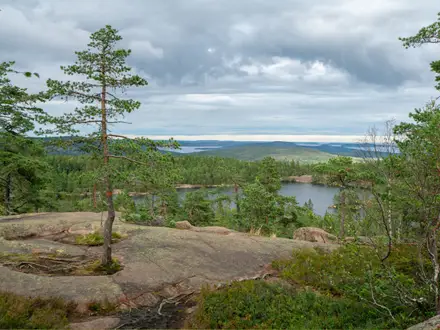
The Digerhuvud Trail is an easy coastal loop on the northwest coast of Fårö, just north of Gotland in Sweden. The signposted Digerhuvud–Tunguhuvud loop is about 2.9 km, while the protected rauk field stretches roughly 3.5 km along the shore. Allow 1–2 hours, or a short half-day if you stop often for the limestone sea stacks, Helgumannen fishing village and Baltic views. It suits walkers wanting a short, near-flat nature-reserve walk rather than a long-distance hike.
Route Overview
Most walkers start from one of the six roadside car parks near Lauterhorn or Släthällar, follow the shoreline north-east through the rauks towards Tunguhuvud and Helgumannen fishing village, then return by the reserve’s paved/gravel access road. This is a loop, not a point-to-point route. The shore section is the reason to come: loose limestone cobbles, low cliffs and Sweden’s largest continuous rauk field. Access is easiest by car after taking the short free ferry from Fårösund to Fårö. For longer Swedish coastal walking, compare it with the Bohus Coast Trail or Höga Kustenleden.
A 430-Million-Year-Old Fossil Reef
Digerhuvud’s rauks are eroded remains of a Silurian coral reef that formed in a warm tropical sea about 430 million years ago. After the ice sheets retreated roughly 10,000 years ago, the land rose and waves stripped away softer rock, leaving harder reef limestone as pillars. The coast is still being shaped today, especially around the outermost stacks. The area has protected status as a nature reserve and natural monument, established in 1930 and managed by Länsstyrelsen i Gotlands län.
Notable highlights
- Sweden’s largest rauk field: Several hundred limestone sea stacks, from about 1 m to 8 m tall, line this 3.5 km stretch of Fårö’s coast.
- 430-million-year-old fossil reef: The limestone contains fossil corals, crinoids, snails, cephalopods and other ancient sea creatures; fossil collecting is not allowed.
- Helgumannen fishing village: At the northern end of the reserve, this traditional fiskeläge has around 15 weathered timber fishermen’s huts.
- Stunted strand-pine forest: Inland from the cobble field, wind-shaped maritime pines form a low, twisted coastal woodland.
- Tunguhuvud headland loop: The signposted loop rounds this low headland, giving open Baltic views and dense rauk clusters in a compact circuit.
Challenges to expect
The walk is easy, short and well signed, but the shore is uneven underfoot on loose limestone cobbles and pebbles. The coast is exposed, so wind can make it feel cold outside the May–September season. Keep back from cliff edges and do not swim or venture onto submerged stacks: offshore drops and dangerous currents are noted hazards. Dogs must be on lead except from 1 November to 31 January.
HikeList Score
Digerhuvud Trail (Gotland) scored 65/100 on HikeList's trail-quality metrics.
See score breakdownHide breakdown
- Ideal length 55
- Balanced challenge 64
- Scenery & wildness 85
- Varied terrain 83
- Accommodation 49
- Food & support 38
- Path quality 80
- Season flexibility 89
Computed from length, challenge, scenery & wildness, terrain variety, accommodation, food & support, path quality and season flexibility.
 Sweden
Show more data Show less
- Coastal
- Limestone Cliffs
- Forest
- Rocky
- Gravel
- Paved
- Wild camping spots
- Family Friendly
- Pet Friendly
- None
Photos from hikers
Taken on the trail by people who've reviewed Digerhuvud Trail (Gotland).
Reviews
How would you rate Digerhuvud Trail (Gotland)?
Tap a star to start your review — you could be the first.