Weserbergland Trail
How would you rate Weserbergland Trail?
Tap a star to share your experience and help other hikers.
Weserbergland Trail: A Complete Hiking Guide
HikeList Score
Weserbergland Trail scored 91/100 on HikeList's trail-quality metrics.
See score breakdownHide breakdown
- Ideal length 89
- Balanced challenge 100
- Scenery & wildness 78
- Varied terrain 100
- Accommodation 100
- Food & support 88
- Path quality 78
- Season flexibility 100
Computed from length, challenge, scenery & wildness, terrain variety, accommodation, food & support, path quality and season flexibility.
The Weserbergland Trail, officially the Weserbergland-Weg, is a 225 km point-to-point hike through the Weser Uplands in Germany. The standard itinerary takes 13 days from Hann. Munden to Porta Westfalica and is best rated moderate: there is no scrambling or exposed terrain, but the full route has around 6,259 m of ascent. It suits hikers who want a well-waymarked, town-to-town forest trail with guesthouse accommodation, historic towns and steady upland walking rather than high mountains.
Route Overview
The route starts at the Weserstein in Hann. Munden, where the Werra and Fulda meet to form the Weser, and finishes at the Kaiser-Wilhelm-Denkmal above the Weser gorge in Porta Westfalica. It is most commonly walked northbound, but the blue XW waymarking is signed in both directions. Official stage stops include Reinhardshagen/Veckerhagen, Sababurg, Bad Karlshafen, Silberborn, Bodenwerder, Hameln, Rinteln and Porta Westfalica. Regular towns and rail connections make it practical to section-walk. For other German long-distance options, compare the Harzer Hexenstieg, Eifelsteig or Goldsteig.
Fairy-tale country and Weser Renaissance towns
The Weserbergland-Weg is a modern quality long-distance trail through a region closely linked with German folklore and the Deutsche Marchenstrasse, the German Fairy Tale Road. The route connects places associated with the Brothers Grimm and folk legend: Sababurg is tied to Sleeping Beauty, Hameln to the Pied Piper, and Bodenwerder to Baron Munchhausen. It was certified as a Qualitatsweg Wanderbares Deutschland in 2012 and is also one of the Top Trails of Germany.
Notable highlights
- Sababurg (Sleeping Beauty castle): A hilltop castle in the Reinhardswald associated with the Brothers Grimm tale of Dornroschen. The surrounding Hutewald pasture-forest adds an unusual woodland landscape to the stage.
- Bad Karlshafen (baroque spa town): A planned town on the Weser with a symmetrical harbour basin and Huguenot museum. It is one of the route’s most distinctive riverside stops.
- Hochmoor Mecklenbruch (raised bog): The largest raised bog in the Solling, crossed by boardwalk. It gives the trail a rare upland moor section amid the forests.
- Kloster Amelungsborn (Cistercian monastery): A monastery founded in 1135 and one of the oldest in Lower Saxony. The historic herb garden and monastic setting make it a worthwhile cultural stop.
- Hameln (Pied Piper town): The historic town of the Pied Piper legend, with a preserved Weser Renaissance old town. It is also one of the major service points on the route.
- Kaiser-Wilhelm-Denkmal (trail finish): The large 1896 monument to Emperor Wilhelm I stands above the Weser gorge at Porta Westfalica, marking the official end of the hike.
Challenges to expect
The trail is not technically difficult: no scrambling, sure-footedness or head for heights is required. The main challenge is sustained distance over 13 days, with about 6,259 m ascent and 6,343 m descent across rolling wooded uplands. Expect mostly natural forest and field paths, some paved town sections, and weather-dependent conditions in forests and moorland. Wild camping is not permitted in German forests, so plan accommodation in advance.
HikeList Score
Weserbergland Trail scored 91/100 on HikeList's trail-quality metrics.
See score breakdownHide breakdown
- Ideal length 89
- Balanced challenge 100
- Scenery & wildness 78
- Varied terrain 100
- Accommodation 100
- Food & support 88
- Path quality 78
- Season flexibility 100
Computed from length, challenge, scenery & wildness, terrain variety, accommodation, food & support, path quality and season flexibility.
 Germany
Show more data Show less
- Wooded Uplands
- Forest
- Ridge Trails
- Meadows
- Moorland
- River Valleys
- Natural Paths
- Forest Paths
- Field Paths
- Paved
- Guesthouses
- Hotels
- Pensions
- Inns
- Family Friendly
- Pet Friendly
- Restrooms
- Water Sources
- Campsites
- Shelters
- Picnic Areas
Download Our Full Guide to Weserbergland Trail FREE!
Get our comprehensive guide to this hike for free. Save it for later reading or print out at home.
In these collections
Photos from hikers
Taken on the trail by people who've reviewed Weserbergland Trail.
Weserbergland Trail: The Complete Guide
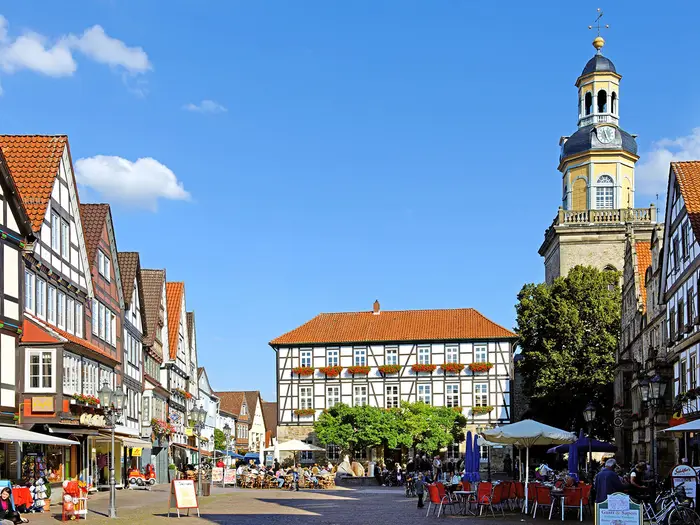 i
Image by R.-Andreas Klein
i
Image by R.-Andreas Klein The Weserbergland Trail is a 225 km waymarked walk through Germany’s Weser Uplands, running from the Weserstein in Hann. Münden to the Kaiser-Wilhelm-Denkmal above Porta Westfalica. It suits walkers who want a long, steady route of forests, river towns and upland ridges rather than high mountains or technical ground.
The route follows the Weser’s story northwards through the Reinhardswald, Solling and Wesergebirge, linking places such as Sababurg, Bad Karlshafen, Bodenwerder, Hameln and Rinteln. Expect quiet beech and mixed forest, old Fachwerk towns, open meadows, boardwalk through Hochmoor Mecklenbruch and rocky viewpoints such as the Hohenstein Klippen.
This is fairy-tale country without being a soft option: Sleeping Beauty at Sababurg, the Pied Piper at Hameln and Münchhausen at Bodenwerder sit between long rural stages. The blue XW waymarks make the line straightforward, and rail access at Hann. Münden, Bad Karlshafen, Hameln, Rinteln and Porta Westfalica makes the trail unusually practical for section walking.
What the Weserbergland-Weg asks for is endurance, sensible booking and attention in forest. The walking is moderate, with about 6,259 m of ascent over rolling Mittelgebirge terrain, but stage lengths vary widely and the Solling accommodation is thinner than in the main river towns.
This guide covers stages, daily planning, accommodation, food, transport, terrain and the common mistakes to avoid.
Stage-by-Stage Guide
The notes below follow the 13-stage itinerary from Hann. Münden to Porta Westfalica. Distances are approximate, and live train times, accommodation availability and any forest or path diversions should be checked before travelling.
The route is waymarked with a blue XW on a green ground, but the long forest sections make a GPX track or offline map sensible. Food and water planning matters most on the Reinhardswald and Solling stages, where services are thinner than in the Weser towns.
Stage 1: Hann. Münden to Reinhardshagen / Veckerhagen — 14 km
The first stage starts at the Weserstein on the Tanzwerder, where the Werra and Fulda meet to form the Weser. The blue XW waymarks lead out from Hann. Münden old town, so allow time to find the correct line before leaving the built-up area.
Underfoot, expect a mixture of town paths, riverside or valley walking and natural tracks as the route begins to move towards the Reinhardswald. This is one of the shorter days, but it is still worth treating it as a proper walking stage rather than a gentle prologue, especially if arriving by train the same morning.
Hann. Münden is the best place for supplies at the start, with the old town also being the main cultural highlight of the day. Food and water options after leaving town should not be assumed; carry what is needed to reach Reinhardshagen / Veckerhagen.
Accommodation at the end should be arranged ahead, particularly outside the main season. Hann. Münden has its own Bahnhof with regional train access from Göttingen and Kassel; onward public transport from the stage end should be checked before travelling.
Navigation is straightforward where the waymarks are clear, but pay attention at the urban exit and at path junctions in wooded sections. Forest tracks can be muddy after rain.
Stage 2: Reinhardshagen / Veckerhagen to Sababurg — 13 km
This short stage moves into the Reinhardswald, one of the defining forest sections of the trail. The walking is generally on forest and field paths, with the main interest coming from the quiet woodland setting and the approach to Sababurg.
Sababurg is the key landmark: the hilltop castle in the Reinhardswald associated with the Sleeping Beauty story, set within historic Hutewald pasture-forest with veteran oaks. This is one of the most distinctive cultural stops on the Weserbergland-Weg.
Services are limited compared with the river towns. Leave Reinhardshagen / Veckerhagen with enough food and water for the stage, and do not rely on finding shops or cafés during the walk.
Accommodation at or near Sababurg is a potential pinch point and should be booked ahead. Public transport or road-based pick-ups at the stage end should be checked before travelling.
Navigation is mainly a matter of staying alert at forest junctions. The route is not technically difficult, but waymark-to-waymark walking through woodland is slower if visibility is poor or signs are missed.
Stage 3: Sababurg to Bad Karlshafen — 20 km
Stage 3 is a longer day out of the Reinhardswald towards the Weser at Bad Karlshafen. Expect rolling forest walking, natural tracks and a more substantial distance than the previous two stages.
The end point is the main highlight. Bad Karlshafen is a planned baroque spa town founded by Huguenot refugees, with a symmetrical harbour basin and strong Huguenot heritage.
Carry food and water from the start, as the forested character of the stage means services may be sparse until Bad Karlshafen. Once in Bad Karlshafen, accommodation and food options are generally better than on the preceding upland stages.
Bad Karlshafen has a station, making this a useful joining or leaving point for section-walkers. Current train times should be checked before travelling.
The main practical issue is endurance rather than terrain difficulty. Forest tracks can become muddy after rain, and the longer distance makes an early start sensible if staying outside the immediate stage end.
Stage 4: Bad Karlshafen to Schönhagen — 12 km
This is one of the shortest stages of the trail, leaving the Weser town of Bad Karlshafen and heading back into quieter upland country. The walking is on rolling Mittelgebirge terrain, with a mix of forest and field paths.
The short distance makes it a useful recovery stage after the 20 km walk from Sababurg. It is also a good day to resupply properly in Bad Karlshafen before entering the thinner-service Solling section.
Food and water should be carried from Bad Karlshafen. Schönhagen is not one of the larger service towns on the route, so do not assume late-opening shops or extensive eating options at the end.
Accommodation in Schönhagen or nearby should be booked ahead. Public transport details for this stage end should be checked before travelling.
Navigation is generally forest-and-village walking, with no technical ground. The main warning is practical: a short stage can still become awkward if the booked bed or meal option is unavailable, so confirm arrangements before setting off.
Stage 5: Schönhagen to Silberborn — 14 km
Stage 5 continues into the Solling, leading towards Silberborn and the trail’s higher forest country. The terrain remains moderate, but the setting becomes more remote, with long wooded sections and fewer obvious bail-out points than in the Weser valley.
Silberborn sits in the Hochsolling area, one of the quietest and highest-feeling parts of the Weserbergland-Weg. The walking here is about sustained forest travel rather than exposed summits or technical paths.
Carry a full day’s food and water unless specific stops have been arranged. Services in the Solling villages are thinner than in Hann. Münden, Bad Karlshafen, Bodenwerder, Hameln or Rinteln.
Accommodation in Silberborn should be booked ahead, especially in busy walking periods or outside standard holiday opening times. Any public transport connection from the stage end should be checked before travelling.
Waymarking should not be treated as a substitute for a map in this section. In continuous forest, junctions can look similar, and wet weather can make natural tracks heavy underfoot.
Stage 6: Silberborn to Stadtoldendorf — 22 km
This is a long Solling stage and one of the more important days for pacing. From Silberborn, the route passes the Hochmoor Mecklenbruch, the largest raised bog in the Solling, crossed by boardwalk, before continuing through the Hochsolling towards Stadtoldendorf.
The boardwalk through the Hochmoor Mecklenbruch is a major landscape change after days of forest. In wet or cold conditions, timber surfaces can be slippery, so poles and careful foot placement are useful.
The stage combines upland forest, moorland boardwalk and a longer overall distance. It is not technically hard, but 22 km through quiet terrain can feel more demanding than the number suggests if tracks are muddy.
Carry food and water from Silberborn. Stadtoldendorf is a more substantial end point than the smaller Solling villages, but accommodation and meal arrangements should still be checked in advance.
Navigation needs care across the high forest country. Keep to the marked route around the bog and avoid stepping off the boardwalk in protected wetland areas.
Stage 7: Stadtoldendorf to Bodenwerder — 18 km
This stage links Stadtoldendorf with the Weser at Bodenwerder, with Kloster Amelungsborn as the major historic stop along the way. The monastery, founded in 1135, is one of the oldest in Lower Saxony and is known for its historic monastery and herb garden.
The terrain is a mixed day of rolling upland paths, village approaches and the gradual return towards the river corridor. After the forest-heavy Solling stages, the route begins to feel more settled and connected again.
Food and water should be sorted in Stadtoldendorf before departure. Depending on opening times, Kloster Amelungsborn is a cultural highlight rather than a guaranteed service stop, so do not plan the day around finding supplies there.
Bodenwerder is one of the better overnight stops on the route, with more accommodation than the upland villages. It is also the birthplace of Hieronymus von Münchhausen, the “Lügenbaron”, giving the town a strong trail highlight at the end of the day.
Navigation is generally easier where the route approaches towns and villages, but there will still be forest and field junctions. Expect some paved sections near settlements and potentially muddy natural tracks between them.
Stage 8: Bodenwerder to Lüntorf — 19 km
Stage 8 leaves the Weser town of Bodenwerder for quieter countryside towards Lüntorf. It is a moderate-length day with the typical Weserbergland mix of rolling paths, woodland and village approaches.
Bodenwerder is the place to make full use of services before setting off. Once away from the river town, food and water options should be treated as uncertain unless already checked.
Lüntorf is a smaller stage end, so accommodation should be arranged ahead and evening food should not be left to chance. This is especially important if walking outside the main holiday season.
Public transport for this stage end should be checked before travelling. Road access may be possible, but no specific connection should be assumed without checking current local timetables.
The main navigation issue is maintaining the correct line through mixed field and forest paths. There are no technical hazards, but muddy tracks after rain can slow the stage.
Stage 9: Lüntorf to Emmerthal — 14 km
This shorter stage continues through the rolling Weserbergland towards Emmerthal. It is a useful lower-mileage day before the approach to Hameln and the longer stages that follow.
The terrain remains moderate, with natural paths, field sections and village-to-village walking. The route is not exposed, but wet forest and field tracks can be slippery or heavy.
Carry food and water from Lüntorf. Emmerthal is the stage end, but current services and accommodation should be checked before relying on them.
This is one of the stages where planning the overnight location matters. The following stage is listed to Rohrsen, with Hameln immediately important for services and rail access, so accommodation choices around Emmerthal, Rohrsen and Hameln should be aligned with the next day’s start.
Navigation is normally straightforward on the marked trail, but do not become casual on shorter days. Missed waymarks around villages can add unnecessary road walking or backtracking.
Stage 10: Emmerthal to Rohrsen (Hameln) — 20 km
Stage 10 brings the route into the Hameln area, ending at Rohrsen. It is a 20 km day, so although services improve as the route nears Hameln, it should still be planned as a full walking stage.
Expect a mixture of natural paths and more settled approaches near built-up areas. Paved town or village sections become more likely as the route reaches the Hameln area.
Hameln is the major highlight and service centre here, famous for the Pied Piper legend, its Weser Renaissance old town and the Rattenfängerhaus. It is the best place on this part of the trail for resupply, accommodation and onward travel.
Food and water should still be carried from Emmerthal, especially if walking directly to Rohrsen before entering central Hameln. Accommodation is generally more plentiful in Hameln than in the smaller stage ends.
Hameln sits on the Elze–Löhne railway, making this a practical access point for section-walkers. Check current rail times before travelling.
Navigation needs attention where the trail moves through the urban edge. Make sure the chosen overnight location matches the next morning’s route, as the official split uses Rohrsen / Hameln around this point.
Stage 11: Hameln to Rohdental — 27 km
This is the longest stage of the Weserbergland-Weg and should be treated as one of the key endurance days. From Hameln, the route heads into the Süntel and towards the Hohenstein Klippen before finishing at Rohdental.
The Hohenstein Klippen are the standout feature: limestone cliffs up to around 50 m high, with the Teufelskanzel viewpoint over the Weserbergland. The route remains a hiking trail rather than a scrambling route, but stay on the marked paths and keep clear of cliff edges.
Terrain is more demanding by duration than by technicality: forest paths, ridges, natural tracks and sustained distance. Mud after rain and poor visibility in woodland can make the day feel significantly longer.
Start with a full food and water carry from Hameln. Do not rely on frequent services between Hameln and Rohdental, and make sure accommodation at or near Rohdental is booked ahead.
Hameln’s railway access makes it a logical place to begin this stage after a rest or resupply. Public transport from Rohdental should be checked before travelling if not staying there.
Navigation through the Süntel needs care at junctions and around viewpoints. An offline map or GPX track is particularly useful on this stage, as the long distance leaves little margin for avoidable detours.
Stage 12: Rohdental to Rinteln — 16 km
Stage 12 is a shorter day after the long crossing from Hameln. It leads from Rohdental towards Rinteln, returning to a larger Weser town with better services.
The walking is typical rolling Weserbergland terrain, with forest and field paths gradually giving way to a more settled approach. After the Süntel section, the day should feel more manageable, though wet tracks can still slow progress.
Carry food and water from Rohdental unless specific services have been checked. Rinteln is a good resupply and overnight point, with accommodation generally easier than in the smaller upland villages.
Rinteln lies on the Elze–Löhne railway, so it works well for section-walkers or for anyone needing a flexible finish before the final stage. Current train times should be checked before travelling.
Navigation is less complex than the long forest stages, but the usual discipline still applies at path junctions and village approaches. Keep following the blue XW rather than assuming the most direct route into town is the trail.
Stage 13: Rinteln to Porta Westfalica — 16 km
The final stage crosses the Wesergebirge to Porta Westfalica. It is a moderate-distance finish, but it still includes upland walking before the trail reaches the Kaiser-Wilhelm-Denkmal high above the Weser gorge.
The Kaiser-Wilhelm-Denkmal is the official endpoint and one of the strongest viewpoints of the whole route. It marks the place where the Weser breaks out of the uplands onto the North German Plain.
Expect forested ridge and upland paths, with possible paved sections as the route approaches the monument and Porta Westfalica. The final day is not technical, but tired legs and wet forest tracks can still make footing slower than expected.
Start with food and water from Rinteln, and check what will be open near the finish before relying on post-walk services. Porta Westfalica has a station on the Hannover–Hamm line, with direct trains to and from Hannover, making onward travel straightforward once the route is complete.
The official finish is at the monument, not simply at the railway station, so allow time for the practical transfer between the high endpoint and onward transport. Current train times and local access from the Kaiser-Wilhelm-Denkmal should be checked before travelling.
Navigation remains important to the end, particularly in the Wesergebirge where forest paths and viewpoint approaches can be confusing. Stay with the blue XW waymarks until the Kaiser-Wilhelm-Denkmal rather than leaving the trail early for the quickest route into Porta Westfalica.
Recommended Itinerary
Standard 13-day itinerary
The standard plan follows the official 13-stage structure from Hann. Münden to Porta Westfalica. It suits most fit walkers: daily distances are manageable, the route keeps to recognised stage towns, and the harder logistics are concentrated on the quieter Reinhardswald and Solling sections, where accommodation should be booked before travelling.
| Day | From | To | Approx. distance | Why this stage makes sense | Services/accommodation notes |
|---|---|---|---|---|---|
| 1 | Hann. Münden | Reinhardshagen / Veckerhagen | 14 km | A short first day after reaching the Weserstein and leaving Hann. Münden on the blue XW waymarks. It gives time for travel to the start without immediately committing to a long forest stage. | Hann. Münden has strong rail access and a good choice of town services. Reinhardshagen / Veckerhagen is a smaller overnight stop, so book ahead. |
| 2 | Reinhardshagen / Veckerhagen | Sababurg | 13 km | Another short day, but useful because the route moves into the Reinhardswald and the accommodation pattern becomes thinner. Sababurg is a logical stop before the longer walk to Bad Karlshafen. | Accommodation in and around Sababurg should be arranged in advance. Do not rely on finding a last-minute bed on the forest stages. |
| 3 | Sababurg | Bad Karlshafen | 20 km | A fuller walking day out of the Reinhardswald to the Weser at Bad Karlshafen. This is a good first longer stage while still ending in a proper river town. | Bad Karlshafen is one of the stronger service points on the route and has a station, making it useful for section-walkers or a schedule reset. |
| 4 | Bad Karlshafen | Schönhagen | 12 km | The shortest listed stage gives recovery after the first three days and positions the route for the climb into the Solling. It is better treated as a deliberate easy day than combined automatically. | Schönhagen is a smaller stop before the high forest country. Accommodation should be booked ahead. |
| 5 | Schönhagen | Silberborn | 14 km | A moderate stage into the Hochsolling around Silberborn, the route’s high, quiet forest country. This is a sensible place to stop before the longer next day to Stadtoldendorf. | Silberborn is the key overnight base for the Solling section. Beds are more limited than in the Weser towns, so reserve early. |
| 6 | Silberborn | Stadtoldendorf | 22 km | One of the more substantial stages, crossing the Hochsolling area and passing the Hochmoor Mecklenbruch boardwalk region before descending towards Stadtoldendorf. | Start with food and water organised, as forest services are limited. Stadtoldendorf is a more practical town stop after the upland section. |
| 7 | Stadtoldendorf | Bodenwerder | 18 km | A balanced mid-route day linking Stadtoldendorf, Kloster Amelungsborn and the Weser at Bodenwerder. It gives a good change from forest walking to river-town services. | Bodenwerder is a useful Weser overnight town with more services than the small upland villages. |
| 8 | Bodenwerder | Lüntorf | 19 km | A steady day away from the Weser valley into quieter village country. It keeps the following stage to Emmerthal at a comfortable length. | Lüntorf is a smaller stage stop; book accommodation before committing to this split. |
| 9 | Lüntorf | Emmerthal | 14 km | A shorter day into Emmerthal, useful before the Hameln section and the longer Süntel day that follows. | Emmerthal is close to the Hameln service area, but accommodation availability should still be checked before travelling. |
| 10 | Emmerthal | Rohrsen (Hameln) | 20 km | This stage brings the route into the Hameln area. The official split places the stage end at Rohrsen, with Hameln functioning as the practical major service point around this part of the trail. | Plan this night around Hameln services rather than assuming plentiful beds in Rohrsen. Stage breakpoints around Hameln vary slightly by route presentation; check official mapping before booking. |
| 11 | Hameln | Rohdental | 27 km | The longest official stage and the main endurance test of the itinerary, moving from Hameln towards the Süntel and Hohenstein Klippen area before Rohdental. | Start early and carry what is needed for the day. Rohdental is not a large service centre, so accommodation and meals should be arranged in advance. |
| 12 | Rohdental | Rinteln | 16 km | A shorter recovery day after the longest stage, ending in Rinteln, one of the better-connected towns on the route. | Rinteln has rail access on the Weser railway and is a sensible resupply or section-walking point. |
| 13 | Rinteln | Porta Westfalica | 16 km | A manageable final stage through the Wesergebirge to the Kaiser-Wilhelm-Denkmal above Porta Westfalica. It leaves time to descend to onward transport after finishing. | Porta Westfalica has a station on the Hannover–Hamm line. Check current Deutsche Bahn times before arranging same-day onward travel. |
Slower variant: 14–16 days
A slower schedule suits first-time long-distance hikers, walkers who prefer shorter days in forest terrain, or anyone wanting more margin for weather and sightseeing in the Weser towns. The simplest way to slow the route down is to add rest or buffer nights at stronger service points such as Bad Karlshafen, Hameln or Rinteln.
Splitting the longest stage, Hameln to Rohdental, can make sense for some walkers, but only if accommodation or transport works on the ground. Do not assume an intermediate overnight is available without checking current accommodation and official mapping before booking.
The Solling section around Schönhagen, Silberborn and Stadtoldendorf is the other place to build in caution. These are quieter upland stages with fewer beds, so a slower plan needs early reservations rather than flexible day-by-day improvisation.
Faster variant: 10–12 days
A faster itinerary is realistic for strong walkers comfortable with repeated 20 km-plus days and limited flexibility on accommodation. The easiest places to gain time are by combining shorter official stages, for example Hann. Münden to Sababurg by linking Days 1 and 2 at about 27 km, or Bad Karlshafen to Silberborn by linking Days 4 and 5 at about 26 km.
This approach reduces the margin for forest navigation, mud after rain and late starts. It also makes accommodation more critical, especially across the Reinhardswald and Solling, where skipping a stage stop can leave few practical alternatives.
A 10-day plan should only be used by walkers happy to carry longer days across rolling uplands with about 6,259 m of total ascent over the full trail. Check official mapping and all overnight stops before booking, because the route’s official stage distances range from about 12 km to 27 km rather than forming even daily sections.
Planning the Route
The Weserbergland-Weg is best planned around its official 13-stage structure. The stages are not equal: the shortest days are around 12–14 km, while the longest day, Hameln to Rohdental, is about 27 km. Most walkers should allow the full 13 walking days unless they are already comfortable with repeated long forest days and can arrange accommodation at non-standard stopping points.
This is not a route that gains much from being rushed. The walking is moderate rather than technical, but the accumulated ascent, long wooded sections and occasional sparse services make a steady itinerary more reliable than trying to compress the trail into fewer days. A rest or short day is easiest to add in a larger service town such as Bad Karlshafen, Bodenwerder, Hameln or Rinteln.
Choosing stage breaks
The natural overnight points are mostly dictated by towns, villages and available accommodation rather than by terrain alone. River towns such as Hann. Münden, Bad Karlshafen, Bodenwerder, Hameln and Rinteln have more services, while the Reinhardswald, Solling and Hochsolling sections require more care with booking.
The Solling stages around Schönhagen, Silberborn, Hochmoor Mecklenbruch and Stadtoldendorf are the part to plan most carefully. Accommodation is thinner here than in the Weser valley towns, so do not leave these nights until late, especially in the main walking season.
| Route section | Planning implication |
|---|---|
| Hann. Münden to Bad Karlshafen | Shorter early stages, but with forest walking through the Reinhardswald and a key overnight at Sababurg. Book Sababurg/Reinhardswald accommodation ahead. |
| Bad Karlshafen to Stadtoldendorf | The main Solling and Hochsolling section. Services are more limited and weather can feel more exposed on the uplands. Carry enough food and water for the day. |
| Stadtoldendorf to Hameln | More regular settlement pattern, with Bodenwerder and Emmerthal before the major service point at Hameln. |
| Hameln to Rinteln | Includes the longest official day, Hameln to Rohdental, and the Süntel/Hohenstein Klippen area. Check the distance carefully before booking this section. |
| Rinteln to Porta Westfalica | A manageable final stage through the Wesergebirge, finishing high at the Kaiser-Wilhelm-Denkmal rather than down at the station. Allow time and energy for the final climb and onward transfer. |
The official stage split around Hameln uses Emmerthal to Rohrsen, followed by Hameln to Rohdental. Hameln sits close to Rohrsen and is the practical service base, so accommodation planning here can vary. Be precise about whether the booked night is in Rohrsen, Hameln or another nearby part of the route.
Shortening, extending and rest days
Shortening the trail is straightforward because the route has useful rail access at both ends and at several mid-route towns. Hann. Münden has a station at the start, Porta Westfalica has a station near the finish, and Bad Karlshafen, Hameln and Rinteln are practical access points for joining or leaving the trail.
Combining stages is possible, but it should be done selectively. Joining two of the shorter 12–14 km stages may work for fit walkers, but combining stages in the Solling or around Hameln can create long days with fewer escape options and more dependence on accommodation availability.
Adding time is usually more useful than cutting time. A 14- or 15-day plan gives more flexibility for a shorter day, a rest in Hameln, or a slower pace through the forest sections without changing the character of the walk.
Section hiking
The Weserbergland-Weg is well suited to section hiking. The clearest access points are Hann. Münden, Bad Karlshafen, Hameln, Rinteln and Porta Westfalica, all of which make it possible to divide the trail into shorter blocks.
Live train times should be checked before travelling, especially when connecting through regional services. For a weekend or short break, it is usually more practical to build the itinerary around rail-served towns than to rely on ad hoc lifts from smaller forest villages.
Accommodation planning
Hotels, Gasthöfe, Pensionen and guesthouses are the normal accommodation pattern. The river towns offer the best choice; upland and forest stages have fewer beds and should be booked in advance.
Wild camping is not permitted in German forests, so the route should not be planned as an informal camping trip. Use recognised campsites or managed pitches only, and check their current opening dates before relying on them.
If walking the full route, book the Solling nights first, then the smaller village nights, then the larger towns. Larger places are more forgiving, but even there it is sensible to book ahead during busy periods.
Food and water
Do not assume there will be shops or cafés between every overnight stop. The safest routine is to leave each town or accommodation with the day’s lunch, snacks and enough water, particularly on the Reinhardswald, Hochsolling and Süntel sections.
Hann. Münden, Bad Karlshafen, Bodenwerder, Hameln and Rinteln are the most obvious places to reset supplies. Smaller villages may have limited services or seasonal opening hours; this should be checked before travelling.
Navigation and route finding
The trail is waymarked with a blue XW on a green ground and is signed in both directions, but most walkers follow it northbound from Hann. Münden to Porta Westfalica. Waymarking is a major advantage of the route, yet the long forest sections still justify carrying an offline map or GPX track.
A full-route GPX is available from Top Trails of Germany. Download it before setting off, as mobile reception and battery life should not be treated as the only navigation system on wooded upland stages.
Forest diversions can occur after storms, forestry work or path damage. Check for current route changes before travelling, and be prepared to follow signed local diversions where they are in place.
Weather and underfoot conditions
The route is not alpine, but weather still matters. Forest tracks can be muddy after rain, and the high ground around the Hochsolling and exposed viewpoints can feel colder and windier than the Weser valley.
Waterproof footwear with good tread is more useful than lightweight town shoes, especially in spring and autumn. The Hochmoor Mecklenbruch is crossed on boardwalk, but wet timber, leaf litter and shaded forest paths can still be slippery.
Spring, summer and autumn are the main walking seasons. In summer, carry sufficient water for warm forest days; in spring and autumn, plan for mud, shorter daylight and cooler upland conditions.
Permits and access
Permits are not a significant planning issue for walking the waymarked trail itself. The main access rule to build into the plan is accommodation: do not wild camp in the forests, and use official accommodation, campsites or managed pitches.
Current accommodation availability, transport times and any temporary forest or path closures should be checked before booking the final itinerary.
Towns, Villages and Overnight Stops
The Weserbergland-Weg is easiest to plan as a string of village and small-town nights, with the main accommodation safety nets in the Weser towns and the more delicate booking points in the Reinhardswald, Solling and Süntel sections. Hotels, Gasthöfe, Pensionen and guesthouses are the normal accommodation style; wild camping is not permitted in German forests, so use campsites or managed pitches only where available.
The most important booking advice is simple: reserve the upland and forest-stage nights before committing to travel dates. Hann. Münden, Bad Karlshafen, Bodenwerder, Hameln and Rinteln have the strongest accommodation base; Schönhagen, Silberborn, Lüntorf and Rohdental need more care.
| Stage stop | Role in planning | Practical note |
|---|---|---|
| Hann. Münden | Start town | Good place to arrive the day before starting; rail access at the Bahnhof. |
| Reinhardshagen / Veckerhagen | Stage 1 overnight | Small Weser-side stop before the Reinhardswald. Book ahead. |
| Sababurg | Stage 2 overnight | Isolated forest/castle-area stop in the Reinhardswald. Do not arrive without a booking. |
| Bad Karlshafen | Stage 3 overnight | Stronger service point, with rail access and more accommodation than the forest stages. |
| Schönhagen | Stage 4 overnight | Small stop before the higher Solling country. Book ahead and check meals. |
| Silberborn | Stage 5 overnight | Key Solling/Hochsolling overnight. Accommodation is thinner than in the river towns. |
| Stadtoldendorf | Stage 6 overnight | Useful town stop after the Hochsolling. Good place to reset logistics. |
| Bodenwerder | Stage 7 overnight | Larger Weser town and practical resupply/accommodation point. |
| Lüntorf | Stage 8 overnight | Small village stop. Book ahead and check food arrangements. |
| Emmerthal / Rohrsen | Stage 9–10 area | Transition towards Hameln; stage splits differ slightly around here, so check your exact overnight location. |
| Hameln | Major mid-route stop | Best full-service town on the route; rail access and a good place for rest, laundry and resupply. |
| Rohdental | Stage 11 overnight | Small stop after the long Hameln–Rohdental stage. Book before setting out. |
| Rinteln | Stage 12 overnight | Strong Weser town stop with rail access. Good final-night base before Porta Westfalica. |
| Porta Westfalica | Finish | Rail access after the Kaiser-Wilhelm-Denkmal finish; decide whether to stay or travel out. |
Hann. Münden
Hann. Münden is the natural place to spend the night before starting. The official start is at the Weserstein on the Tanzwerder, where the Werra and Fulda meet to form the Weser, and the blue XW waymarks lead out from the old town.
Accommodation choice is much better here than on the first forest stages, so it is a sensible place to arrive, sort food, check maps and start with a full pack. The town has its own Bahnhof on the Hannöversche Südbahn, with regional rail connections from Göttingen and Kassel, both of which connect into the wider long-distance network.
Most walkers should avoid trying to combine long inbound travel with the first stage unless arrival times are certain. Current Deutsche Bahn timings should be checked before travelling.
Reinhardshagen / Veckerhagen
Reinhardshagen / Veckerhagen is the first official overnight point after the short opening stage from Hann. Münden. It sits on the Weser side of the route before the trail commits more fully to the Reinhardswald.
This is a practical village-stage night rather than a large service centre. Book accommodation ahead, especially if walking in the main spring, summer or autumn hiking season, and check whether an evening meal is available at the place you are staying.
Public transport details for this stop should be checked before travelling. It is not one of the main rail access points listed for the trail, so do not assume a late or frequent onward option.
Reinhardswald and Sababurg
The Reinhardswald is one of the first major forest sections of the trail, and Sababurg is the official second-night stop. The setting is memorable, with the route passing through ancient Hutewald pasture-forest and the Sababurg area associated with the Sleeping Beauty tale.
For logistics, Sababurg should be treated as an isolated forest-stage overnight. Accommodation and food options are much thinner than in Hann. Münden or Bad Karlshafen, so this is one of the nights to secure before booking the rest of the trip.
Do not rely on turning up and improvising here. If accommodation is unavailable, adjust the itinerary in advance rather than expecting easy alternatives in the forest.
Bad Karlshafen
Bad Karlshafen is one of the stronger overnight stops on the southern half of the Weserbergland-Weg. It sits on the Weser after the Reinhardswald stages and makes a good logistical reset before the trail heads towards the Solling.
Accommodation is generally more plentiful here than in the small upland villages, and it is one of the named rail-access points on the route. The town is also a practical place to sort food before the shorter but more accommodation-sensitive stages to Schönhagen and Silberborn.
Its baroque harbour basin and Huguenot heritage make it worth allowing a little time, but the main hiking value is practical: beds, transport and a stronger service base after several quieter days.
Schönhagen
Schönhagen is the official stop between Bad Karlshafen and Silberborn, reached after one of the shorter stages. It is a useful staging point because it breaks the approach to the Solling into manageable days.
Treat Schönhagen as a small-place overnight. Accommodation should be booked ahead, and meal arrangements should be checked directly with the accommodation or current local providers.
This is not the place to leave resupply to chance. Carry enough food from Bad Karlshafen to cover the walking day and any uncertainty around opening times.
Silberborn, Hochmoor Mecklenbruch and the Hochsolling
Silberborn is the key overnight base in the Hochsolling, the high forest country of the trail. The nearby Hochmoor Mecklenbruch, crossed by boardwalk, is one of the distinctive landscape features of this section.
Accommodation in the Solling is thinner than in the main Weser towns, so Silberborn should be booked early. Weather and ground conditions can also feel more exposed here than in the valley sections, with long forest tracks that may be muddy after rain.
Food planning matters on this stage. Check current opening times before relying on cafés, shops or evening meals, and carry enough provisions to be self-sufficient between booked stops.
Stadtoldendorf
Stadtoldendorf is the official overnight after the long Silberborn stage and is an important break after the Hochsolling. It is a Fachwerk town and a more useful service point than the preceding forest terrain.
This is a good place to recover from the upland section, reorganise food and confirm the following day’s plan towards Kloster Amelungsborn and Bodenwerder. Accommodation should still be booked rather than assumed, but the town is a more forgiving stop than the smaller Solling villages.
Public transport options from here should be checked before travelling if using it as a section start or finish.
Kloster Amelungsborn
Kloster Amelungsborn is not an official overnight stage end in the 13-day itinerary, but it is a significant point between Stadtoldendorf and Bodenwerder. The route reaches the Cistercian monastery after Stadtoldendorf before continuing towards the Weser.
For most hikers it is a daytime stop rather than a lodging base. Opening times, access and any local services should be checked before relying on them.
Do not plan this as a resupply point without current information. Carry what is needed from Stadtoldendorf through to Bodenwerder.
Bodenwerder
Bodenwerder is the next major Weser town and a strong overnight stop after the Stadtoldendorf stage. It is the birthplace of Hieronymus von Münchhausen, but for hikers its main value is as a river-town service base.
Accommodation is more plentiful here than in the surrounding smaller villages. It is a sensible place to shop, eat properly and prepare for the next run of quieter stops towards Lüntorf and Emmerthal.
If section-walking, onward transport should be checked before travelling. The main named mid-route rail hubs in the trail information are Bad Karlshafen, Hameln and Rinteln.
Lüntorf
Lüntorf is a small official overnight stop between Bodenwerder and Emmerthal. It keeps the stage lengths reasonable but needs advance planning.
Book accommodation before committing to this stage. Food and evening meal availability should be checked directly, and it is wise to carry enough from Bodenwerder in case local options are limited or closed.
This is a classic Weserbergland-Weg village night: useful for breaking the route, but not a place to depend on last-minute flexibility.
Emmerthal and Rohrsen
Emmerthal and Rohrsen sit in the approach to Hameln, where the stage split can cause confusion. The official itinerary uses Emmerthal to Rohrsen for Stage 10, while Hameln sits just north of Rohrsen and is the start point for the following long stage to Rohdental.
When booking, match the accommodation to the stage plan actually being walked. A night in Hameln may be more convenient for services, but it changes the exact start and finish points compared with an itinerary that stops at Rohrsen.
Emmerthal and Rohrsen are best treated as practical staging points rather than major rest stops. Check accommodation, food and any local transport before travelling.
Hameln
Hameln is the major service point of the Weserbergland-Weg. It has rail access on the Elze–Löhne railway, a preserved Weser Renaissance old town, and the strongest mid-route base for accommodation, food, laundry and resupply.
This is the best place to build in a rest night if the 13-day itinerary feels tight. It is also the most practical point for section-walkers joining or leaving the trail in the central part of the route.
The stage after Hameln to Rohdental is the longest official day at about 27 km, so start that day well supplied. If staying in Hameln rather than Rohrsen, check the exact distance to the next booked bed and do not underestimate the extra logistics created by the stage split.
Süntel, Hohenstein Klippen and Rohdental
After Hameln the route enters the Süntel, with the Hohenstein Klippen among the most distinctive viewpoints on the northern half of the trail. Rohdental is the official overnight at the end of the long Hameln stage.
This is one of the most important nights to book in advance because the preceding stage is long and escape flexibility is limited by the forest-and-ridge terrain. Arriving tired without a bed arranged is poor planning here.
Carry enough food and water for a full upland day. Any cafés, shops or local transport in the Rohdental area should be checked before travelling.
Rinteln
Rinteln is a strong overnight stop on the Weser and the main service base before the final push through the Wesergebirge to Porta Westfalica. It has rail access on the Elze–Löhne railway, making it useful for both full-route walkers and section hikers.
Accommodation is generally more plentiful here than in the small villages, and it is a sensible place for a final resupply. The last stage is moderate in length, but it still finishes high at the Kaiser-Wilhelm-Denkmal rather than at the station.
If travelling home the same day from Porta Westfalica, allow time for the finish logistics after reaching the monument.
Wesergebirge and Porta Westfalica
The final stage crosses the Wesergebirge from Rinteln to Porta Westfalica. The official end is the Kaiser-Wilhelm-Denkmal above the Weser gorge, where the river leaves the uplands for the North German Plain.
Porta Westfalica has a station on the Hannover–Hamm line, with direct trains to and from Hannover taking about 40–55 minutes. Current Deutsche Bahn times should be checked before travelling, especially if connecting to long-distance trains or flights.
Decide in advance whether to stay in Porta Westfalica or travel out after finishing. If travelling out the same day, remember that the trail endpoint is the monument above the gorge, not simply the railway station.
Getting to the Start
By train
Hann. Münden is the natural access point for the Weserbergland Trail and has its own railway station, Hann. Münden Bahnhof. The station is on the Hannöversche Südbahn, with regional train connections from Göttingen and Kassel; both are useful long-distance rail hubs with ICE connections.
For most walkers arriving from elsewhere in Germany, the simplest plan is to travel by long-distance train to Göttingen or Kassel, then change onto a regional train to Hann. Münden. Live Deutsche Bahn times, platform changes and engineering works should be checked before travelling.
From Hann. Münden Bahnhof, allow time to get to the official start at the Weserstein on the Tanzwerder, where the Werra and Fulda meet to form the Weser. The blue XW waymarks lead out from the old town, so it is worth starting with enough daylight to orientate properly rather than rushing straight off the train.
By bus
Local buses may be useful for short regional journeys into Hann. Münden, but rail is the main public-transport option for reaching the start. Exact bus routes, weekend services and evening frequencies can change and should be checked before travelling.
If arriving late or staying outside the town centre, a local taxi can simplify the final transfer to accommodation or to the Weserstein. Taxi availability should be arranged in advance for early starts, late arrivals or Sundays.
By car
Driving to the start is possible, but this is a point-to-point trail ending at Porta Westfalica, so leaving a car in Hann. Münden creates an end-of-walk return journey. For a full thru-hike, public transport is usually the cleaner option because both the start and finish have railway stations.
If using a car, check current long-stay parking rules in Hann. Münden before committing to the plan. Town-centre parking restrictions, overnight rules and maximum-stay limits can change, and secure long-stay options should not be assumed.
A common alternative is to travel by train to Hann. Münden, walk northbound to Porta Westfalica, then leave directly by train from the finish. This avoids returning across the whole route to collect a vehicle.
From the nearest airport
The nearest major airport for the route is Hannover Airport (HAJ). From there, continue by rail via Hannover and then onward through the German rail network to Göttingen or Kassel, changing to a regional train for Hann. Münden where required.
For international walkers, Hannover and Kassel are the key rail hubs to plan around rather than trying to reach a minor local connection directly. Flight arrival times should be matched carefully with onward train times, especially if planning to start walking the same day. This should be checked before travelling.
Where to stay before starting
Hann. Münden is one of the better places on the trail for a pre-walk night, with hotels, Gasthöfe, Pensionen and guesthouses in and around the old town. Staying locally gives time to visit the Weserstein, sort food and cash, and begin the first stage to Reinhardshagen / Veckerhagen without a rushed morning transfer.
Accommodation is generally easier here than on the quieter forest and Solling stages later in the route, but booking ahead is still sensible in holiday periods and at weekends. Check current opening days, check-in times and whether breakfast is early enough for the first walking day before booking.
Getting Home from the Finish
The Weserbergland-Weg finishes at the Kaiser-Wilhelm-Denkmal above Porta Westfalica. The main onward transport point is Porta Westfalica station, but the monument is high above the Weser gorge, so allow time after the official finish for the descent or for a local transfer into town.
By train
Porta Westfalica has a railway station on the Hannover–Hamm line. This is the simplest way to leave the trail, with frequent direct trains to and from Hannover; journey times to Hannover are typically about 40–55 minutes.
Hannover is the most useful onward rail hub from the finish, especially for long-distance connections across Germany. If travelling south or east after the hike, it may still be easiest to route via Hannover rather than trying to make cross-country regional connections from smaller stations.
Train times, platform changes and ticket conditions should be checked before travelling, especially if finishing on a Sunday, public holiday or late in the day.
By bus
Local buses may be useful for reaching Porta Westfalica town or station from the area around the Kaiser-Wilhelm-Denkmal, but services are timetable-dependent and can be limited outside normal daytime hours. This should be checked before travelling.
If the final stage from Rinteln runs later than planned, do not rely on an evening bus without checking the current timetable first. A taxi or an overnight stay at the finish is the safer fallback.
By car/taxi
Because this is a point-to-point trail from Hann. Münden to Porta Westfalica, car logistics need planning in advance. Most walkers will find it easier to use the train at the finish rather than leave a vehicle at one end and return for it later.
A taxi is the practical option if finishing late, if the descent from the monument to the station is inconvenient with luggage, or if local buses do not line up with train departures. Book ahead where possible, particularly at weekends or in the evening.
From the nearest airport
The nearest major airport for the route is Hannover Airport (HAJ). From Porta Westfalica, the usual public-transport approach is to travel by train to Hannover and continue from there to the airport.
Allow a buffer between the final walking day and any flight. The last stage starts in Rinteln and finishes at the monument above Porta Westfalica, so delays from weather, tired legs or missed local connections can make same-day flights risky. Current rail and airport connections should be checked before booking.
Where to stay at the finish
Staying in or around Porta Westfalica is sensible if you expect to finish late, want to visit the Kaiser-Wilhelm-Denkmal without rushing, or have a long onward journey the next morning. It also removes pressure from the final stage, which comes after 13 days of cumulative walking.
If accommodation at the finish is limited or fully booked, another practical option is to continue by train towards Hannover after finishing, provided the timetable still works. Accommodation should be booked ahead during busy periods, and late check-in arrangements should be confirmed directly with the property.
Which Direction Should You Walk?
Standard direction: Hann. Münden to Porta Westfalica
The Weserbergland-Weg is signed in both directions, but it is usually walked northbound from Hann. Münden to Porta Westfalica. This is also the cleanest way to follow the official 13-stage structure: begin at the Weserstein on the Tanzwerder, where the Werra and Fulda form the Weser, then track the river-and-upland country through the Reinhardswald, Solling and Wesergebirge.
Northbound gives the route its strongest narrative. The walk starts in the old town of Hann. Münden, moves through the quieter forest country around Sababurg, Bad Karlshafen, Silberborn and the Hochsolling, then builds towards Hameln, the Süntel, Rinteln and the final ridge above the Weser gorge.
The finish at the Kaiser-Wilhelm-Denkmal is a major advantage of the northbound direction. Ending high above Porta Westfalica, where the Weser leaves the uplands for the North German Plain, feels like a clear geographical and psychological endpoint rather than just another town arrival.
Reverse direction: Porta Westfalica to Hann. Münden
Walking southbound is fully possible because the blue XW waymarks are signed both ways. It can make sense if accommodation availability, rail connections or a fixed start date work better from Porta Westfalica.
Transport is not a major reason to choose one direction over the other. Hann. Münden has its own Bahnhof with regional train access from Göttingen and Kassel, both with long-distance connections. Porta Westfalica also has a station on the Hannover–Hamm line, with frequent direct trains to and from Hannover; live Deutsche Bahn times should be checked before travelling.
The main drawback of the reverse direction is that the route’s scenic progression is less satisfying. Starting at the Kaiser-Wilhelm-Denkmal gives away the grand finale on day one, and the final arrival at the Weserstein in Hann. Münden is symbolic but less dramatic as an ending.
Climbs, weather and accommodation flow
There is no meaningful climbing advantage in either direction. The route is rolling Mittelgebirge walking rather than a high mountain traverse, with about 6,259 m of cumulative ascent and a similar amount of descent across the full 225 km. The hardest days are determined more by stage length, forest navigation and cumulative fatigue than by one-direction-only gradients.
Prevailing wind is not a strong planning factor for this trail. Much of the route is in beech, mixed forest and sheltered upland country, though exposed sections in the Hochsolling and on ridges can feel harsher in poor weather whichever way you walk.
Accommodation also favours the standard northbound itinerary because the official stages are laid out that way. Beds are plentiful in larger river towns such as Hann. Münden, Bad Karlshafen, Bodenwerder, Hameln and Rinteln, but thinner on the forest and Solling stages around Schönhagen, Silberborn and the Hochsolling. Those nights should be booked ahead in either direction.
| Direction | Best for | Watch-outs |
|---|---|---|
| Hann. Münden → Porta Westfalica | Standard itinerary, strongest scenery progression, symbolic start at the Weserstein and dramatic finish at the Kaiser-Wilhelm-Denkmal | Book the thinner Solling stages ahead; check live train times and any path diversions |
| Porta Westfalica → Hann. Münden | Hikers whose transport or accommodation works better from the north | Less satisfying finish; official stage flow is easier to follow northbound |
Recommendation
Walk the Weserbergland-Weg northbound from Hann. Münden to Porta Westfalica unless there is a specific logistical reason to do otherwise. It follows the usual direction, matches the official stage rhythm, gives the best landscape progression through the Reinhardswald, Solling and Wesergebirge, and saves the Kaiser-Wilhelm-Denkmal above the Weser gorge for a proper finish.
Accommodation Along the Route
The Weserbergland Trail works well as an inn-to-inn walk, with a mix of hotels, Gasthöfe, Pensionen and guesthouses in the towns and villages along the route. The easiest places to find a choice of beds are the larger Weser towns: Hann. Münden, Bad Karlshafen, Bodenwerder, Hameln and Rinteln.
The planning pinch points are the quieter forest and upland stages, especially through the Reinhardswald and the Solling around Schönhagen, Silberborn and the Hochsolling. These nights should be booked before committing to daily distances, because alternatives may involve a taxi transfer or changing the stage split.
Best overnight strategy
For most walkers, the official 13-stage itinerary is the simplest structure: each day ends in or near a settlement, and the route is designed around regular overnight stops. Do not assume, however, that every village has a wide choice or year-round availability.
A practical booking order is:
- Book the limited upland stops first — especially Sababurg, Schönhagen, Silberborn, Lüntorf and Rohdental.
- Then secure the larger service towns — Hann. Münden, Bad Karlshafen, Bodenwerder, Hameln and Rinteln.
- Leave flexibility only where rail access is strong — Bad Karlshafen, Hameln and Rinteln are the most useful mid-route bases for section walking.
Weekend and holiday demand can affect the better-known towns and tourist stops, particularly the fairy-tale and riverside places such as Sababurg, Bodenwerder and Hameln. Opening days, seasonal closures and restaurant availability should be checked before travelling.
Accommodation by place
| Place | Accommodation level | Best for | Notes |
|---|---|---|---|
| Hann. Münden | Good | Start night, late arrival, first resupply | One of the strongest places to begin, with rail access and a full town setting before the first stage to Reinhardshagen / Veckerhagen. |
| Reinhardshagen / Veckerhagen | Limited | End of Stage 1 | A practical first overnight stop, but not a large accommodation centre. Book ahead rather than relying on arrival without a reservation. |
| Sababurg | Limited | Reinhardswald overnight, short early stages | Important for the Reinhardswald section. Availability should be secured early because onward options are not as frequent as in the Weser towns. |
| Bad Karlshafen | Good | Restocking, rest night, section start/end | A strong service point on the Weser and one of the better mid-route places to pause or join the trail. It also has rail access. |
| Schönhagen | Limited | Solling approach night | One of the key thinner accommodation points. If beds are not available, the stage plan may need adjusting. |
| Silberborn | Limited | Hochsolling and Hochmoor Mecklenbruch | Useful for the high forest country of the Solling, but options are not as plentiful as in the river towns. Book ahead. |
| Stadtoldendorf | Limited | End of the long Silberborn stage, access to Kloster Amelungsborn next day | A practical town stop after the Hochsolling section. Check current accommodation and evening food before arrival. |
| Bodenwerder | Good | Weser town night, resupply, easier booking | One of the better accommodation bases on the middle part of the trail. Useful after the Stadtoldendorf and Kloster Amelungsborn section. |
| Lüntorf | Limited | Quiet village overnight between Bodenwerder and Emmerthal | Treat as a pre-booked stop. If unavailable, a transfer or altered stage split may be needed. |
| Emmerthal | Limited | Overnight before the Hameln approach | A practical stage stop, but not as strong a base as Hameln. Check current options before fixing the itinerary. |
| Rohrsen / Hameln area | Good in Hameln; limited in Rohrsen | Major service point, rest night, rail access | The official stage split uses Rohrsen and Hameln closely together. Hameln is the main accommodation and service base in this area. |
| Rohdental | Limited | Overnight after the long Hameln stage | This follows the longest official stage, so accommodation should be booked before setting out from Hameln. |
| Rinteln | Good | Final full trail night, section access | One of the stronger Weser towns for accommodation and logistics before the last stage to Porta Westfalica. It also has rail access. |
| Porta Westfalica | Limited | Finish logistics, overnight or train onward | The trail ends at the Kaiser-Wilhelm-Denkmal above the Weser gorge. Many walkers will either stay locally or use the station for onward travel; current accommodation should be checked before travelling. |
Luggage transfer, taxis and awkward gaps
The route is suitable for walkers who prefer inn-to-inn hiking with a lighter daypack, but luggage transfer should be arranged in advance rather than assumed. Accommodation providers may be able to advise on local taxi or transfer options, particularly where the forest stages make the accommodation pattern awkward.
Taxi transfers can also help if a limited stop such as Schönhagen, Silberborn, Lüntorf or Rohdental is full. Build this into the plan before walking the stage: mobile coverage and late-day taxi availability should not be relied upon in the forested upland sections.
Camping
Wild camping is not permitted in German forests, so this is not a route for informal bivouacs between stages. Campers should use campsites or managed pitches only, and should check locations, opening periods and booking requirements before travelling.
Because the official stages are built around towns and villages rather than campsites, accommodation-based walking is the simpler approach for most people on the Weserbergland Trail.
Camping and Wild Camping
Camping is possible on the Weserbergland Trail only with careful pre-planning. The route passes frequent towns and villages, but it is not a wilderness trail with regular official camping spots at every stage end. Accommodation in hotels, Gasthöfe, Pensionen and guesthouses is the more straightforward way to walk the full 13-day itinerary.
Wild camping is not permitted in German forests, and much of this route runs through the Reinhardswald, Solling, Hochsolling, Süntel and Wesergebirge. Plan to use campsites, managed pitches or other accommodation only. Do not pitch discreetly in woodland, meadows, raised bog areas or viewpoints.
Campsites and managed pitches
There is no reliable stage-by-stage campsite chain in the route information. Any camping itinerary should therefore be built around confirmed campsites or managed pitches near the route, with opening dates, booking rules and access from the trail checked before travelling.
The most practical places to look first are the larger service towns and river settlements, particularly Hann. Münden, Bad Karlshafen, Bodenwerder, Hameln, Rinteln and Porta Westfalica. These are also the better places for food, public transport and fallback accommodation if a campsite is full or closed.
The forest and upland sections need more caution. Around Sababurg, Schönhagen, Silberborn, the Hochsolling, Rohdental and the Wesergebirge, services are thinner and the route spends longer in woodland. Do not assume there will be a legal place to camp at or near the official stage end.
| Route section | Camping practicality |
|---|---|
| Hann. Münden to Bad Karlshafen | Better served than the deep forest sections, but managed camping still needs checking locally. Do not wild camp in the Reinhardswald. |
| Bad Karlshafen to Silberborn and the Hochsolling | One of the least flexible parts for camping. Long forest stretches and thinner services mean overnight stops should be fixed before setting out. |
| Stadtoldendorf to Bodenwerder and Emmerthal | More villages and river-valley access, so camping logistics may be easier if a verified campsite or pitch is available nearby. |
| Hameln to Rohdental and Rinteln | The long Hameln–Rohdental stage is demanding even without camping gear. Check legal overnight options carefully before committing to a camping schedule. |
| Rinteln to Porta Westfalica | Shorter final stage, but the official finish is at the Kaiser-Wilhelm-Denkmal above the Weser gorge, not a camping location. Arrange the final night in or near a settlement. |
Wild camping, bivvying and private land
Wild camping should not be treated as a backup plan on this trail. German forest rules are strict, and the Weserbergland-Weg repeatedly enters wooded uplands where informal camping is not allowed. A small tent hidden in the trees is still wild camping.
Private meadows, field edges and pasture land are not free camping areas. Camping on private land requires the landowner’s permission. Where local rules are unclear, ask locally before pitching or use booked accommodation instead.
The Hochmoor Mecklenbruch is crossed by boardwalk and should be treated as a sensitive protected landscape. Stay on the marked route, do not leave the boardwalk to rest or camp, and avoid any behaviour that damages vegetation or disturbs wildlife.
Water and cooking
Do not plan to use the Weser, forest streams or bog water as a routine drinking-water source. The safest approach is to fill up in towns, at booked accommodation, cafés or other legitimate service points. Carry enough water for the longer forest stages, especially between Schönhagen, Silberborn and Stadtoldendorf, and on the longer Hameln–Rohdental day.
Cooking is easiest at managed campsites or accommodation that explicitly allows it. Open fires are unsuitable on this route and should not be lit in forests, on moorland, at viewpoints or on private land. In dry summer weather, even stove use may be restricted locally; this should be checked before travelling.
Does the Weserbergland Trail suit camping?
The trail can be walked with camping gear, but it is better suited to hikers who are happy to organise legal overnight stops in advance rather than improvise. The 225 km route has moderate terrain, but carrying a tent, sleeping kit and extra food makes the rolling ascents and longer stages noticeably harder.
A camping-based itinerary may also need shorter or uneven days if legal pitches do not match the official 13-stage schedule. The official stage ends are hiking breakpoints, not guaranteed camping locations. If campsite availability is uncertain, combine camping with Pensionen, Gasthöfe or hotels, especially through the Solling and other forest sections.
Minimum-impact rules
Use only legal campsites, managed pitches or accommodation with explicit permission. Keep groups small, arrive and leave quietly, and pack out all rubbish. Human waste, food scraps and washing water should never be left near paths, boardwalks, viewpoints or watercourses.
Respect the blue XW waymarked route, forestry operations, protected areas and private land. The practical rule for this trail is simple: if a place is not clearly legal for camping, do not pitch there.
Food, Water and Resupply
The Weserbergland Trail is not a wilderness route, but it does have several quiet forest stages where food and water should be planned before leaving the overnight stop. The easiest resupply points are the larger river towns: Hann. Münden, Bad Karlshafen, Bodenwerder, Hameln and Rinteln. These are the places to restock properly rather than relying on small villages later in the day.
Smaller places such as Sababurg, Schönhagen, Silberborn, Lüntorf, Emmerthal, Rohrsen and Rohdental should be treated more cautiously. They may have accommodation, cafés, Gasthöfe or limited local services, but opening hours can be short, seasonal or affected by rest days. This should be checked before travelling, especially if arriving late or walking on a Sunday.
Food planning
Carry lunch and snacks for every stage unless a specific open stop has been checked in advance. This is particularly important on the Reinhardswald, Solling, Hochsolling, Süntel and Wesergebirge sections, where the route spends long periods in forest and upland terrain rather than passing frequent shops.
Breakfast is usually easiest to arrange through accommodation. Many hotels, Gasthöfe and Pensionen in Germany offer breakfast, and some may prepare a packed lunch if asked the evening before. Do not assume this automatically, particularly in smaller places or outside the main walking season.
Sunday needs extra planning. Supermarkets, bakeries and many village shops in Germany are commonly closed on Sundays, and rural restaurants may also have a weekly Ruhetag. If a stage falls on a Sunday or public holiday, buy food the day before in a larger town.
Water planning
The safest routine is to fill bottles at accommodation before leaving each morning, then refill only from reliable public or commercial sources such as cafés, restaurants, guesthouses or town facilities where available. On hot days, or on longer forest stages, start with enough water for the full walking day.
As a practical baseline, most walkers should carry around 1.5–2 litres, increasing this for warm weather, the 22 km Silberborn to Stadtoldendorf stage, and the 27 km Hameln to Rohdental stage. There is no technical high mountain terrain, but the repeated climbs, forest tracks and exposed upland sections still make dehydration a realistic issue in summer.
The Weser, forest streams, bog areas and other natural water sources should not be treated as ready drinking water. If using natural water in an emergency, filter or treat it first. The Hochmoor Mecklenbruch is a protected raised bog crossed by boardwalk and is not a water stop.
| Section | Food availability | Water availability | Notes |
|---|---|---|---|
| Hann. Münden to Reinhardshagen / Veckerhagen | Easy at the start in Hann. Münden; limited once out of town unless checked | Fill in Hann. Münden before starting; refill at accommodation or open businesses in Reinhardshagen / Veckerhagen | A short first stage, but do not leave the start without food if walking late in the day |
| Reinhardshagen / Veckerhagen to Sababurg | Limited; forest and village services should be checked ahead | Start with a full day’s water | Reinhardswald stage. Carry lunch and snacks rather than relying on daytime food |
| Sababurg to Bad Karlshafen | Limited until Bad Karlshafen | Start full; reliable refill at the end in Bad Karlshafen | Bad Karlshafen is a key resupply town after the Reinhardswald section |
| Bad Karlshafen to Schönhagen | Good resupply before leaving Bad Karlshafen; limited at Schönhagen | Fill in Bad Karlshafen; check options at Schönhagen accommodation | Short stage, but stock up before entering the Solling sequence |
| Schönhagen to Silberborn | Limited; check accommodation meal options in advance | Carry enough water from the start | Forest/upland character increases. Do not assume a shop or café will be open en route |
| Silberborn to Stadtoldendorf | Limited through the Hochsolling; better at Stadtoldendorf | Start with enough water for the full 22 km stage | One of the more important carry-your-own-food days. The Hochmoor Mecklenbruch is not a water source |
| Stadtoldendorf to Bodenwerder | Better services at both ends; check any intermediate stops before relying on them | Fill before leaving; refill in Bodenwerder | Bodenwerder is a useful river-town resupply point |
| Bodenwerder to Lüntorf | Good at Bodenwerder; limited at Lüntorf | Start full; refill at accommodation or open businesses | Carry dinner back-up if arriving in Lüntorf when services may be closed |
| Lüntorf to Emmerthal | Limited at the start; better chance of services at Emmerthal | Fill before leaving Lüntorf | A shorter stage, but still plan as a self-sufficient walking day |
| Emmerthal to Rohrsen / Hameln area | Services improve approaching Hameln | Fill in Emmerthal; refill in the Hameln/Rohrsen area | Hameln is the strongest mid-route resupply point and a sensible place to restock fully |
| Hameln to Rohdental | Good at Hameln; limited after leaving town | Carry enough water for the full 27 km stage | Longest official stage. Treat the Süntel and Hohenstein Klippen section as a no-reliable-food stretch unless current openings have been checked |
| Rohdental to Rinteln | Limited at Rohdental; good resupply in Rinteln | Fill before leaving; refill in Rinteln | Rinteln is the final major resupply point before the last stage |
| Rinteln to Porta Westfalica | Good at Rinteln; limited once in the Wesergebirge | Fill in Rinteln; refill after finishing in Porta Westfalica | Carry food and water to the Kaiser-Wilhelm-Denkmal rather than relying on the finish area |
Terrain, Conditions and Difficulty in Practice
The Weserbergland-Weg is a long Mittelgebirge walk rather than a mountain route. The ground is generally non-technical: forest tracks, natural woodland paths, field paths, meadow edges and some paved sections through towns and along the Weser. There is no scrambling, no high-altitude terrain and no sustained exposure, but the route still demands steady legs over 225 km and around 6,259 m of cumulative ascent.
The difficulty is cumulative. Most individual climbs are modest, yet the repeated pattern of river valley, wooded ridge, descent and village approach adds up over 13 days. The longest official stage, Hameln to Rohdental at about 27 km, is a bigger endurance day than the headline “moderate” grade might suggest.
Path surfaces and underfoot conditions
Expect a mix of firm forest roads, narrower woodland paths, field tracks and short paved stretches in and around settlements such as Hann. Münden, Bad Karlshafen, Bodenwerder, Hameln, Rinteln and Porta Westfalica. The easier going is usually on broad forest or riverside tracks; the slower going comes where natural woodland paths become wet, leaf-covered or churned after rain.
Mud is the most likely underfoot nuisance. The Reinhardswald, Solling, Hochsolling and Wesergebirge all contain long wooded sections where shaded tracks can stay damp, especially after prolonged rain. Waterproof footwear with a grippy sole is more useful than heavy mountain boots for most walkers, provided it is comfortable over long daily distances.
The Hochmoor Mecklenbruch near Silberborn is a specific wetland environment, crossed by boardwalk. Stay on the boardwalk and marked route here: bog vegetation is fragile, and stepping off can mean wet, unstable ground even when the surrounding forest paths feel dry.
Climbs, descents and daily effort
The trail’s high point is the Köterberg at 495.8 m, with the Hochsolling around Silberborn forming the highest sustained forest country on the route. These are uplands rather than mountains, but the repeated ascent and descent across the Reinhardswald, Solling, Süntel and Wesergebirge gives the walk its physical bite.
The official stages vary from about 12 km to 27 km, so the workload is uneven. Shorter days such as Bad Karlshafen to Schönhagen are useful recovery stages, while longer days, especially Hameln to Rohdental, require an early start and realistic pacing. In practice, tiredness tends to come from consecutive rolling days rather than from any single steep or technical obstacle.
Descents can be awkward after rain where forest paths are muddy or covered in wet leaves. Trekking poles are not essential, but they are useful for walkers carrying a full pack, particularly on damp descents into villages and river towns.
Forest navigation and waymarking
The route is waymarked with the blue XW on a green ground and is signed in both directions. As a certified Qualitätsweg, it is generally straightforward to follow, but long forest sections can still feel repetitive, with junctions between similar-looking tracks.
Navigation difficulty is therefore more about attention than technical route-finding. Carry the GPX track or a reliable offline map, particularly through the Reinhardswald, Solling, Hochsolling and Wesergebirge, where a missed turn can mean an unnecessary detour. This should be checked before travelling, especially after forestry work or storm damage, which can affect woodland paths and waymarks.
Rocky ground, ridges and viewpoints
The route includes rocky viewpoints and ridge sections, notably the Hohenstein Klippen in the Süntel. These cliffs are a major scenic point, but the trail is not a climbing or scrambling route. Normal care is still needed around viewpoints, especially in wet, windy or icy conditions.
Rocky or rooty stretches are likely to be slower than the broad forest tracks, but they do not change the overall character of the walk. Anyone comfortable on typical upland woodland paths should find the terrain manageable.
Open ground, meadows and pasture-forest
Between the wooded ranges, the Weserbergland-Weg passes through open meadows, field paths and historic Hutewald pasture-forest, particularly around the Reinhardswald and Sababurg area. These sections can feel easier underfoot but more exposed to wind, sun and rain than the enclosed forest.
Livestock is not the main challenge of this trail, but normal countryside practice applies where the route crosses grazed or fenced land: keep to the marked path, close any gates, and give animals space. Dogs should be controlled in all meadow, forest-edge and pasture-forest sections.
Seasonal conditions
Spring, summer and autumn are the practical walking seasons. Spring can bring soft ground and muddy forest tracks, especially in shaded woodland and around wetland areas. It is a good season for cooler walking, but waterproofs and footwear that can handle mud are important.
Summer usually gives the longest daylight and easiest scheduling for the longer stages. Heat can still be an issue on open meadow sections, paved town approaches and exposed upland clearings, so water planning matters even though the route regularly returns to settlements.
Autumn is well suited to the beech and mixed forest sections, but wet leaves can make descents slippery and daylight shortens quickly. Later in the season, allow more time for navigation in forest and for reaching accommodation before dark.
Winter is not the main recommended season for this route. The elevations are modest, but the Hochsolling, Köterberg area and other upland sections can be colder and more exposed than the Weser valley. Snow, ice, forestry closures or short daylight would make the walk more committing; current conditions should be checked before travelling.
What makes it easier or harder in practice
The route feels easier because it is well waymarked, non-technical and regularly linked to towns and villages. Paved sections and broad forest tracks also help maintain a steady pace, and there are no alpine hazards to plan around.
It feels harder because the forest stages are long, accommodation is thinner in the Solling and Hochsolling, and the cumulative ascent is substantial for a low upland route. Mud, wet leaves, repetitive forest junctions and one or two long official stages are the main practical challenges. Fit walkers with comfortable footwear, rain protection and reliable navigation should find the Weserbergland-Weg a steady endurance hike rather than a technically difficult one.
Weather and Best Time to Walk
The practical walking season for the Weserbergland Trail is spring, summer and autumn. The route is not high mountain terrain, with the highest point around the Köterberg at roughly 495–500 m, but it spends long days in wooded uplands where rain, mud, wind exposure and short daylight can still affect progress.
For a full 13-day walk, late spring to early autumn is the safest planning window. Summer gives the longest daylight for the 20 km-plus stages, while spring and autumn are often better for cooler walking conditions on the forest climbs and river-valley sections.
Seasonal planning
| Season | What to expect | Practical advice |
|---|---|---|
| Spring | A good walking season, but forest tracks can be wet and muddy after rain. | Carry waterproofs and footwear that copes with soft forest paths. Check accommodation opening dates before booking the thinner upland stages around Schönhagen, Silberborn and the Hochsolling. |
| Summer | Best daylight and the easiest season for long stage days, including the Hameln to Rohdental stage of about 27 km. | Start early on longer days, carry enough water between villages, and be ready for exposed conditions on upland sections and viewpoints. |
| Autumn | Often a good season for the Reinhardswald, Solling and Wesergebirge forest sections, but daylight becomes a real planning factor. | Keep early starts for the longer stages and avoid relying on late arrivals in smaller villages without pre-booked accommodation. Wet leaves, mud and boardwalk sections can be slippery. |
| Winter | Not the recommended season for a full thru-hike. | The route is non-technical, but short daylight, cold rain, possible snow or ice in the uplands, muddy forestry tracks and reduced accommodation availability make a continuous winter crossing less practical. This should be checked before travelling. |
Rain, mud and trail surface
The Weserbergland-Weg uses mostly natural forest and field paths, with some paved town and riverside sections. After rain, the forest tracks in the Reinhardswald, Solling, Hochsolling and Wesergebirge can become muddy, so lightweight road-style footwear is a poor choice for a full-route walk.
The Hochmoor Mecklenbruch section is crossed by boardwalk. In wet, frosty or leaf-covered conditions, take this slowly; the bog section is a highlight, but it is not a place to rush if the timber is slick.
Wind, fog and exposed upland sections
Although this is a low Mittelgebirge route rather than an alpine trail, several upland and viewpoint sections are more exposed than the river towns suggest. The Hochsolling around Silberborn, the Köterberg area, the Hohenstein Klippen and the final Wesergebirge approach to Porta Westfalica can feel significantly colder or windier than sheltered valley sections.
Fog or low cloud can also make forest navigation feel more enclosed, especially where long tracks and junctions repeat through the woods. The blue XW waymarking is a major advantage, but carry offline mapping or the GPX track rather than relying only on signposts in poor visibility.
Daylight and stage length
Daylight matters because the official stages are uneven: some days are around 12–14 km, while the longest stage from Hameln to Rohdental is about 27 km. In summer this is manageable for fit walkers with an early start; in spring and autumn it needs more discipline, especially if the day includes wet forest paths or slower navigation.
For autumn trips, plan the longest stages first when checking accommodation and transport. If necessary, use the good rail access at places such as Bad Karlshafen, Hameln, Rinteln and Porta Westfalica to section-walk rather than forcing a full continuous schedule in poor weather.
Accommodation by season
Accommodation is generally easier in the Weser towns such as Hann. Münden, Bad Karlshafen, Bodenwerder, Hameln and Rinteln. It is thinner on the forest and Solling stages, particularly around Schönhagen, Silberborn and the Hochsolling, so these nights should be booked ahead in any season.
In winter, and at the edges of the walking season, do not assume every Gasthof, Pension or guesthouse is operating daily. Current opening, meal availability and arrival times should be checked before travelling.
Safety Notes
The Weserbergland-Weg is a moderate, non-technical trail, but it is still a 225 km point-to-point route with long forest sections, repeated ascent and some full-value walking days. The main safety issues are fatigue, navigation in woodland, muddy tracks after rain, weather exposure on the uplands and sensible care around cliffs, boardwalks and the Weser.
Emergency help and communication
In Germany, dial 112 for emergency assistance. Be ready to give your location using the nearest village, trail feature, GPS coordinates or the last clear waymark; the route is signed with the blue XW on a green ground.
Do not rely on having continuous mobile signal in the Reinhardswald, Solling, Hochsolling or Wesergebirge forest sections. Carry the route offline on a phone or GPS device, keep a backup map option, and take a power bank if using digital navigation for the full day.
Navigation and long-stage fatigue
The trail is well waymarked, but long stretches of forest can make missed turns harder to spot quickly. Check the blue XW waymarks at junctions and do not continue far after a doubtful turn without checking the route.
Stage lengths vary widely, from about 12 km to 27 km. The long Hameln to Rohdental stage is the day most likely to catch out tired walkers, especially if started late or in poor weather. Plan food, water and daylight around the actual stage distance rather than assuming every day is similar.
Weather, heat and cold
The route is not mountainous, but the Hochsolling around Silberborn, the Köterberg area and open sections of the Wesergebirge can feel exposed in wind, rain or sudden temperature drops. Carry waterproofs and an insulating layer even in the main walking seasons.
In warm weather, forest walking can still be tiring and humid, while exposed viewpoints and open meadows offer little shade. Start early on hot days, refill in settlements when possible, and do not assume water will be available between villages on the quieter upland stages.
Mud, boardwalks and cliff edges
Forest tracks can become muddy after rain, especially in the Reinhardswald, Solling and Wesergebirge. Footwear with good grip is more useful than heavy mountain equipment; the route has no scrambling, but wet roots, leaf litter and churned tracks can still cause slips.
At Hochmoor Mecklenbruch, stay on the boardwalk through the raised bog. Boardwalks can be slippery when wet or frosty, and stepping off damages sensitive ground as well as increasing the risk of a fall.
At the Hohenstein Klippen in the Süntel, keep well back from cliff edges and avoid informal shortcuts to viewpoints. The limestone cliffs are among the most serious objective hazards on the trail, particularly in wet, windy or low-visibility conditions.
Roads, towns and the Weser
The route includes paved town, village and riverside sections, so take normal care with traffic when entering and leaving settlements such as Hann. Münden, Bad Karlshafen, Bodenwerder, Hameln, Rinteln and Porta Westfalica. Use signed crossings and avoid walking distracted through town approaches.
The Weser is the route’s constant reference point, but the trail is not a river-crossing hike and there is no need to enter the water. Wet riverside paths, harbour edges and embankments can be slippery; take particular care in rain and in low light.
Livestock, dogs and forest use
The trail passes meadows and historic pasture-forest landscapes, including Hutewald around the Reinhardswald/Sababurg area. If livestock is present, give animals space, keep dogs under close control and do not walk between cows and calves.
Wild camping is not permitted in German forests. Aside from the legal issue, camping in woodland can complicate emergency access and route planning; use booked accommodation, campsites or managed pitches only.
Solo walking
The Weserbergland-Weg is suitable for competent solo hikers, but solo walkers should be disciplined about timing and communication. Leave a daily route plan with accommodation or a contact, especially before the longer forest stages and the 27 km Hameln to Rohdental day.
If delayed, it is safer to shorten the day using a settlement or transport link where available than to push on tired into dusk. Rail access at Bad Karlshafen, Hameln, Rinteln and Porta Westfalica makes sectioning and bail-out planning relatively straightforward, but live train times should be checked before relying on them.
Check before setting off each day
- Weather forecast, especially wind, rain, heat and daylight hours.
- Current forest or path diversions. This should be checked before travelling.
- Accommodation opening and latest check-in time, particularly on the Solling and upland stages.
- Food and water options before leaving each town or village.
- Phone battery, offline maps/GPX and the next day’s key junctions.
- Deutsche Bahn or local transport times if using rail access or planning a bail-out.
Gear Recommendations
The Weserbergland Trail is not a technical mountain route, so gear should be chosen for long, repeated walking days rather than scrambling or severe altitude. The main demands are muddy forest tracks after rain, mixed paved and natural surfaces, sustained daily distances, and enough independence for quieter upland sections through the Reinhardswald, Solling and Wesergebirge.
Footwear
Lightweight walking boots or robust trail shoes are both suitable, provided they have good grip on wet forest paths. The route has no scrambling or exposed technical ground, but the long forest stages and roughly 6,259 m of cumulative ascent make underfoot comfort more important than heavy mountain protection.
Waterproof footwear is useful in spring and autumn, and after prolonged rain. In summer, breathable trail shoes can work well if the forecast is settled, but expect some damp sections in forest and around the Hochmoor Mecklenbruch boardwalk area.
Avoid starting the 225 km route in new footwear. The mix of woodland tracks, village lanes, riverside sections and paved town approaches can cause blisters if shoes are either too stiff or poorly tested.
Waterproofs and Warm Layers
Carry a proper waterproof jacket throughout the main walking season. The trail stays below high mountain altitude, but the Hochsolling around Silberborn, the Köterberg area and open ridges in the Wesergebirge can feel exposed in wind and rain.
A lightweight waterproof overtrouser is worth packing, especially for inn-to-inn walkers who need to keep moving to booked accommodation. Forest tracks can stay wet and muddy after rain, and a long day such as Hameln to Rohdental is not the place to rely on an umbrella alone.
Use a simple layering system: base layer, light fleece or active insulation, waterproof shell, and a warmer layer for stops. In spring and autumn, add a hat and gloves; in summer, a warm layer is still useful for cool mornings, forest shade and windy viewpoints.
Navigation
The trail is waymarked with a blue XW on a green ground and is signed in both directions, but navigation backup is still important. Long forest sections can make it harder to relocate quickly if a sign is missed, and forest work or path diversions can temporarily change the line.
Carry the route on an offline mapping app or GPS device, plus enough battery to use it all day. The full-route GPX is available from Top Trails of Germany, and current route information should be checked before travelling.
A paper map or printed stage notes are sensible backup on the quieter Solling and Reinhardswald stages. Do not rely solely on mobile signal in forest.
Water and Food Carry
Carry capacity for a full walking day between reliable refills. A two-litre capacity is a sensible default for most walkers, with more in hot weather or if moving slowly on the longer stages.
The river towns such as Hann. Münden, Bad Karlshafen, Bodenwerder, Hameln and Rinteln have better services, but the forest and Solling stages are thinner for shops and cafés. Start each morning with enough food for lunch and snacks unless a definite stop is planned.
This is particularly important around the Reinhardswald, the Hochsolling near Silberborn, and the longer Hameln to Rohdental day. Accommodation providers may be able to supply packed lunches, but this should be arranged in advance rather than assumed.
Trekking Poles
Trekking poles are optional, but useful. The route is moderate rather than steep, yet the repeated climbs and descents across 13 stages add up, and poles can reduce strain on knees and feet.
They are most helpful on muddy forest tracks after rain, longer upland days, and descents in the Solling and Wesergebirge. Fast walkers with light packs may choose to leave them behind, but anyone carrying camping gear or dealing with knee issues should consider them.
Power and Electronics
Carry a power bank if using a phone for navigation, accommodation details and train connections. This is especially useful on section walks where live Deutsche Bahn times may be needed at Bad Karlshafen, Hameln, Rinteln or Porta Westfalica.
Keep navigation files available offline. A phone case or dry bag is worthwhile, as wet forest days are a realistic part of the route even outside winter.
Sun and Insect Protection
Although much of the route is wooded, sun protection is still needed for open meadows, riverside sections, the Köterberg area and exposed viewpoints. Pack sunglasses, sunscreen and a cap or brimmed hat in summer.
Insect repellent is useful in warm, still weather, especially in forest and around damp or boggy areas such as Hochmoor Mecklenbruch. Lightweight long sleeves can be more comfortable than relying on repellent alone.
Inn-to-Inn Hikers
Most walkers can keep the pack relatively light by staying in hotels, Gasthöfe, Pensionen and guesthouses. A 25–35 litre daypack-style rucksack is normally enough for waterproofs, warm layers, water, food, first aid, toiletries and spare clothes.
The key is not to underpack for the quieter stages. Even with booked beds each night, carry daytime food, wet-weather gear and navigation backup, especially through the Reinhardswald and Solling where services are less frequent.
A small pair of indoor shoes or lightweight sandals is useful for accommodation stops, but heavy spare footwear is unnecessary for most inn-to-inn walkers.
Campers
Wild camping is not permitted in German forests, so camping gear only makes sense if using campsites or managed pitches. These should be identified and booked or checked before travelling, particularly because the trail’s official stages are designed around settlements rather than wilderness camping.
A lightweight tent, compact sleeping system and stove can add significant weight on a route with many cumulative climbs. Campers should keep the load disciplined and avoid carrying mountain-expedition kit that is unnecessary for a moderate Mittelgebirge trail.
Because legal camping options and opening periods can change, campsite availability should be checked before travelling. Do not plan to bivvy informally in the Reinhardswald, Solling or Wesergebirge.
Fast and Section Hikers
Fast hikers and section walkers can go lighter, but should not treat the route as an urban trail. Several stages cross quiet forest and upland country where missed turns, rain or a delayed train can quickly make a minimal kit uncomfortable.
For single-day sections from rail-accessible towns such as Bad Karlshafen, Hameln or Rinteln, carry waterproofs, a warm layer, offline navigation, a charged phone, food and enough water for the whole section. A small power bank is still sensible if using phone navigation heavily.
Trail-running shoes can be suitable in dry conditions, but choose grip over speed. Wet leaves, muddy forestry tracks and boardwalk sections demand more traction than paved riverside walking.
Budget and Costs
The Weserbergland Trail is usually a moderate-cost long-distance walk by German standards: the route uses towns, villages, Gasthöfe, Pensionen and hotels rather than remote mountain huts or compulsory transfers. The main cost is accommodation, especially on the thinner forest and Solling stages where booking late can remove the cheaper options.
Use the figures below as practical planning allowances, not fixed prices. Accommodation, rail fares, taxi costs and package rates change through the season, so current prices should be checked before booking.
Indicative daily budgets
| Style | Likely approach | Planning allowance |
|---|---|---|
| Budget | Campsites or the simplest available rooms where possible, supermarket food, packed lunches, no luggage transfer | €60–€90 per person per day |
| Mid-range | Pensionen, Gasthöfe or modest hotels, breakfast where available, simple evening meals, occasional café stops | €100–€150 per person per day |
| Comfortable | Better hotels in the larger towns, restaurant meals, taxis to off-route accommodation if needed, possible luggage help | €160–€230+ per person per day |
For the full 13-day route, a realistic self-organised budget is therefore roughly:
| Style | 13-day walking budget, excluding travel to and from the region |
|---|---|
| Budget | about €780–€1,170 |
| Mid-range | about €1,300–€1,950 |
| Comfortable | about €2,080–€2,990+ |
Accommodation costs
Accommodation is the largest variable. Hann. Münden, Bad Karlshafen, Bodenwerder, Hameln and Rinteln have more choice, while the upland and forest stages around Schönhagen, Silberborn, the Hochsolling and some smaller stage ends have fewer beds. Booking those nights early is the easiest way to control cost.
Expect the cheapest viable trip to mix campsites or managed pitches with simple guesthouse rooms. Do not rely on wild camping: it is not permitted in German forests, so overnight stops must use campsites, managed pitches or indoor accommodation.
Private rooms in Pensionen, Gasthöfe and hotels are the standard option for most walkers. Solo hikers should budget more carefully, as single rooms can make the per-person cost noticeably higher than sharing a double or twin.
Food and drink
Food costs are manageable if lunches are bought from bakeries, supermarkets or village shops where available, with a proper evening meal at the stage end. Larger service towns such as Hann. Münden, Bad Karlshafen, Bodenwerder, Hameln and Rinteln are the best places to resupply.
On the quieter forest and Solling stages, do not assume there will be frequent shops or cafés during the day. Carry lunch, snacks and enough water when leaving smaller places such as Schönhagen, Silberborn, Lüntorf or Rohdental.
A simple food budget is:
| Food style | Planning allowance |
|---|---|
| Mostly self-catered breakfasts/lunches, simple dinners | €20–€35 per day |
| Café stops plus Gasthof or restaurant dinners | €35–€60 per day |
| More comfortable eating out | €60+ per day |
Transport costs
Public transport keeps access costs relatively low. Hann. Münden has a station with regional rail links from Göttingen and Kassel, both useful long-distance rail hubs. Porta Westfalica has a station on the Hannover–Hamm line, with direct trains to and from Hannover taking about 40–55 minutes.
Bad Karlshafen, Hameln and Rinteln also have rail access, which helps if section-walking or leaving the route early. Deutsche Bahn and regional fares vary by ticket type, timing and onward connections, so live prices should be checked before travelling.
Most walkers should not need a private transfer at the start or finish. Budget extra for local taxis only if accommodation is away from the trail, if a bus connection is missed, or if a stage has to be shortened because of weather, injury or accommodation availability.
Luggage transfer and packages
There is no need for a guide to follow the Weserbergland Trail: it is waymarked with the blue XW and has regular towns and rail access. Independent walking is usually the cheapest and most flexible approach.
If walking with luggage transfer, do not assume a continuous trail-wide service is automatically available. Some accommodation may help arrange local taxi movement between nights, and self-guided packages may include baggage transfer, but availability and prices should be checked before booking.
A self-guided package will normally cost more than arranging rooms and transport independently, but it may be worthwhile for walkers who want pre-booked accommodation, route notes and baggage handling. Confirm exactly what is included: accommodation standard, meals, luggage limits, emergency support, and whether transfers are needed on the thinner Solling stages.
Luggage Transfer, Guided Tours and Support Services
The Weserbergland-Weg is a manageable independent walk, but support services can make the 13-day itinerary much easier, especially on the quieter Reinhardswald and Solling stages. The main planning decision is whether to carry a full pack between overnight stops, arrange luggage forwarding locally, or book a self-guided package that handles accommodation and transfers for you.
Luggage transfer
Do not assume that luggage transfer will be available automatically at every overnight stop. If you want bags moved, arrange it before departure with each hotel, Gasthof or Pension, or ask whether they use a local taxi service for baggage forwarding.
This matters most on the thinner accommodation sections around Sababurg, Schönhagen, Silberborn and the Hochsolling, where changing overnight plans at short notice can be awkward. In the larger river towns such as Hann. Münden, Bad Karlshafen, Bodenwerder, Hameln and Rinteln, there is generally more accommodation choice, but bag-transfer arrangements should still be agreed in advance.
For luggage transfer, provide each host with:
- the next accommodation name, address and phone number;
- your booking name and walking date;
- a realistic collection time after breakfast;
- a mobile number that works in Germany;
- one clearly labelled, manageable bag rather than multiple loose items.
Prices, bag limits and whether a hotel will arrange the transfer vary. Confirm current costs and conditions when booking accommodation.
Self-guided walking packages
Self-guided packages suit walkers who want the route, accommodation and logistics organised but do not need a guide on the trail. A good package for this route should normally include pre-booked overnight stays, luggage transfer, route notes or GPX files, and contact details for problems en route.
Check that any itinerary follows the current Weserbergland-Weg stage structure and that the accommodation plan works through the Solling section. Stage lengths on the official route vary significantly, with the longest day being Hameln to Rohdental at about 27 km, so a package that averages the trail too neatly may hide one or two much harder days.
For current package availability, start with the official Weserbergland Tourismus and Top Trails of Germany trail information, then confirm exactly what is included before booking. Pay particular attention to luggage transfer, single-room supplements, rest-day options, cancellation terms and whether GPX navigation is supplied.
Guided walking
A guide is not essential for most fit walkers on the Weserbergland-Weg. The trail is a certified Qualitätsweg, waymarked with the blue XW on a green ground, and the walking is moderate rather than technical.
Guided options are most useful for groups, walkers who prefer a fixed schedule, or anyone who wants cultural interpretation around places such as Hann. Münden, Sababurg, Bad Karlshafen, Bodenwerder, Hameln and Kloster Amelungsborn. If booking a guided trip, check the daily distances carefully, because the route still demands consecutive full walking days and around 6,259 m of cumulative ascent overall.
Taxi transfers and public-transport backup
Taxis are useful for three specific situations on this trail: reaching off-route accommodation, shortening a long day, or returning to a rail town for a night. They are particularly worth considering around the forest and upland sections where accommodation is thinner and services are more spread out.
Public transport also makes the route flexible. Hann. Münden has a station for the start, Porta Westfalica has a station near the finish, and mid-route rail access at Bad Karlshafen, Hameln and Rinteln makes section-walking realistic.
Live train times, local taxi availability and any bus connections should be checked before travelling. Forest stages should not be planned around an unconfirmed late-day transfer, especially if accommodation is booked some distance from the trail.
Shorter Hikes and Best Sections
The Weserbergland-Weg works well as a section hike because several useful railheads sit on or near the line of the trail: Hann. Münden, Bad Karlshafen, Hameln, Rinteln and Porta Westfalica. The harder logistics come in the forest and upland middle sections, especially around the Solling, where accommodation is thinner and onward transport from smaller villages may need a bus, taxi or pre-arranged lift. This should be checked before travelling.
Best day walk: Rinteln to Porta Westfalica
| Detail | Practical notes |
|---|---|
| Start / end | Rinteln → Porta Westfalica |
| Approx. distance | 16 km |
| Best for | A manageable final-stage day with strong scenery and a clear endpoint |
| Why do it | This is the last official stage, crossing the Wesergebirge to the Kaiser-Wilhelm-Denkmal above the Weser gorge. It gives a compact taste of the northern Weserbergland without committing to a multi-day itinerary. |
| Transport | Rinteln is on the Elze–Löhne railway and Porta Westfalica has a station on the Hannover–Hamm line. The official finish is high at the monument, so allow for the onward descent or local transfer to the station; this should be checked before travelling. |
Best weekend section: Hameln to Rinteln
| Detail | Practical notes |
|---|---|
| Start / end | Hameln → Rohdental → Rinteln |
| Approx. distance | 43 km over 2 days |
| Best for | A scenic but demanding weekend |
| Why do it | This section links Hameln, the Pied Piper town, with the Süntel and the Hohenstein Klippen, one of the most distinctive rocky viewpoints on the route, before continuing to Rinteln. It is one of the strongest short trips for walkers who want more than riverside paths and villages. |
| Transport | Hameln and Rinteln both sit on the Elze–Löhne railway, making the endpoints practical by train. The first day from Hameln to Rohdental is about 27 km and is the longest official stage, so this is not an easy weekend unless fitness, daylight and accommodation are well planned. |
Best 3-day section: Hann. Münden to Bad Karlshafen
| Detail | Practical notes |
|---|---|
| Start / end | Hann. Münden → Reinhardshagen / Veckerhagen → Sababurg → Bad Karlshafen |
| Approx. distance | 47 km over 3 days |
| Best for | First-time section hikers who want a complete mini-journey with rail access at both ends |
| Why do it | This opening section starts at the Weserstein in Hann. Münden, passes through the Reinhardswald and reaches Sababurg, the Sleeping Beauty castle in ancient Hutewald pasture-forest. It finishes in Bad Karlshafen, one of the most distinctive Weser towns on the trail. |
| Transport | Hann. Münden has a station with regional connections via Göttingen and Kassel. Bad Karlshafen also has a station, making this one of the simplest multi-day sections to organise without a car. Accommodation in the smaller overnight stops should still be booked ahead. |
Best 4-day high-forest section: Bad Karlshafen to Bodenwerder
| Detail | Practical notes |
|---|---|
| Start / end | Bad Karlshafen → Schönhagen → Silberborn → Stadtoldendorf → Bodenwerder |
| Approx. distance | 66 km over 4 days |
| Best for | Quiet forest walking, upland atmosphere and the Solling |
| Why do it | This is the best short version for the trail’s high-country character. It crosses the Hochsolling around Silberborn, passes the Hochmoor Mecklenbruch boardwalk and continues via Stadtoldendorf and Kloster Amelungsborn to Bodenwerder. |
| Transport | Bad Karlshafen has rail access. Transport away from Bodenwerder is less straightforward from the trail logistics and should be checked before travelling. Book accommodation early on the Solling stages, where beds are thinner than in the main Weser towns. |
Best section for scenery: Hameln to Porta Westfalica
| Detail | Practical notes |
|---|---|
| Start / end | Hameln → Rohdental → Rinteln → Porta Westfalica |
| Approx. distance | 59 km over 3 days |
| Best for | The most varied short trip in the northern half of the route |
| Why do it | This section combines Hameln’s Weser Renaissance old town with the Süntel, Hohenstein Klippen, Rinteln, the Wesergebirge and the final climb to the Kaiser-Wilhelm-Denkmal. It is a strong choice for walkers who want cliffs, ridges, forest and a dramatic finish rather than a gentle village-to-village itinerary. |
| Transport | Hameln, Rinteln and Porta Westfalica all have rail access. The Hameln to Rohdental stage is long at about 27 km, so consider daylight, pace and accommodation before committing to the standard split. |
Best beginner-friendly section: Hann. Münden to Reinhardshagen / Veckerhagen
| Detail | Practical notes |
|---|---|
| Start / end | Hann. Münden → Reinhardshagen / Veckerhagen |
| Approx. distance | 14 km |
| Best for | A first taste of the trail without a long-distance commitment |
| Why do it | This first official stage begins at the symbolic start of the Weser at the Weserstein and leaves Hann. Münden on the blue XW waymarks. The distance is moderate by Weserbergland-Weg standards and gives a straightforward introduction to the route’s river-and-forest pattern. |
| Transport | Hann. Münden is easy to reach by train. Onward transport from Reinhardshagen / Veckerhagen should be checked before travelling, especially if walking it as a day trip rather than staying overnight. |
Best for public transport: Rinteln to Porta Westfalica
For pure rail convenience, Rinteln to Porta Westfalica is the simplest short section. It is one official stage of about 16 km, starts from a town on the Elze–Löhne railway and finishes in Porta Westfalica, which has direct trains on the Hannover–Hamm line.
Hameln to Rinteln is the better choice if a full weekend is wanted, but it is a harder walk because the Hameln to Rohdental day is about 27 km. Hann. Münden to Bad Karlshafen is the best rail-friendly three-day section.
Best for villages and accommodation: Hann. Münden to Bad Karlshafen
The Hann. Münden to Bad Karlshafen section is the most practical short itinerary for walkers who want defined overnight stops and towns with services at both ends. Hann. Münden and Bad Karlshafen have the strongest logistics on this section, while Reinhardshagen / Veckerhagen and Sababurg make natural intermediate stops.
Accommodation should still be booked ahead, particularly outside the larger Weser towns. The Weserbergland-Weg is not a route where every small village can be assumed to have spare rooms on arrival.
Camping and managed pitches
Wild camping is not permitted in German forests, so the Weserbergland-Weg should not be planned as a wild-camping route. Use campsites or managed pitches only, and check their current opening dates and exact location against the day’s stage before committing.
No specific camping-focused section is recommended here. For most walkers, hotels, Gasthöfe, Pensionen and guesthouses are the more reliable way to section-hike this trail, especially through the Reinhardswald, Solling and Wesergebirge.
Highlights and Points of Interest
The Weserbergland Trail is strongest where its quiet forest walking links directly into historic Weser towns, fairy-tale locations and a handful of high viewpoints. If there is time to slow down, the most rewarding extra hours are in Hann. Münden, Bad Karlshafen, Hameln, the Hochmoor Mecklenbruch, the Hohenstein Klippen and at the finish above Porta Westfalica.
Main highlights in route order
| Place | Why it matters | Planning note |
|---|---|---|
| Weserstein, Hann. Münden | The engraved stone on the Tanzwerder marks the meeting of the Werra and Fulda to form the Weser, and is the official start of the trail. | Worth visiting before setting off, rather than rushing straight out of town. |
| Hann. Münden old town | One of Germany’s notable Fachwerk towns, with hundreds of preserved timber-framed houses. | A good place to arrive the day before the walk if travel timing allows. |
| Reinhardswald and Sababurg | The route enters ancient Hutewald pasture-forest with veteran oaks, then reaches Sababurg, the hilltop Dornröschenschloss linked with the Sleeping Beauty tale. | This is one of the key Grimm-linked sections of the walk. Accommodation is thinner than in the river towns, so book ahead. |
| Bad Karlshafen | A planned baroque spa town on the Weser, founded by Huguenot refugees, with a symmetrical harbour basin and Huguenot heritage. | One of the more distinctive towns on the route and a natural place for a longer stop. |
| Hochmoor Mecklenbruch, Silberborn | At about 63 hectares, this is the largest raised bog in the Solling, crossed by boardwalk. It gives a clear change from the surrounding forest terrain. | Allow time to cross the boardwalk section carefully, especially in wet weather. |
| Hochsolling | The high, quiet forest around Silberborn is the trail’s main upland forest country, with long beech-and-spruce sections. | Expect a more remote feel here than in the Weser valley towns; accommodation should be arranged in advance. |
| Köterberg | At 495.8 m, the Köterberg is the highest summit on or beside the route and the highest point between here and the North Sea, with wide views towards the Lipperland. | A clear-weather highlight. Do not confuse it with the Große Blöße, which is higher but not on the trail. |
| Stadtoldendorf and Kloster Amelungsborn | After the Fachwerk town of Stadtoldendorf, the route reaches Kloster Amelungsborn, a Cistercian monastery founded in 1135 and one of the oldest in Lower Saxony. | The monastery garden and historic setting make this a worthwhile cultural pause. |
| Bodenwerder | A riverside Weser town and birthplace of Hieronymus von Münchhausen, the tall-tale baron. | A good place to break up the central part of the trail with a town stop. |
| Hameln | The town of the Pied Piper legend, with a preserved Weser Renaissance old town and the Rattenfängerhaus. It is also a major service point on the route. | One of the best places on the trail for an overnight with time to look around, resupply and reset gear. |
| Süntel and Hohenstein Klippen | Limestone cliffs up to around 50 m high, among the highest natural rock faces in north-west Germany. The Teufelskanzel viewpoint looks out over the Weserbergland. | One of the route’s most dramatic natural viewpoints; take care on paths near cliff edges. |
| Kaiser-Wilhelm-Denkmal, Porta Westfalica | The 1896 monument to Kaiser Wilhelm I stands high above the Weser gorge, where the river breaks out of the uplands onto the North German Plain. | The official finish is a strong endpoint rather than just a transport exit, so leave time before heading down to onward travel. |
Best viewpoints
Hohenstein Klippen and Teufelskanzel are the standout natural viewpoint section, combining limestone cliffs with open views across the Weserbergland. This is one of the places where the route feels most rugged, even though the trail itself remains non-technical.
Köterberg is the high-point viewpoint of the walk. Its broad, open top makes it a good place to appreciate the scale of the surrounding uplands, particularly in clear weather.
Kaiser-Wilhelm-Denkmal gives the final, symbolic view over the Weser gorge at Porta Westfalica. It is the most memorable finish-point landmark on the trail.
Towns and cultural stops worth extra time
Hann. Münden is the best town to spend time in before starting, because the Weserstein and the old town sit together at the beginning of the route. Arriving late and leaving early would miss one of the trail’s strongest townscapes.
Bad Karlshafen is worth more than a quick overnight because its planned baroque layout and harbour basin are unusual for the region. It also marks a clear shift from the Reinhardswald section towards the Solling stages.
Hameln is the most useful longer stop in the second half of the route. It combines the Pied Piper heritage and Weser Renaissance old town with practical services, making it a sensible place for rest, resupply or a section break.
Bodenwerder is smaller in feel but culturally distinctive because of the Münchhausen connection. It is a worthwhile pause for walkers interested in the route’s storybook and folklore thread.
Natural features to look out for
The Reinhardswald gives the first major forest character of the walk, with old pasture-forest and veteran oaks around Sababurg. It is one of the places where the route’s fairy-tale associations feel most tied to the landscape.
The Hochmoor Mecklenbruch is the main wetland feature on the trail and a rare contrast to the long forest tracks of the Solling. Stay on the boardwalk to protect the bog surface.
The Hochsolling is the quietest high-forest section, and the place where the route feels most like a sustained upland traverse rather than a river-valley walk. Forest tracks here can be muddy after rain.
The Süntel and Wesergebirge bring the most pronounced ridges and rock scenery late in the route, before the descent towards the Weser gorge at Porta Westfalica.
Common Mistakes and Planning Tips
The Weserbergland-Weg is not technically difficult, but it is easy to plan it too casually. The main traps are accommodation gaps in the uplands, uneven stage lengths, forest navigation and assuming that every named village will solve food, water or transport problems.
| Common mistake | Practical fix |
|---|---|
| Treating the 13 stages as equal days | Use the real stage distances, not an average. The official stages range from about 12 km to 27 km, with Hameln to Rohdental the longest day at around 27 km. |
| Leaving accommodation until late on the Solling stages | Book ahead for Schönhagen, Silberborn and the Hochsolling section. Beds are much thinner here than in larger Weser towns such as Bad Karlshafen, Bodenwerder, Hameln and Rinteln. |
| Assuming every village has reliable supplies | Carry food and water between service points, especially across forest and upland stages. Named villages on the itinerary are not the same as guaranteed shops or long-opening cafés. |
| Relying only on the blue XW waymarks | Use the waymarks, but carry an offline GPX or map as backup. Long forest tracks in the Reinhardswald, Solling and Wesergebirge make it easy to miss a turning if signs are obscured or a path is diverted. |
| Underestimating the mud and weather exposure | Pack for wet forest tracks and colder, windier conditions on the upland sections, especially around the Hochsolling and open viewpoints. The route is moderate, but 6,259 m of cumulative ascent adds up over 13 days. |
| Planning wild camps in the forest | Do not build the itinerary around wild camping. Wild camping is not permitted in German forests; use official campsites, managed pitches or booked accommodation. |
| Treating Hameln as a simple stage break without checking the exact split | Check whether the itinerary uses Rohrsen or Hameln as the overnight point around Stage 10/11. Official stage information splits Emmerthal to Rohrsen and Hameln to Rohdental, while some plans use Hameln directly as the overnight stop. |
| Assuming transport needs no planning because the route has good rail access | Rail access is strong, but live Deutsche Bahn times should still be checked before travelling. This matters for Hann. Münden at the start, Porta Westfalica at the finish, and section breaks such as Bad Karlshafen, Hameln and Rinteln. |
| Forgetting that the official finish is above the town | The trail ends at the Kaiser-Wilhelm-Denkmal high above the Weser gorge, not on the platform at Porta Westfalica station. Allow enough time and energy after the final walking stage to get from the monument to onward transport. This should be checked before travelling. |
| Using old route files without checking for forest diversions | Download a current GPX before departure and check for temporary path or forestry diversions. This is most important on the long wooded sections, where an unexpected closure can add time or complicate navigation. |
| Confusing the route high point with the region high point | The Köterberg at 495.8 m is the high point on or beside the Weserbergland-Weg. The Große Blöße is higher at 527.8 m, but it is not on the line of the trail, so it should not be planned as part of the standard route unless deliberately adding a detour. |
Extra planning tips
Build a little flexibility into the 13-day schedule if walking the whole trail. A rest or shorter day is easiest to arrange around larger service towns such as Bad Karlshafen, Bodenwerder, Hameln or Rinteln rather than in the quieter forest sections.
For a section hike, use the rail-connected points rather than forcing awkward road transfers. Hann. Münden, Bad Karlshafen, Hameln, Rinteln and Porta Westfalica are the most useful access points named on the route.
Check accommodation opening, live train times and any current forest/path diversions shortly before departure. These are the details most likely to change and the ones most likely to affect a smooth walk on the Weserbergland-Weg.
Final Advice
The Weserbergland-Weg is best suited to walkers who enjoy long, steady days through quiet forest, river towns and rolling uplands rather than high mountains or technical terrain. It is a good first multi-day German trail for fit hikers because the waymarking is strong, the walking is non-technical and rail access is useful, but the full 225 km still demands consistent pacing and good day-after-day endurance.
The main planning priority is accommodation, especially through the Reinhardswald and Solling stages around Sababurg, Schönhagen, Silberborn and the Hochsolling. Beds are easier to find in larger river towns such as Hann. Münden, Bad Karlshafen, Bodenwerder, Hameln and Rinteln, but the quieter upland sections should be booked ahead. Wild camping is not permitted in German forests, so do not rely on pitching discreetly as a fallback.
The most rewarding part of the route is the way the landscape changes in sequence: Reinhardswald fairy-tale country, the high forest and boardwalks of the Solling around Hochmoor Mecklenbruch, then the ridges and viewpoints of the Süntel and Wesergebirge before the finish at the Kaiser-Wilhelm-Denkmal. The trail’s cultural stops — Sababurg, Kloster Amelungsborn, Bodenwerder and Hameln — work best when the itinerary leaves enough time to look around rather than treating every day as a forced march.
A full 13-day thru-hike gives the clearest sense of following the Weser through the uplands from the Weserstein to Porta Westfalica. However, this is also a very practical section hike: Hann. Münden and Porta Westfalica have rail access, and Bad Karlshafen, Hameln and Rinteln make useful entry or exit points for shorter trips.
Before travelling, check live Deutsche Bahn times, current accommodation opening and any forest or path diversions. Carry offline mapping as well as following the blue XW waymarks, particularly in forest where tracks can be confusing after rain or forestry work. The trail is moderate rather than difficult, but its success depends on simple logistics done well: realistic stages, booked beds, enough food and water for quieter stretches, and weatherproof kit for muddy, exposed upland days.
The official first stage starts at the Weserstein in Hann. Munden, where the Werra and Fulda meet to form the Weser, and continues to Reinhardshagen/Veckerhagen.
This suggested stage leads to Sababurg, the hilltop castle in the Reinhardswald associated with the Sleeping Beauty legend.
The route continues from Sababurg to Bad Karlshafen, a planned baroque spa town on the Weser with Huguenot heritage.
This official stage links Bad Karlshafen with Schonhagen as the route continues through the Weserbergland.
The suggested itinerary continues to Silberborn in the Solling uplands, a key area of forest and moorland on the trail.
This stage runs from Silberborn to Stadtoldendorf, keeping to the official 13-stage Weserbergland-Weg itinerary.
The route reaches Bodenwerder, known as the home of Baron Munchhausen and one of the folklore-linked towns on the trail.
This official stage continues from Bodenwerder to Luntorf through the Weser Uplands.
The suggested stage links Luntorf and Emmerthal, one of the regular towns and villages that make the trail easy to section-walk.
This stage finishes in Hameln, the historic town famous for the Pied Piper legend and its Weser Renaissance old town.
The official itinerary leaves Hameln and continues to Rohdental as the trail heads towards the northern Weser Uplands.
This suggested stage links Rohdental with Rinteln, keeping to the northbound progression towards Porta Westfalica.
The final official stage finishes at Porta Westfalica by the Kaiser-Wilhelm-Denkmal above the Weser gorge.
Useful Links
Hand-picked external resources for planning and researching the Weserbergland Trail — official trail sites, maps and GPX downloads, baggage transfer and local information. Each link opens in a new tab.
Official & reference
-
 Weserbergland-Weg – Wikipedia (German) de.wikipedia.org
Encyclopaedic overview of the 225 km trail: route from Hann. Münden to Porta Westfalica, the 13 stages, the three natural regions (Reinhardswald, Solling, Wesergebirge) and its Qualitätsweg / Top Trails of Germany status.
Maps & GPX
-
 Full-route GPX download (Top Trails of Germany) top-trails-of-germany.de
A complete GPX track of the whole Weserbergland-Weg (with per-stage segments and elevation) for loading into a GPS device or hiking app. Hosted by the official Top Trails of Germany organisation.
-
 Weserbergland Trail – komoot collection (13 stages) komoot.com
An interactive komoot collection breaking the trail into its 13 stages, each with distance, elevation profile, difficulty and a map. Useful for day-by-day planning and downloadable GPX (free komoot account).
Local area & national parks
-
 Weser Uplands Trail – Germany Travel (GNTB) germany.travel
The German National Tourist Board's English-language overview of the trail and the Weser Uplands, with route facts, terrain, highlights (Sababurg, Solling, Reinhardswald) and the fairy-tale cultural context.
-
 German Fairy Tale Route (Deutsche Märchenstraße) deutsche-maerchenstrasse.com
Official English site for the German Fairy Tale Route, which threads through the same Weser country as the trail. Helpful background on the Brothers Grimm towns the route links, including Hameln (Pied Piper) and Bodenwerder.
-
 Naturpark Solling-Vogler im Weserbergland naturpark-solling-vogler.de
Official site of the nature park covering the Solling – one of northern Germany's largest forests, crossed by the trail's middle stages. Information on the protected landscape, wildlife and visitor centres.
External links are provided for convenience and are not affiliated with HikeList. Always check official sources for the latest trail conditions before you set out.
Reviews
How would you rate Weserbergland Trail?
Tap a star to start your review — you could be the first.