Aletsch Glacier UNESCO Trail
How would you rate Aletsch Glacier UNESCO Trail?
Tap a star to share your experience and help other hikers.
Aletsch Glacier UNESCO Trail: Bettmerhorn to Fiescheralp
HikeList Score
Aletsch Glacier UNESCO Trail scored 80/100 on HikeList's trail-quality metrics.
See score breakdownHide breakdown
- Ideal length 55
- Balanced challenge 100
- Scenery & wildness 98
- Varied terrain 64
- Accommodation 66
- Food & support 81
- Path quality 98
- Season flexibility 76
Computed from length, challenge, scenery & wildness, terrain variety, accommodation, food & support, path quality and season flexibility.
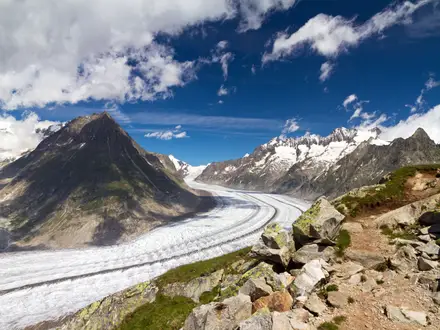
The Aletsch Glacier UNESCO Trail is an 11 km single-day mountain hike in the Aletsch Arena, Valais, Switzerland. It runs from Bettmerhorn to Fiescheralp inside the Jungfrau-Aletsch UNESCO World Natural Heritage site, with close views of the Great Aletsch Glacier. Rated moderate on Swiss T2 mountain terrain, it suits hikers who are sure-footed and fit for a descent-dominated alpine route. For a related lower panorama variant, see the Aletsch Glacier Panorama Trail.
Route Overview
This point-to-point route starts at Restaurant Bettmerhorn by the Bettmerhorn cable-car mountain station, reached by gondola from Bettmeralp, and finishes at Fiescheralp for the cable-car link down to Fiesch. From 2647 m, the trail descends via stone steps into Rote Chumma, crosses the Grosses Gufer active rock glacier, then continues towards Märjelensee beside the glacier. The final section uses either the old Tällistollen tunnel or the alternative ridge route over Tälligrat before reaching Fiescheralp. It is a compact glacier-view hike rather than a hut-to-hut trek; for another Swiss glacier day hike, compare the Diavolezza Glacier Trail, or for a much longer Swiss crossing see the Alpine Pass Route (Route 6).
Glacier history and UNESCO status
Local alpine communities long used the valleys below the ice for grazing and seasonal life. Märjelensee became well known in the 19th century for dramatic ice floes and occasional sudden glacial-lake outbursts that flooded the Rhône valley, prompting early scientific interest in the glacier. Alpine tourism opened the high terraces around Riederalp and Bettmeralp from the late 1800s. In 2001, Jungfrau-Aletsch was inscribed as a UNESCO World Heritage Site, and the retreating glacier is now closely monitored.
Notable highlights
- Great Aletsch Glacier: Europe’s longest and the Alps’ largest glacier, roughly 23 km long. The trail stays high on its flank, giving sustained views of the ice river.
- Bettmerhorn viewpoint (2647 m): The start station has a panoramic terrace and glacier exhibition, with views towards the Aletschhorn, Eiger, Mönch and Jungfrau.
- Grosses Gufer rock glacier: An active rock glacier — a slow-moving mixture of rock and ice — crossed early on the route, making the geology feel unusually close underfoot.
- Märjelensee: A glacial lake at about 2300 m beside the glacier. It is a natural mid-route rest point and was historically known for ice floes.
- Jungfrau-Aletsch UNESCO World Heritage site: Inscribed in 2001 as the first natural World Heritage Site in the Alps, recognised for its glacier landscapes, geology and climate-change significance.
Challenges to expect
Expect rocky and dirt mountain paths, stone steps, and a broad track partly cut into the rock face above the glacier. The route is technically moderate but endurance-demanding, with about 430 m ascent and about 865 m descent. Snow can linger or return early outside the June to October season. Cable-car timings matter because both the Bettmerhorn access and Fiescheralp descent rely on lifts.
HikeList Score
Aletsch Glacier UNESCO Trail scored 80/100 on HikeList's trail-quality metrics.
See score breakdownHide breakdown
- Ideal length 55
- Balanced challenge 100
- Scenery & wildness 98
- Varied terrain 64
- Accommodation 66
- Food & support 81
- Path quality 98
- Season flexibility 76
Computed from length, challenge, scenery & wildness, terrain variety, accommodation, food & support, path quality and season flexibility.
 Switzerland
Show more data Show less
- Mountainous
- Alpine
- Rocky
- Dirt
- Huts
- Hotels
- Family Friendly
- Restrooms
- Water Sources
- Shelters
Photos from hikers
Taken on the trail by people who've reviewed Aletsch Glacier UNESCO Trail.
Start at Restaurant Bettmerhorn by the cable-car mountain station, descend through Rote Chumma, cross the Grosses Gufer active rock glacier and continue to Märjelensee. Finish via the Tällistollen tunnel or the Tälligrat ridge option to Fiescheralp, where the cable car links down to Fiesch.
Reviews
How would you rate Aletsch Glacier UNESCO Trail?
Tap a star to start your review — you could be the first.