GR 57 (Ourthe Valley Trail)
How would you rate GR 57 (Ourthe Valley Trail)?
Tap a star to share your experience and help other hikers.
GR 57 (Ourthe Valley Trail): Ardennes River Walking to Luxembourg
HikeList Score
GR 57 (Ourthe Valley Trail) scored 91/100 on HikeList's trail-quality metrics.
See score breakdownHide breakdown
- Ideal length 92
- Balanced challenge 100
- Scenery & wildness 85
- Varied terrain 83
- Accommodation 92
- Food & support 88
- Path quality 98
- Season flexibility 89
Computed from length, challenge, scenery & wildness, terrain variety, accommodation, food & support, path quality and season flexibility.
The GR 57 is a 265 km point-to-point trail from Barchon near Liège in Belgium to Diekirch/Gilsdorf in Luxembourg. Allow 10–12 days. It is a moderate long-distance hike, best for fit walkers who want river valleys, Ardennes forest and regular but manageable climbs rather than high mountains. The route follows the Ourthe and Ourthe orientale, then becomes the Luxembourg Sentier du Nord. Expect red-and-white GR waymarks, dirt, gravel and rocky paths, with the best walking window from April to October.
Route Overview
The route starts at Barchon, linking with the GR 5, then passes Jupille-sur-Meuse, Liège, Angleur and Sart-Tilman before tracing the Ourthe valley through Esneux, Comblain-au-Pont, Hamoir, Bomal, Durbuy, Barvaux-sur-Ourthe, Hotton, Marcourt and La Roche-en-Ardenne. At the Nisramont dam, after roughly 140 km, the GR 57 divides; the eastern branch follows the Ourthe orientale via Houffalize, Gouvy and Troisvierges, then continues through Clervaux to Diekirch/Gilsdorf. Rail roughly parallels the walk from Liège to Hotton and again from Gouvy to Diekirch, making section hikes realistic. For other Walloon river routes, compare the GR 126 Semois and Meuse or the history-focused Battle of the Bulge Trail.
From the Sentier de l’Ourthe to the GR 57
The route began as the early-20th-century “sentier de l’Ourthe”, described in regional walking guides, and was officially designated a GR in 1966 by Belgium’s Sentiers de Grande Randonnée association. It was later extended north to Barchon, connecting it to the GR 5, when the Simenon youth hostel opened in Liège in 1996. The Ourthe valley itself has long been a corridor of settlement and defence, which helps explain the castles, towns and river crossings along the walk.
Notable highlights
- Liège: The northern gateway city on the Meuse, where the Ourthe joins the river. It is a major rail hub and a practical cultural starting point before the trail turns south into the valleys.
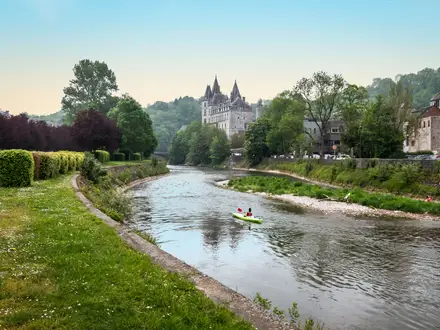
- Durbuy: A compact medieval town on the Ourthe, known for marketing itself as the “smallest city in the world”. Its stone old town makes it one of the most memorable stops on the middle route.
- Grottes de Hotton: Limestone show caves near Hotton, with an underground river and large galleries. They are a worthwhile off-trail-style pause if you are pacing the Ourthe valley section.
- La Roche-en-Ardenne: A classic mid-route halt below the ruins of a medieval castle. The town sits tight to the Ourthe and works well for accommodation and resupply.
- Parc naturel des Deux Ourthes: The protected upland park carrying much of the upper Ardennes section. This is where the route feels most wooded, remote and hilly around the Ourthe and Ourthe orientale.
- Clervaux: A Luxembourg town in the Oesling, set in a deep wooded valley below a castle and Benedictine abbey. It marks the late Sentier du Nord stages before Diekirch/Gilsdorf.
Challenges to expect
The GR 57 is not alpine, but it is not flat: total ascent is about 5,200 m, built from frequent steep climbs out of river gorges and descents back to the Ourthe. Paths can be rooty, rocky and slippery in wet weather, especially in forest. Waymarking is generally good, but a map or GPS is sensible in remoter wooded stretches. If you like Belgian long trails with mixed terrain, also see the Abbey Trail of Wallonia and the longer-distance GR 12.
HikeList Score
GR 57 (Ourthe Valley Trail) scored 91/100 on HikeList's trail-quality metrics.
See score breakdownHide breakdown
- Ideal length 92
- Balanced challenge 100
- Scenery & wildness 85
- Varied terrain 83
- Accommodation 92
- Food & support 88
- Path quality 98
- Season flexibility 89
Computed from length, challenge, scenery & wildness, terrain variety, accommodation, food & support, path quality and season flexibility.
 Belgium
Show more data Show less
- Forest
- River Valley
- Hilly
- Dirt
- Gravel
- Rocky
- Hotels
- Hostels
- Campsites
- Wild Camping Spots
- Family Friendly
- Pet Friendly
- Restrooms
- Water Sources
- Campsites
- Picnic Areas
Download Our Full Guide to GR 57 (Ourthe Valley Trail) FREE!
Get our comprehensive guide to this hike for free. Save it for later reading or print out at home.
In these collections
Photos from hikers
Taken on the trail by people who've reviewed GR 57 (Ourthe Valley Trail).
GR 57 (Ourthe Valley Trail): The Complete Guide
The GR 57 is a long, green traverse of the Ourthe valley, running from Barchon near Liège through the Ardennes and on into northern Luxembourg. It suits walkers who want forests, river bends, castles, caves and quiet uplands rather than high mountains or technical terrain.
The route follows red-and-white GR waymarks south from the Meuse at Liège, then works steadily through Tilff, Esneux, Comblain-au-Pont, Durbuy, Hotton and La Roche-en-Ardenne. Beyond the Barrage de Nisramont it takes the eastern Ourthe orientale branch towards Houffalize, Gouvy and the Luxembourg border.
This is a practical point-to-point trek of about 265 km, normally walked in 10–12 days or divided into shorter weekend sections. Rail access is strong on parts of the Ourthe line, while the middle around La Roche-en-Ardenne and Houffalize needs more careful bus and accommodation planning.
The walking is moderate, but not effortless. Expect repeated steep climbs out of the valley, rooty and rocky forest paths, slippery mud after rain and roughly 5,150 m of cumulative ascent before the finish at Diekirch and Gilsdorf.
This guide covers stages, days, accommodation, food, transport, terrain and the common mistakes to avoid.
Stage-by-Stage Guide
The stages below follow the 14-day end-to-end itinerary from Barchon to Diekirch/Gilsdorf via the eastern Ourthe orientale branch. Distances are approximate: the GR 57 is a waymarked walking route, not a measured road itinerary, and GPS traces can vary with local diversions, accommodation detours and whether the Liège connection is included.
Stage 1: Barchon to Angleur (Liège) — approx. 18 km
This is the approach stage from the GR 5 link at Barchon into Liège, using the connecting section through Jupille-sur-Meuse before the GR 57 settles into its Ourthe valley character. It is a more urban and transitional day than the Ardennes stages that follow, with the route moving from the edge of Liège towards the Ourthe–Meuse confluence area and Angleur.
Underfoot, expect a mix of lanes, urban paths and easier tracks rather than remote forest walking. Navigation needs more attention than later rural sections because towns, crossings and built-up areas create more opportunities to miss a red-and-white GR flash.
Liège is the key place for food, water, banking and any last-minute gear or map needs. Accommodation is strongest in Liège itself, including the Auberge Simenon youth hostel, while Angleur is better treated as a practical staging point than a scenic overnight base unless accommodation has been arranged.
Public transport is excellent here. Liège-Guillemins is the main rail hub for the route, with frequent direct trains from Brussels, and Angleur sits within the Liège urban transport area. Timetables and any engineering works should be checked before travelling.
Stage 2: Angleur (Liège) to Esneux — approx. 16 km
From Angleur the walk begins to feel properly tied to the Ourthe, leaving the Liège urban fringe for the wooded valley south of the city. Tilff and Esneux are the main places on this stage and both are useful for section-hikers because the Ourthe railway line shadows this part of the route.
The terrain is still moderate, but the GR 57 starts to introduce the pattern that defines the trail: climbs above the river, balcony-like woodland sections, and descents back towards valley settlements. Paths can be muddy or slippery after rain, especially where roots and rock appear in shaded woodland.
Tilff and Esneux are the practical service points for food, water and accommodation on this day. Do not assume every café or shop will be open when arriving late or out of season; carry enough food and water to finish the stage comfortably.
SNCB Line 43 serves Tilff and Esneux, making this one of the easiest stages to shorten, skip or walk as a day section from Liège. The waymarking is generally straightforward, but take care at station approaches, road crossings and riverside junctions where local paths may overlap with the GR.
Stage 3: Esneux to Comblain-la-Tour — approx. 21 km
This is one of the first fully rewarding Ourthe valley stages, with the trail continuing south through a more enclosed Ardennes landscape. Comblain-au-Pont is the main landmark settlement, set where the Ourthe meets the Amblève and known for its limestone crags, karst scenery and caves.
Expect a varied day of woodland tracks, dirt paths, rocky sections and some lanes. The repeated ups and downs begin to add up: none of the climbs is alpine or technical, but the stage is long enough that wet roots, polished rock and mud can slow progress.
Comblain-au-Pont is the principal place to look for food and water before continuing to Comblain-la-Tour. Accommodation at or near the end should be arranged in advance if relying on a specific bed, especially outside the main holiday season.
Rail access remains good on this part of the route, with stations at Comblain and nearby Ourthe-line settlements. Check current SNCB services before using the train to reposition, as rural frequency can vary by time of day.
Stage 4: Comblain-la-Tour to Bomal-sur-Ourthe — approx. 21 km
The GR 57 continues along the middle Ourthe, passing through or near Hamoir before reaching Bomal-sur-Ourthe. The valley remains the organising feature of the day, with wooded slopes, river bends and small settlements giving a consistent rhythm.
Terrain is mixed and typically Ardennes: forest tracks, dirt paths, gravel and occasional lane sections. After rain, the shaded slopes above the river can be greasy, and descents deserve care if carrying a full pack.
Hamoir and Bomal-sur-Ourthe are the useful service points. Both sit on the Ourthe corridor, but opening hours should not be assumed; leave Comblain-la-Tour with enough food and water for several hours.
This is still a strong public-transport stage, with SNCB Line 43 serving Hamoir and Bomal. That makes Bomal a sensible stop for walkers breaking the GR into weekends, as well as a practical overnight point before the Durbuy and Wéris section.
Stage 5: Bomal-sur-Ourthe to Wéris / Durbuy — approx. 16 km
This shorter stage links the Ourthe valley with two of the route’s best-known cultural highlights: the megalithic area around Wéris and the medieval riverside town of Durbuy. The exact overnight choice matters here, as Wéris and Durbuy are not the same type of stop: Wéris is quieter, while Durbuy is the more obvious service and accommodation base.
The walking is moderate but not flat. Expect the usual Ardennes mix of wooded paths, lanes and valley approaches, with some climbs away from the river to reach higher ground around Wéris.
Wéris is known for its Neolithic dolmens and menhirs of Devonian pudding-stone, while Durbuy offers the more developed halt with cobbled streets, a castle setting and tourist services. For food, water and beds, Durbuy is generally the safer planning anchor; if staying in or near Wéris, accommodation and evening meals should be booked ahead.
Bomal has rail access at the start, but onward rail options become less continuous once the route pulls towards Durbuy and the more tourist-focused valley towns. Local bus options and any transfer back to the railway should be checked before travelling.
Stage 6: Wéris / Durbuy to Hotton — approx. 21 km
This stage leaves the Durbuy area and continues through the Ourthe valley via Barvaux-sur-Ourthe towards Hotton. It is a varied day combining tourist settlements, quieter valley walking and the gradual transition towards the more wooded Ardennes interior.
The path uses a mix of dirt, gravel, woodland and some lanes. The walking is still moderate, but the cumulative climbing and descending is more important than the headline distance suggests, particularly if the day starts away from the direct line of the GR.
Barvaux-sur-Ourthe is a useful intermediate place, while Hotton is one of the better-supplied towns on the route and a sensible overnight stop. The Grottes de Hotton are a notable nearby highlight, but visiting them adds time and should be planned around opening hours and the day’s walking schedule.
Food, water and accommodation are generally easier to manage in the Durbuy–Barvaux–Hotton corridor than on the upper-Ardennes stages. Even so, summer weekends and holiday periods can fill quickly, so beds in Hotton should be booked rather than left to chance.
Public transport is less simple than on the Liège–Bomal railway section. Buses and any rail connections from Barvaux or nearby points should be checked before travelling.
Stage 7: Hotton to Queue de Vache, near La Roche-en-Ardenne — approx. 20 km
From Hotton the GR 57 heads deeper into the Ardennes via the Marcourt area towards La Roche-en-Ardenne. This is a classic middle-route stage: wooded slopes, river bends and repeated changes of height rather than one major climb.
Paths are often forested and can be rooty or rocky. In wet weather this section can feel slower than its distance suggests, especially on descents back towards the Ourthe.
Marcourt is the main named place between Hotton and the La Roche area, but it should not be treated as a guaranteed full resupply point without checking current services. Carry lunch and enough water from Hotton unless a stop has been planned.
La Roche-en-Ardenne is the practical overnight base for most walkers, even if the stage endpoint is described as Queue de Vache nearby. It is a well-known Ardennes town with accommodation, food and visitor services, set beneath the ruins of its medieval feudal castle.
There is no railway through La Roche-en-Ardenne. Public transport in this middle section relies on TEC buses, so onward plans, rest-day transfers or section breaks should be checked carefully before travelling.
Stage 8: Queue de Vache / La Roche-en-Ardenne to Le Hérou, near Nadrin — approx. 23 km
This is one of the most important and demanding stages of the Belgian section. It runs from the La Roche area towards the Barrage de Nisramont, where the GR 57 divides, and then continues on the eastern branch towards Le Hérou and Nadrin.
The terrain is rugged by Ardennes standards, with forest paths, rocky ground and steep climbs and descents around the Ourthe. The distance is also one of the longer days in the itinerary, so an early start is sensible if staying away from the exact trail line.
The key navigation point is the Barrage de Nisramont. Here the GR 57 splits: the through-route to Luxembourg follows the eastern Ourthe orientale branch towards Houffalize, Gouvy and Troisvierges; the western branch heads towards the Ourthe occidentale and Libramont. Check the waymarks and map carefully at the split.
Le Hérou is a major highlight, with a long quartzite ridge above a dramatic Ourthe meander in the Parc naturel des Deux Ourthes. The setting is impressive, but the terrain can be slippery when damp and should not be rushed in poor conditions.
Food and accommodation are more limited than in La Roche or Hotton. Nadrin is the practical place to look near the end of the stage, but beds and meals should be booked ahead; do not arrive assuming there will be multiple options.
There is no railway here. Access depends on roads and TEC buses, and this should be checked before travelling.
Stage 9: Le Hérou / Nadrin to Houffalize — approx. 20 km
This stage follows the eastern continuation of the GR 57 into the quieter upper-Ardennes landscape. The route leaves the dramatic Ourthe meanders around Le Hérou and works towards Houffalize, one of the main towns on the Ourthe orientale branch.
Expect a quieter, more wooded day with fewer intermediate services. Paths are typically forest tracks, dirt and rocky woodland sections, with the same pattern of short, steep climbs and descents that makes the route more tiring than a flat 20 km walk.
Carry food and water from Nadrin or the previous overnight stop unless specific services have been checked. Houffalize is the main resupply and accommodation point at the end of the day and should be used to reset supplies before the higher, thinner section towards Gouvy.
Navigation is generally supported by red-and-white GR waymarking, but the upper-Ardennes forest network can contain many local tracks. A map or GPX is useful, especially in poor visibility or after forestry work.
There is no railway at Houffalize. TEC bus times and any connections back to railheads should be checked before travelling.
Stage 10: Houffalize to Gouvy — approx. 22 km
This is the highest and one of the most remote Belgian stages, climbing onto the upper-Ardennes plateau of the Ourthe orientale. The route passes through the Cetturu area before reaching Gouvy, near the Meuse/Rhine watershed.
The high point of the route is around 522 m on this plateau rather than on a distinct summit. The walking is not technical, but the stage is exposed to Ardennes weather in a way the lower river-valley sections are not, so wind, rain and cold conditions can make it feel more serious.
Underfoot, expect forest and plateau tracks with dirt, gravel and muddy stretches. In wet periods, progress can be slower across the higher ground, and waterproof footwear is useful.
Services are thinner between Houffalize and Gouvy. Leave Houffalize with enough food and water for the full stage unless a definite stop has been arranged.
Gouvy is a key logistical point because rail access returns here on the Liège–Gouvy/Luxembourg corridor. Accommodation should still be booked ahead, particularly if arriving late or walking outside the main summer period.
Stage 11: Gouvy to Troisvierges — approx. 19 km
This stage takes the GR 57 from the upper Belgian Ardennes towards Luxembourg, continuing through the quieter Ourthe orientale country before reaching Troisvierges. The character is more plateau and forest than gorge and meander.
The walking remains moderate, with no technical ground, but the path can be muddy, rooty and slippery in poor weather. The stage is shorter than the previous day, yet still deserves a full hillwalking day’s food and water if services have not been checked.
Gouvy and Troisvierges are the main logistical anchors. Both are useful for rail-based planning, with Gouvy on the Belgian side and Troisvierges near the Luxembourg section.
At or near the border, ensure maps, GPX files and any guidebook pages cover both the Belgian GR 57 and the Luxembourg Sentier du Nord continuation. Waymarking remains the main navigation aid, but cross-border route naming can confuse walkers who are expecting only one label.
Public transport improves again here, with rail options at Gouvy and Troisvierges. Luxembourg public transport is free, but current timetables should still be checked before travelling.
Stage 12: Troisvierges to Drauffelt / Clervaux — approx. 21 km
From Troisvierges the route continues into the Luxembourg Oesling on the Sentier du Nord. The landscape is still wooded and hilly, but the villages, public transport system and trail context change as the GR 57 moves fully into Luxembourg.
Expect forested valley walking, tracks and paths with steady ups and downs rather than high mountain terrain. Mud and slippery roots remain possible after rain, especially in shaded woodland.
Clervaux is the main highlight and service centre on this stage. It sits in a deep wooded valley below its white castle, which houses the UNESCO-listed The Family of Man photography exhibition, and near the Benedictine Abbey of St-Maurice.
Food, water and accommodation planning should focus on Clervaux rather than assuming full services at smaller intermediate places such as Drauffelt. Beds in the Luxembourg stages are thinner than in the main tourist towns of the Ourthe valley, so book ahead.
CFL trains and buses serve Clervaux, and Luxembourg public transport is free. This makes Clervaux a strong section break, rest stop or access point for walkers joining only the Sentier du Nord section.
Stage 13: Drauffelt / Clervaux to Goebelsmühle — approx. 20 km
This is a quieter Oesling stage through wooded valleys and small settlements, with Kautenbach the key named place before Goebelsmühle. The walking is typical of northern Luxembourg: not high, but repeatedly folded by valleys and forested slopes.
The path is likely to feel more remote than the distance suggests if accommodation or food has not been planned. Carry enough water and lunch from Clervaux unless a definite stop has been checked on the route.
Terrain remains a mix of woodland paths, dirt tracks, gravel and occasional lanes. After rain, the same cautions apply as in the Ardennes: roots, rock and mud can make descents slippery.
Kautenbach is an important public-transport point in this part of Luxembourg, with CFL trains and buses serving the area. Goebelsmühle is the stage endpoint in this itinerary, but accommodation availability should be checked before committing to the day’s finish.
Navigation is generally manageable with the waymarks, but the Luxembourg trail network is dense in places. Keep an eye on the specific GR 57 / Sentier du Nord continuation rather than following local circular routes away from the line.
Stage 14: Goebelsmühle to Diekirch / Gilsdorf — approx. 21 km
The final stage continues through the Luxembourg Oesling towards the Sûre valley, passing near Bourscheid and Lipperscheid before descending to Diekirch. The GR 57 / Sentier du Nord finishes at Diekirch and continues on to the Gilsdorf bridge area, where it reconnects with the international GR 5.
The terrain remains hilly to the end, so do not treat the final day as a flat walk-in. Expect forest paths, lanes, valley descents and the usual mix of dirt, gravel and potentially slippery woodland ground.
Bourscheid is a notable area on the line of travel, while Diekirch is the clear practical finish with food, accommodation and onward transport. If continuing to Gilsdorf for the GR 5 connection, allow time and energy for the final continuation beyond the town centre.
Food and water should be carried from the start of the day unless intermediate services have been checked. Diekirch is the place to rely on for end-of-route meals, accommodation and onward travel arrangements.
CFL trains and buses serve Diekirch, and public transport in Luxembourg is free. Check current timetables before booking onward connections, particularly if finishing late in the day or walking on a public holiday.
Recommended Itinerary
Standard itinerary: 14 walking days
This is the most practical schedule for walkers who want manageable day lengths without turning the GR 57 into a forced march. It follows the eastern Ourthe orientale branch from the Barrage de Nisramont towards Houffalize, Gouvy and Luxembourg; do not accidentally take the western Ourthe occidentale branch towards Libramont.
Distances are approximate and should be checked against the current SGR topo-guide or mapping before accommodation is fixed, especially where the overnight stop is listed as a nearby settlement rather than directly on the path.
| Day | From | To | Approx. distance | Why this stage makes sense | Services/accommodation notes |
|---|---|---|---|---|---|
| 1 | Barchon | Angleur (Liège) | 18 km | A logical opening day from the GR 5 link at Barchon into the Liège area, using the connecting section before the trail settles into the Ourthe valley. | Liège is the best serviced place at the start, with rail links via Liège-Guillemins and hostel/hotel options including the Simenon youth hostel. Angleur keeps the next day short and close to the valley. |
| 2 | Angleur (Liège) | Esneux | 16 km | A shorter day helps ease into the route and gives time to leave the urban edge behind for the Ourthe valley. | Rail access is strong on this section, with SNCB Line 43 serving the Ourthe corridor, including Tilff and Esneux. Esneux is a sensible first valley stop. |
| 3 | Esneux | Comblain-la-Tour | 21 km | The stage continues through the accessible lower Ourthe, with repeated river-valley walking and good transport fallbacks. | Comblain-au-Pont and Comblain-la-Tour sit on the Ourthe line corridor. Accommodation and services should still be easier here than in the later Ardennes stages. |
| 4 | Comblain-la-Tour | Bomal-sur-Ourthe | 21 km | A steady valley stage linking the Comblain and Hamoir/Bomal area, keeping to a conventional GR day length. | Hamoir and Bomal-sur-Ourthe are on the railway. This is a useful section-hiking access point or bailout area. |
| 5 | Bomal-sur-Ourthe | Wéris / Durbuy | 16 km | A deliberately shorter day, allowing time for the Wéris megalithic area or Durbuy rather than rushing through one of the more visited parts of the route. | Durbuy and the Barvaux-sur-Ourthe area are among the better supplied tourist stops. If staying in Wéris rather than Durbuy, check the exact route link and accommodation position before booking. |
| 6 | Wéris / Durbuy | Hotton | 21 km | This keeps the route moving south through the middle Ourthe while using Hotton as a practical overnight point. | Hotton is one of the better supplied valley towns, with accommodation options more likely than in smaller hamlets. The Grottes de Hotton are nearby if building in extra time. |
| 7 | Hotton | Queue de Vache, near La Roche-en-Ardenne | 20 km | A natural approach to the La Roche-en-Ardenne area without overextending the day. | Do not assume full services at Queue de Vache itself. Most walkers should plan accommodation in or around La Roche-en-Ardenne and check the exact distance from the GR before booking. |
| 8 | Queue de Vache, near La Roche-en-Ardenne | Le Hérou (Nadrin) | 23 km | One of the longer and more committing Ardennes days, taking in the wilder Ourthe scenery around Nisramont and Le Hérou. | This is part of the train-free middle section. Accommodation should be booked ahead around Nadrin or nearby. At the Barrage de Nisramont, keep to the eastern branch for Houffalize and Gouvy. |
| 9 | Le Hérou (Nadrin) | Houffalize | 20 km | A practical continuation through the upper-Ardennes terrain to a recognised town stop. | Houffalize has no railway, so onward changes depend on TEC buses or pre-arranged logistics. Check current bus times before travelling. |
| 10 | Houffalize | Gouvy | 22 km | A substantial day across the higher Ourthe orientale country, reaching the railway again at Gouvy. | Beds are thinner in the quieter upper Ardennes, so book ahead. Gouvy is an important logistics point because the railway returns here. |
| 11 | Gouvy | Troisvierges | 19 km | A manageable border-area stage from the Belgian upper Ardennes towards the Luxembourg Sentier du Nord. | Gouvy and Troisvierges both help with transport planning. From the Luxembourg side, public transport is generally free, but current arrangements should be checked before travelling. |
| 12 | Troisvierges | Drauffelt / Clervaux | 21 km | A solid first Luxembourg stage through the Oesling, finishing near one of the key towns on the Sentier du Nord section. | Clervaux is the more substantial accommodation and transport base. If using Drauffelt or a nearby stop, check the exact accommodation location against the trail. |
| 13 | Drauffelt / Clervaux | Goebelsmühle | 20 km | Keeps the Luxembourg section in even, achievable stages through wooded valley country. | Public transport in Luxembourg makes logistics easier than in the Belgian middle section, but rural accommodation should still be reserved rather than left to chance. |
| 14 | Goebelsmühle | Diekirch | 21 km | A final full walking day to the Sûre at Diekirch, where the GR 57 / Sentier du Nord reconnects with the GR 5. | Diekirch is the practical finish, with onward public transport. The route continues to the Gilsdorf bridge, so check whether accommodation and transport plans finish in Diekirch or after the final link to Gilsdorf. |
Slower variant: 15–16+ days
A slower schedule suits walkers who want time for Liège, Durbuy, La Roche-en-Ardenne, Le Hérou, Clervaux or the Hotton caves, or anyone carrying camping gear through wet Ardennes conditions. It also makes sense if accommodation availability forces shorter days.
The easiest places to add time are the better-served towns: Liège at the start, Durbuy/Barvaux-sur-Ourthe, Hotton, La Roche-en-Ardenne, Houffalize, Gouvy, Clervaux and Diekirch. Splitting the more remote stages around Le Hérou, Houffalize and the upper Ourthe can be very worthwhile, but intermediate beds are not guaranteed; check official mapping and accommodation before booking.
This variant is also the best fit for section-hikers using the railway-supported lower valley stages, especially around Tilff, Esneux, Comblain, Hamoir and Bomal, then returning later for the train-free middle section.
Faster variant: 10–12 days
A 10–12 day crossing is realistic only for fit walkers who are comfortable with longer Ardennes days, repeated steep climbs and limited flexibility where accommodation is sparse. It usually means combining some of the shorter standard stages and keeping sightseeing stops brief.
The lower Ourthe section has the best scope for compression because rail access is good and services are more frequent. The middle section around La Roche-en-Ardenne, Nisramont, Le Hérou and Houffalize is less forgiving: there is no railway, buses are thinner, and accommodation choices can dictate the day length.
For a fast itinerary, book the remote nights first, then shape the easier rail-served days around them. Do not rely on being able to improvise beds in the upper Ardennes or on the Luxembourg Sentier du Nord stages during busy periods.
Planning the Route
How many days to allow
Most walkers should plan on 10–14 walking days, with 12 days a sensible target for a fit hiker who wants steady progress without turning every day into a race. The official stage pattern is closer to 15 stages of roughly 16–23 km, which suits walkers who prefer shorter days, more time in towns such as Durbuy, La Roche-en-Ardenne and Clervaux, or a lower daily load in wet conditions.
A fast 10-day schedule is possible for strong walkers, but it gives little margin for the repeated valley climbs, slippery forest paths after rain, or the transport complications in the train-free middle section. The route is not technically difficult, but the cumulative ascent and constant up-and-down profile make it more tiring than the map distance can suggest.
For accommodation planning, do not rely too tightly on a single headline distance. The HikeList route is listed at about 265 km, while full eastern-branch traces are often closer to around 279 km, depending on the exact start, finish and mapping source. Stage bookings should be based on the current SGR topo-guide, a current GPX track and the exact overnight stops chosen.
Choosing a pace
The GR 57 is better planned around available towns, accommodation and transport links than around equal daily mileage. The Ourthe valley gives several natural halts early on — Tilff, Esneux, Comblain, Hamoir, Bomal-sur-Ourthe, Durbuy and Hotton — but the upper Ardennes and Luxembourg sections become quieter and need more deliberate booking.
A moderate itinerary keeps most days in the 16–23 km range. This fits the terrain well: short, steep climbs out of the valley, rooty woodland paths and rocky viewpoints slow progress, especially with a full pack.
Slower walkers can split the route into the official-style shorter stages and use the better-served valley towns for rest or half-days. Faster walkers should still be cautious between La Roche-en-Ardenne, Houffalize, Gouvy and the Luxembourg border, where accommodation and transport are thinner than in the lower Ourthe valley.
The key route decision: Nisramont
The most important navigation and planning choice is at the Barrage de Nisramont, after roughly 140 km. Here the GR 57 divides into two branches:
| Branch | Direction | Planning note |
|---|---|---|
| Eastern Ourthe orientale branch | Via Houffalize, Gouvy and Troisvierges into Luxembourg | This is the through-route for the HikeList GR 57 to Diekirch / Gilsdorf. |
| Western Ourthe occidentale branch | Towards Libramont | This is part of the wider GR 57 network, but not the point-to-point route to Diekirch. |
Make this decision before booking the second half of the walk. The full waymarked GR 57 network, including both branches, is much longer than the through-route to Diekirch, so guidebook, GPX and accommodation plans must all match the eastern branch if the aim is to finish in Luxembourg.
Natural overnight areas
The route is easiest to organise where it passes through established river towns. The first half has frequent settlement and good rail access, so stages can be adjusted more flexibly.
Typical overnight planning points include:
| Section | Practical planning character |
|---|---|
| Barchon / Liège to Esneux | Strongest transport access, with Liège-Guillemins as the main rail hub and the trail reaching the Ourthe valley south of the city. |
| Esneux to Bomal-sur-Ourthe | Good valley walking with several settlements and rail access on SNCB Line 43. Useful for short stages or weekend sections. |
| Bomal-sur-Ourthe to Hotton | More tourist infrastructure around Durbuy, Barvaux-sur-Ourthe and Hotton, but still worth booking ahead in busy periods. |
| Hotton to La Roche-en-Ardenne / Nadrin | More committing Ardennes walking, with longer, hillier days and fewer easy escape options. |
| Nisramont to Houffalize and Gouvy | The upper-Ardennes section is quieter and higher; accommodation should be arranged before setting out. |
| Troisvierges to Diekirch / Gilsdorf | Luxembourg Sentier du Nord stages through the Oesling, with useful public transport at places such as Troisvierges, Clervaux, Kautenbach and Diekirch. |
In the tourist towns — especially Durbuy, Hotton and La Roche-en-Ardenne — beds are generally easier to find than on the wooded upper-Ardennes stages. Even so, popular weekends and holiday periods can fill accommodation, so end-to-end walkers should book key nights before committing to travel.
Accommodation strategy
A mixed accommodation plan works well: hotels, guesthouses, chambres d'hôtes, gîtes, youth hostels and campsites are all part of the route’s practical infrastructure. Liège has urban accommodation, including the Auberge Simenon youth hostel, while the Ourthe valley has many campsites and guest accommodation.
The main risk is not the first half of the trail but the quieter high sections around the Ourthe orientale and the Luxembourg Sentier du Nord. Do not assume that every village has a bed, evening meal or campsite within easy walking distance of the GR.
If camping, plan around established campsites rather than treating the route as a wild-camping itinerary. Campsite opening periods, reservation rules and local camping restrictions should be checked before travelling.
Food and water planning
Food planning is straightforward in the larger valley towns but becomes more important after La Roche-en-Ardenne and around the upper Ardennes. Carry enough food for the day, plus a reserve snack, when walking the quieter stages through forest and plateau country.
Do not plan on frequent shops in the smaller villages unless this has been checked against the current stage plan. Evening meals should also be considered when booking accommodation, particularly where the overnight stop is outside a larger town.
For water, start each day full and refill in towns or at accommodation. The route follows rivers for much of its length, but river water should not be treated as a routine drinking source without proper treatment.
Transport and shortening the route
The GR 57 is very practical for section hiking in its northern and southern parts. Liège-Guillemins is the main approach hub, with frequent direct trains from Brussels, and SNCB Line 43 follows much of the early Ourthe valley with stations including Tilff, Esneux, Comblain, Hamoir and Bomal.
This makes the first half especially suitable for weekend sections, short breaks or flexible bail-out plans. Rail access also returns near the upper sections at Gouvy and Troisvierges.
The middle of the route around La Roche-en-Ardenne and Houffalize has no railway and relies on TEC buses. This is the section where daily plans should be most conservative and current bus times should be checked before travelling.
In Luxembourg, public transport is free, and CFL trains and buses serve places including Clervaux, Kautenbach and Diekirch. This makes the final Sentier du Nord stages easier to adjust than the remote middle of the Belgian Ardennes.
Navigation and mapping
The route is waymarked with red-and-white GR flashes and maintained by Les Sentiers de Grande Randonnée. Waymarking is a major strength of the walk, but it is not a substitute for carrying proper route information, particularly at junctions, diversions and the Nisramont branch split.
Use the current official SGR topo-guide for GR 57 — Vallée de l'Ourthe et Sentier du Nord, supported by a current GPX track or suitable Belgian and Luxembourg mapping. The topo-guide edition, price and any route updates should be checked before travelling.
Take extra care where the route leaves the river for wooded climbs or high balcony paths. In poor visibility or after forestry work, waymarks can be easier to miss than on open valley tracks.
Weather and seasonal planning
The practical walking season is spring, summer and autumn. Summer gives the longest daylight and the easiest logistics, but accommodation in the well-known towns can be busier.
Spring and autumn are good walking seasons, but rain has a direct effect on the route. Roots, limestone, rock steps, mud and steep forest paths can become slippery, so daily distances should be planned with enough time in hand.
This is not an alpine route, but the upper-Ardennes plateau near Gouvy reaches about 522 m and can feel noticeably more exposed and remote than the lower Ourthe valley. Carry layers appropriate for a full day outside, even when the day starts in a sheltered river town.
What matters most when planning
The main planning priorities are:
- Choose the eastern branch at Nisramont if walking through to Luxembourg and Diekirch.
- Book accommodation ahead for the upper Ardennes and Luxembourg stages, where options are thinner.
- Use rail access strategically on the Ourthe valley stages, but do not expect the same flexibility around La Roche-en-Ardenne and Houffalize.
- Carry reliable navigation, including the current SGR topo-guide or GPX, not just the painted waymarks.
- Allow time for wet, slippery ground, especially on steep wooded climbs and descents.
- Check current train and bus timetables before travelling, particularly SNCB Line 43, TEC buses in the middle section and Luxembourg connections for the final stages.
Towns, Villages and Overnight Stops
Accommodation planning on the GR 57 is easiest in the Ourthe valley towns and hardest on the quieter upper-Ardennes and Luxembourg stages. Liège, Durbuy, Hotton and La Roche-en-Ardenne are the most useful full-service stops, while smaller villages can work well only if accommodation is booked in advance.
Many walkers combine hotels, chambres d’hôtes, gîtes, gîtes d’étape, youth hostels and campsites. Along the Ourthe there are many campsites and regular valley settlements; after Nisramont, Houffalize and Gouvy, services thin out and food planning becomes more important.
| Section | Overnight planning notes |
|---|---|
| Barchon to Liège / Angleur | Best treated as an approach into Liège, with the city as the practical overnight base. |
| Liège to Bomal-sur-Ourthe | Strong rail backup on SNCB Line 43, with useful stops at Tilff, Esneux, Comblain, Hamoir and Bomal. Good for section-hiking. |
| Bomal-sur-Ourthe to Hotton | More tourist-oriented, with Durbuy, Barvaux-sur-Ourthe and Hotton among the easier places to plan nights. |
| Hotton to La Roche-en-Ardenne / Nadrin | Good hiking country but transport becomes less rail-based; La Roche-en-Ardenne is the key stop. |
| Nisramont to Gouvy | Quieter upper-Ardennes stages via the eastern branch through Houffalize and Gouvy. Book beds ahead. |
| Gouvy to Diekirch / Gilsdorf | Luxembourg Sentier du Nord stages, with free public transport in Luxembourg and useful towns at Troisvierges, Clervaux, Kautenbach and Diekirch. Accommodation should still be planned ahead. |
Barchon
Barchon is the northern start point, near Liège, where the GR 57 links with the GR 5. It is mainly a practical trailhead rather than the best place to spend a first night.
Most walkers will find Liège more useful for accommodation, food and onward transport. If starting directly from Barchon, check local bus or taxi options before travelling.
Jupille-sur-Meuse
Jupille-sur-Meuse sits on the connecting section between Barchon and Liège. It is useful mainly as part of the approach into the city rather than as a major overnight halt.
Plan to carry what is needed for the day from Liège or from the start. Local services and transport details should be checked before travelling.
Liège
Liège is the main northern gateway for the route and the most practical place to begin if travelling by public transport. Liège-Guillemins is a major rail hub, with frequent direct trains from Brussels taking about an hour.
For accommodation, Liège has the widest choice at the start of the hike, including the Auberge Simenon youth hostel. It is also the obvious place to buy food, gas where available, maps and any missing kit before heading into the Ourthe valley.
Liège is worth considering for the night before the walk even if the official start at Barchon is being used. It gives the best transport flexibility and removes the risk of beginning a long first day after a late arrival.
Angleur
Angleur sits at the Liège end of the first listed stage and is where the route begins to feel more closely tied to the Ourthe valley. It can work as a practical stage end for walkers who want to clear the urban approach before starting the valley stages.
For most services, Liège remains the stronger base. Transport and accommodation options around Angleur should be checked before travelling.
Tilff
Tilff is one of the first useful Ourthe valley settlements south of Liège and has a station on SNCB Line 43. This makes it a convenient access point for short sections, late starts or bail-outs in poor weather.
It is not necessarily a required overnight stop on a through-hike, as Angleur to Esneux is a manageable stage in the standard schedule. Food and accommodation details should be checked before travelling if planning to stop here.
Esneux
Esneux is a strong early overnight stop, usually reached from Angleur in the second stage. It has rail access on the Ourthe line, making it one of the easiest places on the GR 57 for section-hikers.
The village is useful because it keeps early stage lengths sensible while still staying on the river corridor. Book accommodation ahead at busy times, and avoid assuming that every small valley settlement will have late-opening food options.
Comblain-au-Pont
Comblain-au-Pont lies at the Ourthe–Amblève confluence, in a notable limestone and karst section of the valley. The GR 57 passes through this area before continuing towards Comblain-la-Tour.
It has rail access via the Comblain area on SNCB Line 43 and is a useful place for joining or leaving the trail. If using it as an overnight stop rather than continuing to Comblain-la-Tour, accommodation availability should be checked before travelling.
Comblain-la-Tour
Comblain-la-Tour is a standard overnight point in the stage schedule, reached from Esneux after a longer valley day. It works well for keeping the next stage to Bomal-sur-Ourthe at a practical length.
Expect a smaller settlement feel than Liège or the main tourist towns. Carry food if arriving late, and book accommodation ahead rather than relying on turning up.
Hamoir
Hamoir is another useful Ourthe valley settlement with a station on SNCB Line 43. It is especially helpful for section-hiking because it gives rail access between Comblain-la-Tour and Bomal-sur-Ourthe.
It can be used to shorten or reshape the Comblain-la-Tour to Bomal stage. Accommodation, food and timetable details should be checked before travelling.
Bomal-sur-Ourthe
Bomal-sur-Ourthe is a key practical stop before the route turns towards Wéris and Durbuy. It has a station on SNCB Line 43, which makes it one of the best places to pause, restart or split the early half of the walk.
It is a sensible overnight point in the standard itinerary and has better planning value than many smaller villages because of its transport link. From here, the next section heads into a more tourist-oriented area around Wéris, Durbuy and Barvaux-sur-Ourthe.
Wéris
Wéris sits near the route between Bomal-sur-Ourthe and Durbuy and is known for its megalithic landscape of dolmens and menhirs. It is a good reason to slow the pace on this part of the walk, especially for hikers interested in the cultural side of the Ardennes.
As an overnight stop, Wéris is more of a booked-ahead village option than a guaranteed full-service base. If staying here, confirm accommodation and evening food before committing to the stage plan.
Durbuy
Durbuy is one of the best-known towns on the route and one of the easier places to arrange an overnight stay. Its tourist infrastructure makes it useful for hotels, guesthouses and meals, particularly compared with the smaller villages before and after it.
It also gives walkers a good recovery stop after the early Ourthe valley stages. Because it is a popular destination, accommodation should be booked ahead in busy periods rather than left to arrival.
Barvaux-sur-Ourthe
Barvaux-sur-Ourthe sits close to Durbuy and is another useful service point in this part of the valley. It can help if accommodation in Durbuy is full or if the day’s distance needs adjusting.
Treat Durbuy and Barvaux-sur-Ourthe as a combined planning area. Exact food, shop and transport options should be checked before travelling.
Hotton
Hotton is a major practical stop on the GR 57 and one of the best-supplied valley towns. It works well as an overnight halt between Durbuy/Barvaux-sur-Ourthe and the La Roche-en-Ardenne section.
The town is also close to the Grottes de Hotton, one of the notable highlights of the route. For through-walkers, its main value is logistical: a good place to restock, eat properly and start the next stage with confirmed accommodation ahead.
Marcourt
Marcourt lies between Hotton and La Roche-en-Ardenne on a quieter stretch of the Ourthe valley. It may be useful for adjusting stage lengths, but it is not one of the major guaranteed service centres on the route.
If planning to stop here, accommodation and food should be arranged in advance. Otherwise, most walkers will aim for La Roche-en-Ardenne as the more practical overnight base.
La Roche-en-Ardenne
La Roche-en-Ardenne is the key mid-route town and one of the most important overnight stops on the whole GR 57. It sits in a loop of the Ourthe below the ruins of its medieval castle and has the level of visitor infrastructure that makes it practical for a longer rest, laundry planning and food resupply.
This is also where transport planning changes. The middle stretch around La Roche-en-Ardenne and Houffalize has no railway and relies on TEC buses, so check current timetables before building a section hike around this area.
La Roche-en-Ardenne is a good place to book a secure bed before tackling the wilder upper Ourthe sections. It is also a sensible fallback if the previous day has been slowed by wet, slippery forest paths.
Nisramont
Nisramont is logistically important because of the Barrage de Nisramont, where the GR 57 divides. The through-route described here follows the eastern Ourthe orientale branch towards Houffalize, Gouvy and Luxembourg; the western Ourthe occidentale branch heads towards Libramont.
Do not treat Nisramont as a casual decision point without checking the onward route. Make sure the accommodation plan, maps and GPX all match the eastern branch if walking to Diekirch.
Overnight options around this area are thinner than in the main tourist towns. Book ahead and carry enough food for the next stage if there is any doubt.
Nadrin / Le Hérou
Nadrin is the practical village name to know for the Le Hérou area, where the route passes one of the most dramatic Ourthe meanders and quartzite ridges. This is a highlight section but not a place to improvise accommodation late in the day.
The standard stage schedule uses Le Hérou / Nadrin as an overnight area between La Roche-en-Ardenne and Houffalize. Confirm exactly where the accommodation is in relation to the trail, as small detours can matter at the end of a 20 km-plus Ardennes day.
Houffalize
Houffalize is the main town on the eastern Ourthe branch after Nisramont and is an important overnight and resupply stop. It sits on the upper-Ardennes section where the walking becomes quieter and more remote.
There is no railway in this middle section, so onward or exit transport depends on TEC buses. Timetables should be checked before travelling, especially at weekends or outside peak periods.
For through-hikers, Houffalize is one of the best places to reset before the climb towards the higher Ourthe orientale plateau and Gouvy. Book accommodation ahead, as the route options become less flexible here than in the lower valley.
Cetturu
Cetturu is a small upper-Ardennes place on the Houffalize to Gouvy stage. This section reaches the high plateau country near the Meuse/Rhine watershed and is more exposed to planning errors than the rail-served lower valley.
Do not rely on Cetturu for full services unless these have been arranged in advance. Carry food and water appropriate for the day, and keep Gouvy as the main planned stop.
Gouvy
Gouvy is a crucial stop near the end of the Belgian section and has rail access on the Liège–Gouvy/Luxembourg line. It is the best practical base after the Houffalize stage and before crossing towards Troisvierges.
The surrounding country is among the higher and quieter parts of the route, so accommodation should be booked ahead. Gouvy is also a useful point for section-hikers because it reconnects the route with the railway after the train-free middle stages.
Troisvierges
Troisvierges is the first major Luxembourg-side planning point after Gouvy and is served by rail. It is a logical overnight stop or restart point for the Sentier du Nord section.
Public transport in Luxembourg is free, which makes this part of the walk easier to section-hike than the Belgian middle section. Still, do not assume that accommodation is as plentiful as in Durbuy, Hotton or La Roche-en-Ardenne; book ahead.
Clervaux
Clervaux is one of the most useful Luxembourg towns on the GR 57 / Sentier du Nord. It lies in a deep wooded valley below its castle and abbey, and it is served by Luxembourg public transport.
For hikers, Clervaux is a strong overnight choice because it combines transport access with a proper town stop. It is also a good place to break the longer Luxembourg stages if not following the standard schedule exactly.
Kautenbach
Kautenbach is another important Luxembourg route point, served by CFL trains and buses. It is useful for both through-walkers and section-hikers because it gives a clear public transport access point between Clervaux and Diekirch.
Accommodation and food options should be checked before travelling. If beds are limited, plan alternatives nearby rather than assuming availability at the end of the day.
Goebelsmühle
Goebelsmühle is a standard stage end before the final approach to Diekirch. It is a practical place to split the Luxembourg section, but it should be treated as a booked-ahead stop rather than a large service town.
Check accommodation and meal arrangements before setting out from Clervaux or Kautenbach. This is especially important if walking outside the main holiday season.
Bourscheid
Bourscheid lies near the Luxembourg route between Goebelsmühle and Diekirch. It is more useful as a route landmark and possible accommodation area than as a guaranteed full-service trail town.
If using Bourscheid to adjust stage lengths, confirm the exact location of the accommodation in relation to the GR 57. The terrain in this part of the Oesling can make off-route detours feel longer than they look on a map.
Lipperscheid
Lipperscheid comes before the final descent towards Diekirch in the last part of the route. It can be useful in stage planning, but it is not the main finish base.
Most walkers will continue to Diekirch for the night because it has stronger transport and service value. Any plan to stop at Lipperscheid should be booked and checked in advance.
Diekirch
Diekirch is the main finish town on the Sûre and the most practical place to end the hike. It is served by Luxembourg public transport, which is free, making onward travel straightforward compared with the Belgian bus-dependent middle section.
As a riverside town and the point where the GR 57 / Sentier du Nord reconnects with the international GR 5, Diekirch is the natural place for a final overnight stay. It is also the best place to build in flexibility if the final Luxembourg stage takes longer than expected.
Gilsdorf
Gilsdorf lies just beyond Diekirch at the bridge where the route connection continues. It matters mainly for walkers completing the full signed line rather than stopping at Diekirch town centre.
For accommodation, food and transport, Diekirch is the practical base. If finishing specifically at Gilsdorf, check the onward walking or transport back to Diekirch before travelling.
Getting to the Start
By train
The practical rail gateway for the GR 57 is Liège-Guillemins, a major Belgian station with frequent direct trains from Brussels taking about 1 hour. From Liège, the route’s opening section runs out through Jupille-sur-Meuse towards the official start at Barchon, where the GR 57 links with the GR 5.
Barchon is the formal northern start, but Liège is the easier place to reach by public transport and to use as a pre-walk base. Walkers who want to complete the full signed route should allow for the Barchon–Jupille-sur-Meuse–Liège connecting section rather than simply beginning in the city centre.
For section hikers or anyone joining after the opening day, SNCB Line 43, the Ourthe line, is useful: it serves places such as Angleur, Tilff, Esneux, Comblain, Hamoir and Bomal, which the early GR 57 either passes through or comes close to. Current SNCB times should be checked before travelling, especially at weekends and on public holidays.
By bus
Local bus access around Liège, Jupille-sur-Meuse and Barchon is the usual public-transport solution for reaching the official start if you do not want to walk out from Liège. Services are operated within the Walloon public transport network, and times, routes and stop locations should be checked before travelling.
If the bus timing does not work with a long first day, a taxi from Liège to Barchon is the simplest fallback. This is also a sensible option for early starts, late arrivals or groups splitting the fare.
By car
Barchon can be reached by road, but driving to the start is not the most convenient option for an end-to-end walk that finishes in Diekirch / Gilsdorf in Luxembourg. Unless someone is collecting the vehicle, you will need to return from Luxembourg to the Liège area by public transport at the end of the hike.
Long-stay parking at or near the start should not be assumed. If driving, arrange parking with accommodation in the Liège area or use a formal long-stay car park where available. This should be checked before travelling.
From the nearest airport
For international arrivals, the simplest planning principle is to reach Brussels or Liège by rail, then continue to Liège-Guillemins. From there, use local bus, taxi or the GR 57’s connecting section to reach Barchon.
Airport-to-rail links and late-evening connections can change, so do not plan a same-day arrival and full first stage without checking current timetables. If arriving late, staying in Liège before starting is the more reliable option.
Where to stay before starting
Liège is the most practical pre-walk base because it has the main railway station, the best onward transport options and more accommodation than Barchon. The city also has the Auberge Simenon youth hostel, which is a useful budget option before starting the route.
Starting from Liège also makes it easier to buy food, fuel where available, and any last-minute supplies before heading into the Ourthe valley. If staying closer to Barchon, check transport and evening food options in advance, as the official start is less convenient than the Liège rail hub.
Getting Home from the Finish
By train
Diekirch is the practical exit point at the southern end of the GR 57 / Sentier du Nord. The route finishes in Diekirch and continues on to the Gilsdorf bridge, but Diekirch is the place to aim for if you want public transport immediately after finishing.
CFL trains serve Diekirch, and Luxembourg public transport is free. Use the CFL journey planner for live connections, especially if you need to reach an onward international train the same day.
For returning towards Belgium, plan the journey through the Luxembourg and Belgian rail networks rather than assuming a direct link. The GR 57 corridor has useful rail access at Troisvierges and Gouvy, with SNCB Line 43 continuing north towards the Ourthe valley and Liège, but connections and timings should be checked before travelling.
If finishing late after the Goebelsmühle–Diekirch stage, avoid building a tight onward connection into the plan. The final day is still a full walking stage, and a missed train can be awkward if onward accommodation or international tickets are fixed.
By bus
CFL buses also serve Diekirch, and they are part of Luxembourg’s free public transport system. Buses can be useful for short local movements around the finish, particularly if ending at the Gilsdorf bridge rather than stopping in Diekirch itself.
Do not assume evening or weekend bus timings will suit a late finish. Check current CFL bus and train times before committing to a same-day departure.
By car/taxi
The GR 57 is a point-to-point route, so leaving a car at Barchon or Liège and retrieving it from Diekirch involves a cross-border public-transport return. For most walkers, using public transport at both ends is simpler than arranging a car shuttle.
A taxi is best treated as a local fallback rather than the main plan: useful for reaching accommodation, returning from the Gilsdorf bridge to Diekirch, or dealing with a late finish. Pre-booking is sensible if arrival is likely to be in the evening.
From the nearest airport
No airport sits on the route itself. From Diekirch, airport transfers require an onward CFL train or bus connection into the wider Luxembourg or Belgian transport network.
The best airport will depend on your onward destination and ticket prices, so check live public-transport links before booking flights. Build in extra time if connecting from a long final walking day to an evening flight.
Where to stay at the finish
Diekirch is the sensible overnight stop at the end of the GR 57. Staying there removes the pressure of catching a same-day connection after the final stage and gives more flexibility if weather, fatigue or navigation delays slow the day down.
Accommodation on the Luxembourg Sentier du Nord stages is generally thinner than in the busier Ourthe valley towns, so the final night should be booked ahead rather than left to chance. This is particularly important if walking in a fixed 10–12 day schedule or arriving at weekends.
Which Direction Should You Walk?
The practical default is to walk the GR 57 southbound: Barchon / Liège to Diekirch / Gilsdorf, via the eastern Ourthe orientale branch through Houffalize, Gouvy and Troisvierges. This matches the route’s natural storyline, following the Ourthe valley out of the Liège area, into the Ardennes, over the Belgian–Luxembourg border and on to the Sûre.
The route can be walked in either direction. The red-and-white GR waymarking is not dependent on a single direction, but the planning flow is generally easier southbound.
Southbound: Barchon / Liège to Diekirch
Southbound is the better direction for most end-to-end walkers. Liège-Guillemins is the strongest transport gateway on the route, with frequent direct trains from Brussels, so starting via Liège is straightforward. The Barchon start links with the GR 5, and the connecting section through Jupille-sur-Meuse brings you into Liège before the trail settles into the Ourthe valley.
The accommodation pattern also works well this way. The early and middle Ourthe valley has regular towns and villages such as Tilff, Esneux, Comblain-au-Pont, Hamoir, Bomal-sur-Ourthe, Durbuy, Hotton and La Roche-en-Ardenne, giving more flexibility while you settle into the route. The quieter upper-Ardennes and Luxembourg stages come later, when daily rhythm, food planning and booking discipline are usually better established.
Scenically, southbound gives a strong progression. The walk starts near the Meuse and the Liège urban fringe, then tightens into wooded Ourthe valleys, limestone crags, meander viewpoints, castles and Ardennes forest. After the Barrage de Nisramont, the eastern branch climbs into the more remote Ourthe orientale country before crossing into Luxembourg’s Éislek and finishing at Diekirch on the Sûre.
The finish is also more satisfying. Diekirch / Gilsdorf is a clear end point where the GR 57 / Sentier du Nord reconnects with the international GR 5, and Luxembourg’s free public transport makes onward travel from the final stages convenient. Current Luxembourg train and bus times should still be checked before travelling.
Northbound: Diekirch to Barchon / Liège
Walking northbound is perfectly viable, especially if transport to Luxembourg is more convenient for a particular trip. Diekirch, Kautenbach, Clervaux and Troisvierges are served by Luxembourg public transport, and Luxembourg public transport is free, which can make the start logistically simple.
The main drawback is that northbound front-loads some of the quieter accommodation sections. The Luxembourg Sentier du Nord and upper-Ardennes stages around Gouvy, Houffalize and the Ourthe orientale have thinner services than the busier Ourthe valley towns, so beds and food stops need to be fixed early. This is less forgiving if travel delays affect the first day.
Northbound also gives a less natural scenic build. You begin with some of the wilder high-plateau and Oesling walking, then descend towards the more populated Ourthe valley and eventually the Liège area. For many walkers, finishing near a major city or at Barchon feels less conclusive than ending on the Sûre at Diekirch.
Are the climbs easier one way?
There is no major directional advantage. The difficulty of the GR 57 comes from repeated short, steep climbs out of the Ourthe valleys and descents back to the river, often on rocky, rooty or muddy forest paths. Those climbs and descents are frequent in both directions.
Southbound does involve a broad transition from the low Meuse / Ourthe area towards the higher Ardennes plateau near Gouvy, but the route is not a single sustained climb. Northbound simply reverses the same pattern: more early descent from the higher country, but with the same repeated valley work.
In wet weather, direction matters less than footing. Steep forest paths, roots and rock can be slippery either uphill or downhill, so daily pace should be set for conditions rather than for compass direction.
Recommendation
Walk the GR 57 southbound from Barchon / Liège to Diekirch unless there is a specific transport or accommodation reason to do otherwise. It gives the best logistical flow, the clearest scenic progression, easier early flexibility and the strongest psychological finish on the Sûre in Luxembourg.
Accommodation Along the Route
The GR 57 works well as an inn-to-inn walk, but it is not evenly supplied from end to end. The easiest accommodation planning is in Liège and the tourist Ourthe valley towns, especially Durbuy, Hotton and La Roche-en-Ardenne. These places have the broadest mix of hotels, guesthouses, gîtes and campsites, and they make the most forgiving overnight stops.
Smaller villages on the lower Ourthe, such as Esneux, Comblain-la-Tour, Hamoir and Bomal-sur-Ourthe, are useful stage breaks, but choice is more limited. The high upper-Ardennes section after Nisramont, through Nadrin / Le Hérou, Houffalize and Gouvy, needs more care: accommodation is thinner, distances between practical bases feel more consequential, and public transport is less useful than in the railway-served lower valley.
In Luxembourg, the Sentier du Nord stages through Troisvierges, Clervaux, Kautenbach, Goebelsmühle and Diekirch are also quieter. Beds should be booked ahead rather than left to chance, especially if walking fixed stages with no spare time for bus or train adjustments.
Best Overnight Bases
Liège is the strongest starting base, with city accommodation and the Auberge Simenon youth hostel. Many walkers overnight in Liège or Angleur rather than trying to treat Barchon as a full accommodation hub.
Durbuy, Hotton and La Roche-en-Ardenne are the most useful mid-route bases. They are also popular visitor towns, so weekends, holidays and summer dates can book out earlier than the map might suggest.
Houffalize and Gouvy are important strategic stops on the eastern Ourthe branch. Do not assume the same level of choice as in the lower valley; these nights should normally be fixed before reaching the Nisramont split.
Booking Strategy
For a full through-hike, book the first few nights, the La Roche-en-Ardenne / Nadrin / Houffalize section, and the Luxembourg stages before setting off. More flexibility is possible on the lower Ourthe because SNCB Line 43 shadows parts of the route, with stations at places including Tilff, Esneux, Comblain, Hamoir and Bomal.
The middle section around La Roche-en-Ardenne and Houffalize has no railway, so a failed accommodation plan is harder to solve at the end of a walking day. TEC buses may help in places, but current times should be checked before travelling.
Camping is a realistic style on parts of the route because there are many campsites along the Ourthe, but it is not a complete solution for every stage unless each stop has been planned. Campsite opening dates, hiker pitches and check-in arrangements should be checked before travelling.
Luggage Transfers and Taxi Workarounds
Do not assume a seamless route-wide luggage-transfer service unless it has been arranged in advance. Some walkers may be able to solve awkward gaps by using local taxis, accommodation pick-ups or public transport, but this depends on the place and date.
Taxi transfers are most useful where the official walking stage ends near a small settlement rather than a strong accommodation base. In the lower valley, the railway gives more fallback options; in the La Roche-en-Ardenne, Houffalize and upper-Ardennes sections, transfers need arranging before the walking day begins.
Accommodation Planning Table
| Place | Accommodation level | Best for | Notes |
|---|---|---|---|
| Barchon | Limited | Trail start logistics | The GR 57 starts here where it links with the GR 5, but most walkers will find Liège a more practical overnight base. |
| Liège / Angleur | Good | Pre-start night, first night, transport hub | Strongest start-area choice, with city accommodation and the Auberge Simenon youth hostel. Liège-Guillemins is the main rail hub. |
| Tilff / Esneux | Limited | Early Ourthe valley stages | Useful for short first sections and section-hiking. Rail access on SNCB Line 43 gives flexibility. |
| Comblain-au-Pont / Comblain-la-Tour | Limited | Lower Ourthe stage break | Practical small-valley stops, but book rather than assuming late availability. Rail access helps if accommodation is full. |
| Hamoir / Bomal-sur-Ourthe | Limited | Staging before Wéris and Durbuy | Useful rail-served stops on the lower valley approach to the tourist section. |
| Wéris / Durbuy / Barvaux-sur-Ourthe | Good | Comfortable overnight, rest stop, sightseeing | One of the strongest accommodation areas on the walk. Durbuy is popular, so weekends and holiday periods need early booking. |
| Hotton | Good | Mid-route overnight | A well-supplied Ourthe valley stop and a sensible place to reset food, laundry or stage plans. |
| Marcourt / La Roche-en-Ardenne | Good | Major mid-route base | La Roche-en-Ardenne is one of the best places to secure a bed before the quieter upper Ourthe stages. Book ahead in busy periods. |
| Barrage de Nisramont | None | Route decision point | Treat the dam as the eastern/western branch split, not as an overnight base. The through-route follows the eastern branch towards Houffalize and Gouvy. |
| Nadrin / Le Hérou | Limited | Wild upper Ourthe scenery | Accommodation should be arranged before arrival. This is not a good area for improvising at the end of the day. |
| Houffalize | Limited | Strategic upper-Ardennes stop | Important overnight before the high Ourthe orientale section. There is no railway here, so accommodation and onward transport plans matter. |
| Cetturu / Gouvy | Limited | High plateau stage, rail reconnection | Gouvy is the more practical planning point, with rail access. Book before walking the Houffalize–Gouvy section. |
| Troisvierges | Limited | Belgium–Luxembourg transition | Useful for the cross-border stage and public transport connections. Availability should be checked before committing to fixed dates. |
| Clervaux | Limited | Luxembourg overnight stop | A natural Sentier du Nord base, but still part of the thinner Luxembourg accommodation pattern. Book ahead. |
| Kautenbach / Goebelsmühle | Limited | Sentier du Nord staging | Small transport-linked stops where public transport may help if accommodation is unavailable. Current train and bus times should be checked before travelling. |
| Lipperscheid / Bourscheid area | Limited | Penultimate-stage planning | Do not rely on finding a spontaneous bed. Consider a pre-arranged transfer if your chosen accommodation is off-route. |
| Diekirch / Gilsdorf | Limited | Finish night, onward travel | Sensible place to book a final night before travelling on or joining the GR 5. Luxembourg public transport is free, but current connections should still be checked. |
Camping and Wild Camping
Camping can work well on the GR 57, especially through the Ourthe valley, but it needs more planning than a hut-to-hut or hotel-based itinerary. The route passes many campsites along the Ourthe and through well-supplied valley towns such as Durbuy, Hotton and La Roche-en-Ardenne, but the upper Ardennes and the Luxembourg Sentier du Nord stages are quieter and have thinner overnight options.
Do not assume that every official stage ends beside a campsite. Some days may need to be shortened, lengthened or linked with a bus or train connection, particularly around the train-free middle section near La Roche-en-Ardenne and Houffalize, and on the quieter stages after Gouvy towards Luxembourg.
Where camping is most practical
The easiest camping logistics are on the lower and middle Ourthe, where the trail repeatedly returns to river settlements and tourist areas. The stretch through Tilff, Esneux, Comblain-au-Pont, Hamoir, Bomal-sur-Ourthe, Durbuy, Hotton and La Roche-en-Ardenne is the most natural part of the route for a tent-based walk.
After the Barrage de Nisramont, the eastern branch towards Houffalize, Gouvy and Troisvierges becomes more remote in feel. Campsites and other low-cost options should be checked and booked ahead where possible, especially if walking in the main holiday season or relying on a small number of possible overnight stops.
In Luxembourg, the Sentier du Nord stages through Troisvierges, Clervaux, Kautenbach, Goebelsmühle and Diekirch are still within settled valleys, but services are more spread out. Free public transport in Luxembourg can help with repositioning to accommodation if a campsite is not available at the ideal point on the route.
Wild camping and bivouacking
Wild camping should not be treated as the default plan on this route. The GR 57 passes through private woodland, working farmland, villages, tourist areas and protected landscapes, including the Parc naturel des Deux Ourthes around the wilder upper-Ourthe sections.
Rules and permissions for bivouacking can vary by landowner, commune and protected area. This should be checked before travelling. If there is any doubt, use an official campsite, gîte, hostel, hotel or guesthouse rather than pitching discreetly without permission.
A practical approach is to plan around formal campsites where they exist, then use public transport or a booked room to bridge the gaps. This is especially sensible around the upper Ardennes and Luxembourg stages, where the day lengths, woodland terrain and fewer services make an unplanned overnight stop more awkward.
Water and resupply for campers
The Ourthe is the defining feature of the walk, but river water should not be treated as a guaranteed drinking source. Plan to refill with potable water at accommodation, campsites, cafés, shops and villages, and carry enough between settlements.
The repeated climbs away from the river can make water management more important than the map suggests. On warm days, a stage may spend long stretches on wooded slopes or high balcony paths before dropping back to a village.
Food resupply is easiest in the larger valley towns and more limited on the quieter upper sections. Campers should avoid relying on a shop or restaurant at the end of every stage unless opening times have been checked.
Fires, impact and wet-weather considerations
Open fires are not appropriate on this route unless a campsite has a designated facility and explicitly allows it. Much of the walk is through forest, and dry periods, private land and protected areas make fire discipline essential.
Use a stove only where permitted, keep campsites compact, take all rubbish out and avoid damaging riverbanks, meadows or woodland edges. The GR 57 is a well-used long-distance trail through inhabited valleys, not a wilderness route where informal camping has no consequences.
A lightweight tent, reliable waterproofs and good ground protection are useful. The Ardennes forest paths can become muddy, rooty and slippery after rain, and low valley sites may feel damp even outside poor weather. Campsites may also be seasonal, so opening dates and reception arrangements should be checked before booking a tent-based itinerary.
Food, Water and Resupply
The GR 57 is not a wilderness trail, but it does pass through long wooded valley and plateau sections where food cannot be assumed between stage ends. Resupply is easiest in Liège and the main Ourthe valley towns, then becomes thinner around the upper Ardennes and the Luxembourg Sentier du Nord stages.
Plan each day around the named stage towns rather than expecting regular shops on the path. Cafés, brasseries, restaurants and small shops may exist in the larger villages and tourist towns, but opening days and seasonal hours vary, especially outside summer and on Sundays. This should be checked before travelling.
Food planning
Liège is the best place to start with a full resupply. The lower Ourthe valley through Tilff, Esneux, Comblain-au-Pont, Hamoir and Bomal-sur-Ourthe has the most forgiving logistics, helped by rail access and regular settlements.
Durbuy, Barvaux-sur-Ourthe, Hotton and La Roche-en-Ardenne are the key mid-route food stops. These tourist towns are much better places to eat and restock than the smaller hamlets between them, but cafés and restaurants can be busy in season and more limited outside peak periods.
From Nisramont, Le Hérou / Nadrin, Houffalize and Gouvy onwards, the route feels more remote. The high, wooded upper-Ardennes stages and the Luxembourg Oesling sections have fewer obvious resupply points, so carry at least a full day’s lunch and snacks whenever leaving a main town.
On a typical 16–23 km stage, most walkers should carry breakfast if accommodation does not provide it, a packed lunch, emergency snacks and food for the evening if staying somewhere without a guaranteed meal. If booking guesthouses, gîtes or small hotels in quieter places, ask in advance whether dinner is available or whether there is somewhere open nearby.
Water planning
The most reliable water is from accommodation, cafés, restaurants and public facilities in towns and villages. Refill whenever there is a clear opportunity, particularly before the forested climbs and plateau sections away from the Ourthe.
Although the route follows the Ourthe and later reaches the Sûre at Diekirch, river water should not be treated as automatically drinkable. If using water from the Ourthe, side streams or woodland sources, filter or treat it first. Agricultural land, settlements and livestock make untreated natural water a poor default choice.
For normal spring or autumn conditions, starting each stage with about 1.5–2 litres is usually sensible. In hot weather, or on the longer and quieter stages around La Roche-en-Ardenne, Le Hérou / Nadrin, Houffalize, Gouvy and the Luxembourg Oesling, carry more and do not wait until the bottle is nearly empty before looking for a refill.
Section-by-section resupply guide
| Section | Food availability | Water availability | Notes |
|---|---|---|---|
| Barchon – Liège – Angleur – Esneux | Best logistics of the route, with Liège as the main urban resupply point and further settlements along the lower Ourthe. | Easy to refill in urban areas, accommodation and cafés. | A good place to buy several days of trail snacks before the valley becomes more rural. |
| Esneux – Comblain-au-Pont – Comblain-la-Tour – Hamoir – Bomal-sur-Ourthe | Generally manageable, with regular valley villages and rail access nearby. | Refill in villages and at accommodation; do not rely on the river untreated. | Still carry lunch, as services may not fall conveniently at the right time of day. |
| Bomal-sur-Ourthe – Wéris / Durbuy – Barvaux-sur-Ourthe – Hotton | Good around the tourist towns, especially Durbuy, Barvaux-sur-Ourthe and Hotton. | Reliable in towns and lodging; limited on intervening rural paths. | Seasonal and Sunday opening hours matter here. This should be checked before travelling. |
| Hotton – Marcourt – La Roche-en-Ardenne – Nisramont – Le Hérou / Nadrin | Food is strongest at Hotton and La Roche-en-Ardenne, then more limited towards Nisramont and Le Hérou / Nadrin. | Fill fully before leaving the main towns; natural water needs treatment. | Treat this as a carry-a-full-day section, especially if staying away from La Roche-en-Ardenne. |
| Le Hérou / Nadrin – Houffalize – Cetturu – Gouvy | Limited between the main settlements; Houffalize and Gouvy are the key resupply points. | Refill at accommodation and in towns; fewer casual opportunities on the upper-Ardennes plateau. | Book accommodation and evening meals ahead where possible. Leave Houffalize with enough food for the day to Gouvy. |
| Gouvy – Troisvierges – Clervaux – Kautenbach – Goebelsmühle – Diekirch / Gilsdorf | Services are concentrated in the larger Luxembourg towns such as Troisvierges, Clervaux and Diekirch, with thinner options between valley settlements. | Refill in towns and accommodation; treat streams if used. | Luxembourg public transport is free, which can help with off-trail resupply if needed, but do not depend on spontaneous rural shop access without checking. |
Practical resupply strategy
The simplest approach is to carry one day of food at a time through the lower Ourthe valley, then increase the margin from La Roche-en-Ardenne onwards. From the upper Ourthe orientale to Gouvy and across the Luxembourg border, keep an emergency meal or substantial snacks in the pack in case a planned café, shop or restaurant is closed.
Do not assume that every village on the map has a shop, bakery or evening meal. Small rural businesses may close one or more days per week, may shut between lunch and late afternoon, and may operate seasonally. Accommodation hosts are often the safest source of local advice, but meal availability should be arranged before arrival rather than after a long walking day.
Terrain, Conditions and Difficulty in Practice
The GR 57 is best understood as a moderate long-distance walk made tiring by repetition rather than altitude. There is no alpine terrain and no technical climbing, but the route repeatedly leaves the Ourthe, climbs steeply onto wooded slopes or balcony paths, then drops back towards the river. Over 10–14 days, that pattern is the main physical challenge.
Total ascent is roughly 5,150 m, despite the high point being only about 522 m on the upper Ardennes plateau near Gouvy. The climbs are generally short by mountain standards, but many are steep enough to break rhythm, especially with a full pack or at the end of a 20 km day.
Underfoot: forest paths, rock, roots and lanes
Expect a mixed surface: dirt paths, gravel tracks, rocky woodland trails, some lanes and occasional greenways. The most characteristic walking is on forest and valley-side paths above the Ourthe, with roots, embedded stones and damp ground under tree cover.
The rocky sections are not technical, but they do require care in wet conditions. Smooth rock, exposed roots and mud can make descents slow, particularly on the steeper drops back to the river. Walking poles are useful for balance and for reducing strain on knees over repeated downhills.
Road walking is part of the route but not the defining feature. It is most noticeable around towns, villages and connecting sections, including the approach through the Liège area and the passages through places such as Durbuy, Hotton, La Roche-en-Ardenne, Houffalize, Gouvy, Clervaux and Diekirch. Most walkers will find the harder kilometres are the wooded climbs rather than the surfaced sections.
Climbs, descents and where the route feels hardest
The lower and middle Ourthe valley gives the trail much of its character: meanders, crags, viewpoints and repeated changes of level. Stages between Esneux, Comblain-au-Pont, Hamoir, Bomal-sur-Ourthe, Durbuy, Hotton and La Roche-en-Ardenne can feel more demanding than the map height figures suggest because the route keeps moving between riverside and hillside.
Around Nisramont, Le Hérou and Nadrin the terrain has a wilder Ardennes feel, with rocky ridges, wooded slopes and more committing valley walking. This is still hiking rather than scrambling, but it is the kind of ground where wet weather, tired legs and a heavy pack noticeably slow progress.
South of Houffalize towards Cetturu, Gouvy and the Luxembourg border, the route reaches quieter upper-Ardennes plateau country. The walking is not high mountain terrain, but it can feel more remote, with longer stretches of forest and fewer easy escape options than the railway-served lower Ourthe valley.
Mud, wet weather and slippery ground
Rain changes the difficulty more than altitude does. The route uses many shaded woodland paths, and these can stay greasy after rain. Mud, wet roots and slick stones are the main hazards; footwear with a reliable sole matters more here than heavy mountaineering boots.
The GR 57 is not primarily a bog walk, but muddy forest sections should be expected in spring and after prolonged wet weather. Descents deserve particular attention, as short steep drops on wet ground can be slower and more awkward than the climbs.
Autumn walking can be excellent, but fallen leaves may hide roots, stones and uneven ground. In summer, the generally firmer surfaces can make daily distances easier to cover, though the same steep ups and downs remain.
Exposure, technicality and navigation difficulty
There is no technical or alpine ground on the standard route. The rocky crags and meander viewpoints are part of the landscape rather than mountaineering obstacles, and the difficulty is mainly sure-footed walking on uneven surfaces.
The waymarking uses red-and-white GR flashes and the route is maintained as a Grande Randonnée. Even so, navigation should not be treated casually: forest junctions, village exits and the route division at the Barrage de Nisramont all deserve attention. At Nisramont, the through-route to Luxembourg follows the eastern Ourthe orientale branch towards Houffalize, Gouvy and Troisvierges; the western branch heads towards Libramont.
Fields, fences and obstacles
This is not primarily a stile-and-pasture route. The main obstacles are terrain-related: steep gradients, rough forest paths, roots, rock and mud. Any local gates, minor fences or rural access points should be treated as normal countryside infrastructure, but they are not the feature that defines the difficulty of the GR 57.
Practical difficulty by condition
| Condition | What it means on the GR 57 |
|---|---|
| Dry spring or summer weather | The route usually feels like a steady moderate walk, with the climbs and day length the main effort. |
| Recent or ongoing rain | Forest paths, roots and rocky descents become much slower and more slippery. Allow extra time. |
| Autumn leaf fall | Attractive conditions, but leaves can conceal uneven ground on wooded paths. |
| Long stages with a full pack | The repeated ascent and descent becomes cumulative, especially on 20 km-plus days. |
| Upper Ardennes and Luxembourg stages | Quieter, more wooded and less forgiving logistically than the lower valley; plan food, accommodation and bail-out options more carefully. |
For most fit walkers, the GR 57 is comfortably within moderate hiking difficulty, but it should not be underestimated as an easy riverside stroll. The route’s real test is maintaining pace over many consecutive days of short, steep climbs, slippery woodland descents and mixed surfaces while keeping enough time in hand for the longer stages.
Weather and Best Time to Walk
The GR 57 is best planned for spring, summer or autumn. It is a low-to-mid-level Ardennes route rather than an alpine trek, but the walking is very affected by wet ground: rooty forest paths, rocky descents and steep climbs in and out of the Ourthe valley become noticeably slower and more slippery after rain.
Best months in practice
Late spring to early autumn is the most practical window for an end-to-end walk. This gives the best balance of daylight, open accommodation and manageable underfoot conditions, especially for the longer 20 km-plus stages around La Roche-en-Ardenne, Nadrin, Houffalize, Gouvy and the Luxembourg Oesling.
Summer gives the longest days and easiest logistics, but the popular valley towns such as Durbuy, Hotton and La Roche-en-Ardenne are busier. Accommodation should be booked ahead, particularly if using guesthouses, gîtes or campsites in the tourist centres.
Spring and autumn suit walkers who prefer quieter trails and cooler walking conditions. Expect more mud in the woods, damp rock on the craggy Ourthe sections and shorter daylight for the longer stages. Autumn can be a strong choice for the forest sections, provided daily distances are planned conservatively.
Rain, mud and slippery forest paths
Rain is the main weather factor on this route. The GR 57 repeatedly drops from wooded ridges to the Ourthe and climbs back out again, often on dirt, rock and exposed roots. After wet weather, the descents need care and progress can be slower than the stage distances suggest.
Footwear with good grip is more important than lightweight speed on this trail. Trekking poles are useful on the steep, muddy descents and on the rocky sections above the Ourthe meanders, especially around the wilder upper-Ardennes stages.
Heat, shade and water planning
Much of the route is in woodland or valley terrain, so it is not an exposed high-mountain heat trap. Even so, summer heat can make the repeated climbs harder, especially when leaving the river for balcony paths, viewpoints and forest plateaux.
Do not rely on finding services at every small village. The valley towns are better supplied, but the upper-Ardennes and Luxembourg Sentier du Nord stages are quieter, so carry enough water and food between planned stops.
Wind, fog and navigation
The route is well waymarked with red-and-white GR flashes, but mist, low cloud or poor visibility can still make the higher wooded plateaux around the Ourthe orientale and the Luxembourg Oesling feel more remote. A map, GPX track or the current SGR topo-guide is useful as a backup, particularly where forestry tracks and small lanes intersect.
Wind is usually a comfort and exposure issue rather than a technical hazard, but conditions can feel more severe on the higher, open sections near Gouvy and across the Luxembourg stages than in the sheltered Ourthe valley.
Winter walking
The GR 57 is not primarily a winter route. There is no alpine ground, but short daylight, wet forest paths, cold conditions and possible ice or snow on the higher Ardennes and Oesling sections can make winter progress slow and less forgiving.
A winter section-hike near rail-served parts of the Ourthe valley may be feasible in settled weather, but a full through-walk is better kept to spring, summer or autumn. Accommodation opening periods, transport times and any local diversions should be checked before travelling.
Accommodation and seasonal availability
Accommodation is generally easier to arrange in the main valley towns, including Durbuy, Hotton and La Roche-en-Ardenne. In peak summer these places can fill quickly; outside the main season, some campsites and smaller lodgings may have limited opening.
The quieter upper-Ardennes and Luxembourg stages need more planning in any season. Book ahead around Houffalize, Gouvy, Troisvierges, Clervaux, Kautenbach and Goebelsmühle rather than assuming a bed will be available on arrival.
Safety Notes
The GR 57 is a moderate, non-technical long-distance trail, but it is still a serious multi-day walk through wooded valleys, rocky river slopes and quieter Ardennes plateau country. The main risks are slips on wet forest paths, tiredness from repeated short steep climbs, poor escape options in the train-free middle section, and choosing the wrong branch at the Barrage de Nisramont.
Emergency help
Use 112 for emergency services in both Belgium and Luxembourg. Be ready to give the nearest named place, such as Liège, Esneux, Hamoir, Durbuy, La Roche-en-Ardenne, Houffalize, Gouvy, Troisvierges, Clervaux, Kautenbach or Diekirch, plus any obvious landmark such as the Ourthe, the Barrage de Nisramont or Le Hérou.
Carry offline mapping and the official GR route information rather than relying only on mobile data. Mobile reception should not be assumed in wooded valleys, gorges or the quieter upper-Ardennes sections.
Slips, steep ground and wet paths
The route has no alpine or technical terrain, but many sections climb sharply out of the Ourthe valley and descend back to the river on rocky, rooty forest paths. These paths can be slippery in or after rain, especially where mud, leaf litter and exposed roots combine on shaded slopes.
Walking poles are useful for the steeper descents, particularly on tired legs late in the day. Waterproof footwear with good grip matters more here than lightweight town shoes, even though the trail also uses lanes, gravel tracks and easier greenways.
Take particular care on balcony paths, rocky viewpoints and craggy sections above the Ourthe, including the wilder upper-valley area around Le Hérou and Nadrin. Stay on the waymarked line and avoid stepping out onto wet rock for photographs.
Weather, heat and cold
The best walking seasons are spring, summer and autumn, but conditions can change quickly between sheltered river valleys and the higher Ardennes plateau. The route reaches about 522 m near Gouvy, which is not mountainous but can still feel exposed in wind, rain or poor visibility.
In summer, heat can be an issue on longer 20 km-plus stages, especially where climbs come late in the day. Start early, carry enough water between villages and do not assume every small settlement will have open services.
In spring and autumn, short days, wet leaves and colder mornings make timing more important. Plan to finish before dusk, especially on the remote middle and upper-Ardennes stages.
Rivers, dams and wet ground
The Ourthe is the defining feature of the trail, but the GR is a walking route, not a route that requires river crossings or wading. Do not shortcut across wet banks, river margins or unofficial crossing points.
Take extra care near the river after heavy rain and around the Barrage de Nisramont, where the route also divides. Follow the signed path and do not enter restricted dam or water-management areas.
Navigation and the Nisramont branch split
The GR 57 is waymarked with red-and-white GR flashes, maintained by Les Sentiers de Grande Randonnée / SGR. Even so, carry a map, GPX or the official topo-guide, as forest junctions and local paths can be confusing when tired or in poor weather.
The most important navigation decision is at the Barrage de Nisramont, where the GR 57 divides. The through-route to Luxembourg follows the eastern Ourthe orientale branch via Houffalize, Gouvy and Troisvierges; the western branch heads towards Libramont. Check the branch before leaving Nisramont.
Roads, lanes and settlements
Most of the route is on paths, tracks and forest ways, but it also uses lanes and passes through towns and villages. On road sections, walk facing traffic where there is no pavement, stay visible in poor light, and take care at village exits where traffic speeds up.
The Liège approach and larger valley towns involve more urban walking than the Ardennes stages. Keep navigation available through built-up areas, where GR flashes can be easier to miss among street signs and junctions.
Remote sections and solo hiking
The early Ourthe valley has strong rail access, but the middle section around La Roche-en-Ardenne and Houffalize has no railway and relies on TEC buses. Once committed to a long stage there, escape options are more limited than on the Liège–Gouvy rail corridor.
Solo walkers should leave a clear itinerary with someone else, including the planned overnight stop and any expected transport connection. This is especially important between La Roche-en-Ardenne, Le Hérou, Houffalize, Gouvy and the Luxembourg Sentier du Nord stages, where services and beds are thinner.
Daily safety checklist
Before setting off each day, check:
| Check | Why it matters on the GR 57 |
|---|---|
| Weather forecast | Wet roots, mud and rocky descents become the main hazard after rain. |
| Day length and stage time | Many stages are around 16–23 km with repeated climbs, so late starts can lead to tired walking near dusk. |
| Water and food | Services are not evenly spaced, especially in the upper Ardennes and Luxembourg stages. |
| Accommodation booking | Quieter areas have fewer beds, so do not rely on finding a room late in the day. |
| Transport options | Rail access is good in places, but the La Roche-en-Ardenne and Houffalize section has no railway. Current SNCB, TEC, CFL and bus times should be checked before travelling. |
| Route branch and diversions | At Nisramont, follow the eastern branch for Houffalize, Gouvy and Luxembourg. Current SGR waymarking and diversion notices should be checked before setting off. |
| Phone battery and offline maps | Signal and data should not be relied on continuously in wooded valleys and remote sections. |
Gear Recommendations
The GR 57 does not need alpine equipment, but it is harder on footwear and wet-weather kit than its modest height suggests. The repeated climbs out of the Ourthe valley, steep descents back to the river, rocky forest paths, exposed roots and muddy sections after rain make grip and stability more important than outright lightness.
Footwear
Choose footwear with a reliable tread for wet rock, mud and rooty woodland paths. Lightweight hiking boots or supportive trail shoes both work, but the sole should be more substantial than a road-running shoe.
Boots are the safer choice for walkers carrying a full pack, camping gear or walking in a wet spring or autumn spell. Fast section hikers with lighter loads may prefer trail shoes, provided they have good grip and drain or dry quickly.
Gaiters are useful rather than essential. They earn their place in wet woodland, on muddy Ourthe-side sections and on the higher Ardennes plateau near Gouvy, especially outside settled summer weather.
Waterproofs and Layers
A proper waterproof jacket should be carried on every stage. The route spends long periods in forest and valley terrain where wet vegetation, slippery paths and repeated climbs can make a damp day more tiring than the altitude suggests.
Waterproof trousers are recommended for end-to-end walkers and campers, particularly in spring and autumn. For short summer sections they can be replaced by quick-drying legwear, but only if the forecast is stable.
Carry a warm layer even in summer. The trail reaches the quieter upper-Ardennes plateau around Cetturu and Gouvy, and the Luxembourg Oesling stages can feel cooler than the lower Ourthe valley, especially early or late in the day.
Navigation
The GR 57 is waymarked with red-and-white GR flashes, but navigation should not rely on waymarks alone. Forest tracks, village exits and the route split at the Barrage de Nisramont are all places where a missed turn can cost time.
Carry the official SGR topo-guide or equivalent mapping, plus an offline GPX track on a phone or GPS device. Belgian IGN mapping and Luxembourg mapping cover the route; current map sources and GPX files should be checked before travelling.
Pay particular attention at Nisramont, where the GR 57 divides. The through-route to Luxembourg follows the eastern Ourthe orientale branch via Houffalize, Gouvy and Troisvierges, not the western branch towards Libramont.
Water and Food Carry
A normal day capacity is sufficient for most walkers, but do not start remote stages with only a small bottle. The Ourthe valley has regular towns and villages in the earlier part of the walk, while the upper-Ardennes and Luxembourg Sentier du Nord stages are quieter and have thinner services.
Carry enough water for a full stage whenever accommodation, shops or cafés are not certain. This is especially important around the more remote middle and upper sections near La Roche-en-Ardenne, Nadrin / Le Hérou, Houffalize, Gouvy and the Luxembourg Oesling.
Food carry can stay modest on stages linking larger valley towns such as Liège, Esneux, Hamoir, Bomal-sur-Ourthe, Durbuy, Hotton and La Roche-en-Ardenne. On quieter stages, carry lunch, snacks and an emergency reserve rather than assuming a shop or café will be open on route.
Trekking Poles
Trekking poles are strongly recommended for the GR 57. The cumulative ascent is built from many short, steep climbs and descents rather than one high pass, and poles reduce strain on knees during repeated drops to the river.
They are particularly useful on wet rock, leaf litter, mud and rooty forest paths. Campers carrying heavier packs will benefit most, but even inn-to-inn walkers may appreciate them on the Le Hérou, upper Ourthe and Oesling stages.
Camping Gear
Campers should keep the load disciplined. The trail is moderate rather than technical, but carrying a heavy pack over successive steep valley climbs will make the route feel significantly harder.
Use compact three-season camping gear suitable for wet ground and cool nights. A tent with a reliable flysheet, a sleeping bag appropriate to spring-to-autumn conditions and a sleeping mat with enough insulation are more relevant here than ultralight fair-weather kit.
There are many campsites along the Ourthe, but the quieter upper-Ardennes and Luxembourg stages need more planning. Use established campsites or booked camping options; any plan outside official sites should be checked before travelling.
Power and Electronics
Carry a power bank if using a phone for maps, GPX, accommodation bookings or transport checks. This is particularly important on the train-free middle section around La Roche-en-Ardenne and Houffalize, where bus connections and onward arrangements may need to be checked during the walk.
Offline maps are essential. Mobile coverage and battery life should not be treated as navigation systems by themselves, especially in wooded valleys and on long wet days.
Sun, Insects and Small Essentials
The GR 57 is often wooded, but sun protection is still needed for open plateau, lane and village sections. Sunglasses, sun cream and a cap are enough for most walkers in summer.
Insect repellent is sensible for warm, still days in river valleys and forest. A small first-aid kit should include blister care, as the mix of steep descents, damp socks and rocky ground can quickly punish poorly managed feet.
Best Set-Up by Hiker Type
| Hiker type | Recommended set-up |
|---|---|
| Inn-to-inn walkers | 25–35 litre pack, grippy trail shoes or lightweight boots, waterproof jacket, warm layer, day food, water for the full stage, topo-guide or offline GPX, power bank. |
| Campers | 45–60 litre pack kept as light as practical, supportive footwear, poles, waterproof jacket and trousers, compact three-season shelter and sleep system, stove and food where services are thin. |
| Fast or section hikers | Light day pack, grippy trail shoes, waterproof shell, warm layer, offline mapping, enough water and food for the planned section, plus transport information for the start and finish. |
Seasonal Additions
Spring often means wetter paths and more mud, so prioritise waterproofs, gaiters and footwear with strong grip. Autumn walkers should add a warmer mid-layer and be realistic about shorter daylight on 20 km-plus stages.
In settled summer weather, the pack can be lighter, but do not drop waterproof protection entirely. The route is still a long Ardennes valley walk, and wet forest descents can become slow and slippery even outside the colder months.
Budget and Costs
All costs on the GR 57 are in euros (€). The route is not an expensive high-mountain trek, but it is not a guaranteed low-cost backpacking route either: accommodation choice, meal planning and the train-free middle section around La Roche-en-Ardenne and Houffalize make the biggest difference.
Prices for hotels, campsites, public transport and attractions change seasonally, especially in tourist towns such as Durbuy, Hotton and La Roche-en-Ardenne. Current prices should be checked before booking.
Main cost items
| Cost item | What to budget for | Practical notes |
|---|---|---|
| Accommodation | Your largest daily cost | Options range from campsites and youth hostels to gîtes, guesthouses and hotels. Beds are easier to find in Liège, Durbuy, Hotton and La Roche-en-Ardenne than on the quieter upper-Ardennes and Luxembourg stages. |
| Food | Daily breakfasts, packed lunches, evening meals and snacks | Self-catering and picnic lunches keep costs down. Restaurant meals in the more touristy valley towns will raise the budget quickly. |
| Belgian rail and bus travel | Access to Barchon/Liège, section-hiking transfers and escapes | Liège-Guillemins is the main rail hub. SNCB Line 43 serves several Ourthe valley points, but the middle around La Roche-en-Ardenne and Houffalize has no railway and relies on TEC buses. |
| Luxembourg transport | Usually €0 on public transport | Public transport in Luxembourg is free, including CFL trains and buses serving places such as Clervaux, Kautenbach and Diekirch. Check current arrangements before travelling. |
| Taxis | Occasional contingency cost | Most useful where stages finish away from rail access, or if bus times do not work. Rural taxis should be booked ahead and priced before committing. |
| Camping | Pitch fees where campsites are used | There are many campsites along the Ourthe, but they are not evenly spaced along the full route. The upper-Ardennes and Luxembourg sections need more planning. |
| Maps / topo-guide | Official route guide and mapping | The official SGR topo-guide is commonly listed at around €23, but the current edition and price should be checked with grsentiers.be before ordering. |
| Attractions | Optional | Caves, castles and exhibitions along the route may add cost if visited. Opening times and prices should be checked locally. |
Budget approach
The lowest-cost way to walk the GR 57 is to combine camping, youth-hostel beds where available, supermarket food and public transport. This works best on the Ourthe valley sections with rail access and better services, especially between Liège and the lower valley towns.
Do not assume every stage has a cheap bed exactly where needed. The quieter upper-Ardennes stages towards Houffalize, Gouvy and the Luxembourg Sentier du Nord are where a budget plan can become awkward if campsites, hostels or inexpensive rooms do not line up with the day’s walking distance.
A budget walker should allow extra time to adjust stages around available accommodation rather than forcing expensive taxis or last-minute hotel rooms. Booking ahead is particularly important if travelling in summer or at weekends.
Mid-range approach
A mid-range plan usually means private rooms in guesthouses, gîtes or modest hotels, with a mix of picnic lunches and simple evening meals. This is the easiest style for most independent walkers because it reduces pack weight and avoids needing to align every night with a campsite.
The main risk is availability rather than complexity. Durbuy, Hotton and La Roche-en-Ardenne have more accommodation, but they are also popular; the high, wooded sections and smaller settlements have fewer beds. Book the thinner nights first, then build the rest of the itinerary around them.
Comfortable approach
A comfortable GR 57 budget uses hotels or better guesthouses, restaurant meals and occasional taxis to smooth awkward stage ends. This is most useful through the train-free middle of the route, where public transport choices are thinner and a poor connection can cost time.
Comfortable itineraries should still be booked carefully. The route is point-to-point, and the most convenient overnight stop is not always the place with the widest choice of accommodation.
Transport costs
The cheapest access strategy is usually to use rail to Liège-Guillemins, then local Belgian transport to the start area or to the relevant stage point. SNCB Line 43 is especially useful for section-hiking the Ourthe valley, with stations including Tilff, Esneux, Comblain, Hamoir, Bomal, Gouvy and Troisvierges.
The middle section around La Roche-en-Ardenne and Houffalize has no railway. TEC bus times should be checked before travelling, especially on weekends, public holidays or if planning a short section hike.
At the southern end, Luxembourg’s free public transport can reduce the cost of finishing logistics. CFL trains and buses serve places including Clervaux, Kautenbach and Diekirch, making the final Sentier du Nord stages easier to access without extra local transport cost.
Luggage transfer, guided and self-guided packages
No route-wide luggage-transfer system is an essential part of walking the GR 57 independently. If luggage transfer is needed, ask accommodation providers directly or use local taxi firms; availability and price should be checked before booking.
Guided or self-guided walking packages may exist for parts of the Ardennes or Luxembourg walking network, but the GR 57 is straightforward to organise independently using accommodation bookings, public transport and the official SGR topo-guide. Any package price should be compared against the cost of booking rooms and transport separately.
Luggage Transfer, Guided Tours and Support Services
Luggage transfer
Do not assume that the GR 57 has a standard end-to-end baggage-transfer network in the way some heavily marketed long-distance trails do. If walking Barchon to Diekirch with luggage support, each transfer should be arranged before the trip rather than improvised stage by stage.
The most practical approach is to book accommodation first, then ask each hotel, guesthouse, gîte or campsite whether it can move a bag to the next overnight stop, arrange a local taxi, or accept luggage delivered during the day. This matters most in the quieter upper-Ardennes and Luxembourg stages, where services are thinner than in Liège, Durbuy, Hotton or La Roche-en-Ardenne.
Transfers are likely to be simpler on the rail-served Ourthe valley sections between Liège, Tilff, Esneux, Comblain-au-Pont, Hamoir and Bomal-sur-Ourthe. They become more important — and harder to organise casually — around La Roche-en-Ardenne, Nadrin / Le Hérou, Houffalize and the higher Ourthe orientale section towards Gouvy.
For any luggage service, agree the following in writing before setting off:
- exact pick-up and delivery addresses, not just village names;
- latest bag drop-off time each morning;
- expected delivery time;
- maximum bag weight;
- whether the driver will cross the Belgium–Luxembourg border;
- what happens if accommodation reception is closed;
- payment method and cancellation terms.
Prices and availability vary by provider, season and distance between overnights. Current prices should be checked when booking.
Self-guided walking packages
A self-guided package can be useful on the GR 57 if you want accommodation booked in advance and help with luggage, especially through the quieter middle and upper sections. A typical package, where available, would normally include overnight bookings, route notes or GPX, baggage movement and local transfer advice.
Because the GR 57 is a fully waymarked Grande Randonnée rather than a single commercial holiday product, do not assume that a complete Barchon–Diekirch package is always available. This should be checked before travelling.
If using a walking-holiday company, make sure the itinerary follows the eastern branch from the Barrage de Nisramont via Houffalize, Gouvy and Troisvierges towards Luxembourg. The western Ourthe occidentale branch goes towards Libramont and is not the through-route described here.
A self-guided arrangement is most useful for walkers who:
- prefer fixed overnight bookings rather than arranging each stage independently;
- want to walk with a light day pack;
- are travelling in peak holiday periods when Durbuy, Hotton and La Roche-en-Ardenne can be busy;
- want help with the train-free middle around La Roche-en-Ardenne and Houffalize;
- are not comfortable managing French-language accommodation or taxi calls.
Independent walkers with a light kit and flexible dates may not need a package. The lower Ourthe valley has useful rail access, and Luxembourg’s public transport is free on the later Sentier du Nord stages.
Guided walking
The GR 57 is generally suited to independent walking: it is waymarked with red-and-white GR flashes, has no technical or alpine terrain, and passes through regular towns and villages. A guide is not normally necessary for navigation in good conditions if you carry the official topo-guide, maps or GPX and know how to use them.
Guided walking may still make sense for groups, less experienced walkers, or those who want natural-history, cultural or logistical support in the Ardennes and Luxembourg Oesling. Any guided arrangement should be booked well ahead, especially if it involves multi-day accommodation and vehicle support.
Before booking, clarify whether the guide covers the full route, a Belgian-only section, or selected day walks from bases such as Liège, Durbuy, La Roche-en-Ardenne, Houffalize, Clervaux or Diekirch. Dates, languages, group sizes and prices should be checked before booking.
Taxi and local transfer planning
Taxis are most useful for linking accommodation slightly off the trail, shortening a long stage, or dealing with the train-free middle of the route. They are particularly relevant around La Roche-en-Ardenne, Nadrin / Le Hérou and Houffalize, where rail fallback is limited.
In the lower valley, SNCB Line 43 offers a more reliable planning tool than ad hoc taxi transfers, with stations at places including Tilff, Esneux, Comblain, Hamoir and Bomal. Later, rail access returns around Gouvy and Troisvierges, and Luxembourg public transport can help with the final stages through Clervaux, Kautenbach, Goebelsmühle and Diekirch.
For taxi-supported walking, book the evening before at the latest in smaller villages, and earlier for morning starts, weekends or luggage moves. Give the driver the exact accommodation name, not only the GR stage endpoint, as several overnight options sit away from the path.
When support is unnecessary
Fit walkers carrying a modest pack can complete the GR 57 without formal support. The route’s main challenge is cumulative ascent and long, uneven forest walking rather than remote wilderness.
Support becomes more valuable if you are camping with heavier gear, walking shorter days than the standard stages, travelling in a busy holiday period, or trying to keep to fixed dates through the quieter upper-Ardennes and Luxembourg sections. For a fully supported trip, accommodation, luggage movement and any taxi links should be arranged as one connected itinerary before departure.
Shorter Hikes and Best Sections
The GR 57 is easy to break into shorter trips, especially on the northern Ourthe valley where SNCB Line 43 runs close to the route. The middle Ardennes section around La Roche-en-Ardenne, Nisramont and Houffalize is much less rail-accessible, so weekend and point-to-point plans there depend on TEC buses or pre-arranged transfers. This should be checked before travelling.
Best options at a glance
| Best for | Start → end | Approx. distance | Why choose it | Transport notes |
|---|---|---|---|---|
| Best day walk / first taste | Angleur (Liège) → Esneux | 16 km | A manageable first GR 57 stage into the Ourthe valley, with woodland paths, river scenery and no need to commit to the remoter Ardennes stages. | Liège-Guillemins is the main rail hub. Tilff and Esneux are on SNCB Line 43, giving practical access and an escape point. Exact access to the Angleur trail point should be checked before travelling. |
| Best public-transport weekend | Esneux → Bomal-sur-Ourthe | 42 km over 2 days | A strong two-day Ourthe valley section via Comblain-la-Tour and Hamoir, with classic river walking, limestone scenery around Comblain-au-Pont and convenient railheads. | Esneux, Comblain, Hamoir and Bomal are served by the Ourthe railway line, making this one of the easiest sections to walk without a car. |
| Best 3–5 day section | Bomal-sur-Ourthe → Le Hérou / Nadrin | 80 km over 4 days | A concentrated highlight stretch: Wéris, Durbuy, Hotton, La Roche-en-Ardenne, the Barrage de Nisramont area and the dramatic Le Hérou ridge. | Bomal has rail access on Line 43. The La Roche-en-Ardenne and Nadrin end of the section has no railway and relies on buses or transfers; check current TEC timetables before fixing accommodation. |
| Best scenery | Queue de Vache / La Roche-en-Ardenne → Houffalize | 43 km over 2 days | The wildest upper-Ardennes feel on the route, with steep Ourthe valley walking, the Nisramont area and Le Hérou above the river meanders. | No railway on this middle section. Plan buses carefully, or arrange a lift or taxi at one end. Accommodation should be booked ahead. |
| Best for villages and accommodation | Bomal-sur-Ourthe → Hotton | 37 km over 2 days | Shorter daily distances with several useful stops, including Wéris / Durbuy and Barvaux-sur-Ourthe, then onward to Hotton. Good if accommodation choice matters more than solitude. | Bomal is on the Ourthe railway line. Onward transport from Hotton should be checked before travelling. |
| Best camping-friendly short section | Bomal-sur-Ourthe → Hotton | 37 km over 2 days | The touristy Ourthe valley has more camping infrastructure than the quieter upper-Ardennes and Luxembourg stages, making this a practical short camping trip. | Start from Bomal by train. Check campsite opening dates and the onward bus options from Hotton before booking. |
Best day walk: Angleur to Esneux
The Angleur to Esneux stage is the most practical first sample of the GR 57: long enough to feel like a proper day, but short enough to suit walkers testing the terrain. It follows the route south from the Liège side into the Ourthe valley and introduces the pattern of woodland paths, river bends and short climbs that defines much of the trail.
This is also the best choice if the forecast is uncertain. Tilff and Esneux are on SNCB Line 43, so the day can be shortened or adjusted around train times. Expect ordinary Ardennes path conditions rather than a riverside promenade: roots, rock and mud can still make the route slippery after rain.
Best weekend section: Esneux to Bomal-sur-Ourthe
Esneux to Bomal-sur-Ourthe is the cleanest two-day GR 57 weekend because both ends, and several points in between, are on the railway. The route passes through a classic lower-Ourthe landscape of wooded valley sides, villages and river crossings, with Comblain-au-Pont nearby for limestone crags and the Ourthe–Amblève confluence.
The two official-style walking days are straightforward to plan: Esneux to Comblain-la-Tour, then Comblain-la-Tour to Bomal-sur-Ourthe. Hamoir is another useful rail-served point on the line, giving flexibility if accommodation availability or weather changes the plan.
Best 3–5 day section: Bomal-sur-Ourthe to Le Hérou / Nadrin
For a short trip that captures many of the route’s best-known sights, Bomal-sur-Ourthe to Le Hérou / Nadrin is the strongest choice. In four walking days it links Wéris, Durbuy, Hotton, La Roche-en-Ardenne, the Nisramont area and the Le Hérou ridge.
This is a more committing section than the rail-served lower valley. Bomal is easy to reach by train, but the finish near Nadrin has no railway, and buses in this middle Ardennes area need careful checking before travelling. Accommodation should also be booked ahead, especially around the popular Durbuy and La Roche-en-Ardenne areas.
Best section for scenery: La Roche-en-Ardenne to Houffalize via Le Hérou
The section from the La Roche-en-Ardenne area to Houffalize gives the most dramatic Ardennes walking on the GR 57. It includes the upper Ourthe landscape around Nisramont and Le Hérou, where steep wooded slopes, rock and river meanders make the trail feel wilder than the easier-access valley stages farther north.
This is not the simplest section logistically. There is no railway around La Roche-en-Ardenne or Houffalize, so transport normally depends on TEC buses, taxis, lifts or a two-car plan. It is worth doing for scenery, but not as the first choice for a low-admin weekend.
Best section for beginners
Beginners should start with Angleur to Esneux or another short rail-served section on the lower Ourthe rather than the remote middle stages. The walking is still genuine GR terrain, but the distances are moderate and the railway gives more room to adapt the day.
Avoid making La Roche-en-Ardenne, Nisramont or Houffalize the first GR 57 attempt unless transport and accommodation are already fixed. Those stages are not technical, but the repeated climbs, slippery forest paths and limited rail access make mistakes harder to absorb.
Best section for public transport
The most public-transport-friendly part of the GR 57 is the lower Ourthe valley between Liège, Tilff, Esneux, Comblain, Hamoir and Bomal-sur-Ourthe. SNCB Line 43 shadows this part of the trail, so it works well for single-day walks, weekend sections and flexible bad-weather plans.
For a longer public-transport trip, Angleur / Liège to Bomal-sur-Ourthe gives about 58 km over three walking days. This keeps the route mostly within the rail-served valley before the logistics become more dependent on buses.
Best section for villages, beds and food
Bomal-sur-Ourthe to Hotton is a good choice if accommodation and village services are a priority. It passes through or near some of the most visitor-oriented places on the route, including Wéris, Durbuy, Barvaux-sur-Ourthe and Hotton.
This section is particularly useful for walkers who want shorter days and more choice of rooms, gîtes or campsites. Bomal is rail-served; transport out of Hotton should be checked before travelling.
Best section for camping
Camping is most straightforward on the Ourthe valley sections where campsites are more common, especially around the busier tourist towns. Bomal-sur-Ourthe to Hotton is a practical two-day camping section because it stays in the better-served mid-valley rather than pushing into the quieter upper-Ardennes or Luxembourg stages.
Campsite opening dates, booking requirements and exact locations can change seasonally, so do not rely on turning up late without checking. The remoter upper sections towards Houffalize, Gouvy and Luxembourg need more careful planning if camping, as services and overnight options are thinner.
Highlights and Points of Interest
The GR 57 is strongest as a river-and-Ardennes route: wooded gorges, meander viewpoints, limestone crags, castles, caves and a handful of compact valley towns. The best places to build in extra time are Liège, Durbuy, Hotton, La Roche-en-Ardenne and Clervaux, especially if you want to visit indoor sites rather than simply pass through on foot.
Ourthe valley and Ardennes viewpoints
The Ourthe is the trail’s defining feature from Liège southwards. The route repeatedly climbs away from the river onto woodland tracks and balcony paths, then drops back to valley settlements such as Esneux, Comblain-au-Pont, Hamoir, Bomal-sur-Ourthe, Hotton and La Roche-en-Ardenne.
Expect the most memorable views where the river is hemmed in by wooded slopes, rocky bluffs and tight meanders. These are also the places where the walking feels tougher than the map distance suggests, because the path often trades easy riverside progress for short, steep climbs on rooty or rocky forest ground.
Liège and the Meuse–Ourthe gateway
Liège is the main urban gateway to the route, sitting on the Meuse where the Ourthe joins it. It is also the most useful place at the northern end for transport, food, accommodation and last-minute kit needs before the trail turns south into the valleys.
Walkers with time to spare may prefer to arrive the day before starting the valley stages, particularly if travelling through Liège-Guillemins by train. The Auberge Simenon youth hostel is in the city, making Liège a practical first overnight stop rather than just a transit point.
Comblain-au-Pont and the limestone landscape
Comblain-au-Pont is one of the key natural-interest stops on the Belgian section. The village sits at the Ourthe–Amblève confluence and is ringed by protected limestone crags, including the Rochers de Sy, with karst caves in the surrounding geological landscape.
This is a good place to slow down if the appeal of the GR 57 is not only the walking but also the geology of the Ourthe valley. The crags and cave country mark a clear change from simple riverside walking into a more rugged Ardennes valley character.
Wéris megaliths and Durbuy
Near Durbuy, Wéris is known as Belgium’s “capital of the megaliths”. Its Neolithic dolmens and menhirs, made of Devonian pudding-stone and dating from the 3rd millennium BCE, are among the most distinctive historic features close to the route.
Durbuy itself is one of the most attractive built stops on the GR 57. The compact medieval town stands on the Ourthe and is known for cobbled stone streets, a castle and a riverside topiary park; it also markets itself as the “smallest city in the world”, having been granted town status in 1331.
For most walkers, this is one of the best places to plan a shorter day or a longer lunch stop. It is also a sensible overnight candidate because the Durbuy and Barvaux-sur-Ourthe area is better supplied than the quieter upland sections that follow later.
Grottes de Hotton
The Grottes de Hotton are the main cave attraction on the route corridor. These limestone show caves descend about 65 m to an underground river and are known as the “Caves of the 1001 Nights”.
They are the only caves in Belgium awarded two Michelin stars, making Hotton a worthwhile pause if time allows. Opening times, visit formats and current prices should be checked before travelling, especially if planning a stage around a cave visit.
La Roche-en-Ardenne and its castle ruins
La Roche-en-Ardenne is a classic mid-route halt, set in a loop of the Ourthe below the ruins of its medieval feudal castle. The castle’s origins go back to the 9th century, and the town makes one of the strongest combinations of scenery, history and practical services on the Belgian section.
This is a natural place to spend extra time or break the journey, particularly because the surrounding middle section has no railway and depends more heavily on bus connections. Anyone planning accommodation around La Roche-en-Ardenne should book ahead in busy periods.
Barrage de Nisramont and the route split
The Barrage de Nisramont is an important landmark for navigation as well as scenery. After roughly 140 km from the start, the GR 57 divides here into two branches.
For the through-route to Luxembourg and Diekirch, follow the eastern Ourthe orientale branch via Houffalize, Gouvy and Troisvierges. The western Ourthe occidentale branch heads towards Libramont and is not the HikeList through-route described here, so this junction deserves careful attention on the ground and in the topo-guide.
Le Hérou and the Parc naturel des Deux Ourthes
Le Hérou, near Nadrin, is one of the finest natural landmarks on the route. It is a long quartzite rock ridge above a dramatic Ourthe meander, classified as exceptional Walloon heritage and visited by Victor Hugo in 1862.
The surrounding Parc naturel des Deux Ourthes contains some of the wildest upper-Ardennes walking on the GR 57. This is where the route feels more remote: accommodation and services are thinner than in the tourist towns lower down the valley, so overnight plans should be made carefully.
Houffalize, Gouvy and the upper Ourthe orientale
Houffalize and Gouvy mark the quieter upper-Ardennes section of the trail. The route follows the Ourthe orientale through higher, more wooded country, with the high point of the walk on the plateau near Gouvy at about 522 m.
This is not summit country, but it is a noticeable shift in mood from the busier Ourthe valley towns. Expect forest, plateau walking and fewer convenient fall-back options, especially compared with the rail-served lower valley.
Clervaux and the Luxembourg Oesling
After crossing into Luxembourg and following the Sentier du Nord through the Oesling, Clervaux is the main cultural stop before the finish. The town sits in a deep wooded valley below its white castle and the red-roofed Benedictine Abbey of St-Maurice.
Clervaux Castle is home to the UNESCO-listed “The Family of Man” photography exhibition. If planning to visit, check current opening times before travelling; it is also one of the better places on the Luxembourg section to consider a more relaxed stage.
Diekirch and the Sûre finish
Diekirch is the riverside finish on the Sûre in northern Luxembourg, with the route continuing to the Gilsdorf bridge area where the GR 57 / Sentier du Nord reconnects with the international GR 5. It is a practical end point as well as a clear geographical finish, with Luxembourg public transport available for onward travel.
For walkers completing the full route, Diekirch is the natural place to allow time for food, onward connections and an unhurried end to the trek rather than rushing straight from the final stage.
Common Mistakes and Planning Tips
The GR 57 is straightforward to follow on the ground, but it is easy to mis-plan because the route is long, branched, and unevenly served by transport and accommodation. The most common problems are not technical mountain hazards; they are stage planning, logistics and using the wrong version of the route.
Mistake: treating every GR 57 distance as the same route
The problem: Distance figures for the GR 57 can be confusing. The HikeList through-route is the Barchon / Liège to Diekirch / Gilsdorf walk via the eastern Ourthe-orientale branch, listed at about 265 km, while full GPS traces often come out closer to about 279 km. Much larger figures, including those over 380 km, refer to the wider GR 57 network with both the eastern and western branches, not a single end-to-end walk.
The fix: Plan your accommodation and daily food around the actual branch being walked, not a headline distance from an unrelated version of the trail. If using a GPX file, topo-guide or app itinerary, check that it follows Barchon – Liège – Nisramont – Houffalize – Gouvy – Troisvierges – Diekirch, rather than turning west towards Libramont after Nisramont.
Mistake: taking the wrong branch at the Barrage de Nisramont
The problem: At the Barrage de Nisramont, around the mid-route point, the GR 57 divides. The eastern branch follows the Ourthe orientale via Houffalize, Gouvy and Troisvierges towards Luxembourg; the western branch follows the Ourthe occidentale towards Libramont.
The fix: Mark Nisramont as a decision point before starting the hike. Anyone walking the HikeList through-route to Diekirch should take the eastern Ourthe-orientale branch. This is especially important if following old notes, a downloaded GPX or waymarks after a tired day in the upper Ourthe valleys.
Mistake: over-planning the daily distance
The problem: The GR 57 is rated moderate, but the repeated climbs out of the Ourthe gorges and descents back to the river add up. A 20–23 km day on rooty, rocky forest paths can feel much harder than the same distance on a canal towpath or lowland track, especially after rain.
The fix: Build the itinerary around effort, not just kilometres. The official-style stages of roughly 16–23 km are a sensible guide for most walkers, and a 10–14 day schedule is more realistic than trying to force the route into a fast schedule with long back-to-back days. Allow extra time for the Comblain-la-Tour to La Roche-en-Ardenne and Nisramont / Le Hérou / Houffalize sections, where the valley terrain is more demanding.
Mistake: assuming rail access is equally good all the way
The problem: Rail access is excellent at Liège and along much of the lower Ourthe, with SNCB Line 43 serving places such as Tilff, Esneux, Comblain, Hamoir and Bomal. It becomes much thinner in the middle of the route around La Roche-en-Ardenne and Houffalize, where there is no railway and travel depends on TEC buses.
The fix: Use the railway for flexible section-hiking on the lower Ourthe, but plan the middle section more carefully. Check current SNCB Line 43 and TEC bus timetables before travelling, especially if joining or leaving the trail around La Roche-en-Ardenne, Nadrin / Le Hérou or Houffalize. This should be checked before travelling.
Mistake: leaving accommodation too late in the quieter sections
The problem: Durbuy, Hotton and La Roche-en-Ardenne are well supplied with visitor accommodation, but the upper-Ardennes and Luxembourg stages are quieter. Beds are thinner around the more wooded and upland sections between Houffalize, Gouvy, Troisvierges, Clervaux, Kautenbach and Diekirch.
The fix: Book the scarce nights first, then fill in the easier valley towns. Gîtes d'étape, guesthouses, campsites and small hotels can make the route very manageable, but the itinerary should not depend on finding a last-minute bed in the high Ardennes or on the Sentier du Nord stages.
Mistake: assuming every village has reliable resupply
The problem: The route passes plenty of settlements, but not every village should be treated as a guaranteed shop stop. Tourist towns are better supplied; the forest plateaux and quieter upper-valley sections are not places to run your food bag down to nothing.
The fix: Restock in larger, better-served places when possible, such as Liège, Durbuy, Hotton, La Roche-en-Ardenne, Houffalize, Gouvy, Clervaux and Diekirch. Carry enough food and snacks to cover the next stage if smaller villages have limited services or closed shops. Opening days and seasonal hours should be checked before travelling.
Mistake: relying only on waymarks
The problem: The GR 57 is well waymarked with red-and-white GR flashes, but waymarks do not replace navigation. Forest tracks, valley junctions, local walking loops and the branch at Nisramont can all create confusion, particularly if a sign is missed or a diversion is in place.
The fix: Carry the current SGR topo-guide or a reliable map/GPX backup as well as following the waymarks. Belgian IGN mapping and Luxembourg mapping/GPX tools are useful for cross-checking position. Check current SGR waymarking and diversion notices before starting.
Mistake: underestimating wet forest paths
The problem: The trail has no alpine or technical ground, but mud, roots and rock make the Ourthe-side paths slippery in or after rain. Descents into the valley can be slow, and steep climbs out of the gorges are harder with a heavy pack.
The fix: Wear footwear with good grip and plan realistic timings in wet weather. Trekking poles are useful for repeated descents and muddy forest sections. Do not schedule tight same-day transport connections after the longer, rougher stages.
Mistake: treating Luxembourg logistics like Belgium
The problem: The final stages cross into Luxembourg, where public transport is free, but the route still needs planning. The Sentier du Nord stages through Troisvierges, Clervaux, Kautenbach, Goebelsmühle and Diekirch are not the same as the train-rich lower Ourthe valley.
The fix: Use CFL trains and buses to simplify access around the Luxembourg section and the finish at Diekirch / Gilsdorf, but check current timetables before committing to a same-day onward journey. Luxembourg public transport is free, but schedules still matter, especially at the end of a long walking day.
Mistake: starting in the wrong place by accident
The problem: The GR 57 begins at Barchon, near Liège, where it links with the GR 5. Many walkers, however, think of Liège as the practical gateway because Liège-Guillemins is the main rail hub and the route reaches the Ourthe valley after the Barchon–Jupille-sur-Meuse–Liège connecting section.
The fix: Decide in advance whether the walk starts formally at Barchon or practically from Liège / Angleur. Purists should include the Barchon connection; walkers using rail-based logistics may prefer to build the first stage around Liège. Make that decision before booking the first night, so the opening day is not longer than expected.
Mistake: booking a route before checking the latest guide and transport details
The problem: Topo-guide editions, GPX files, transport timetables and local diversions can change. The GR 57 is well established, but relying on old files or an out-of-date stage list can create avoidable problems.
The fix: Before booking the full itinerary, check the current SGR topo-guide edition and price, live SNCB and TEC timetables in Belgium, and CFL / Luxembourg bus details for the finish. Confirm whether the file or guide being used covers the eastern through-route to Diekirch, not the whole GR 57 network or the western branch to Libramont.
Final Advice
GR 57 is best suited to walkers who like sustained river-valley hiking, forest paths, small Ardennes towns and frequent short climbs rather than high mountains or technical ground. It is moderate rather than difficult, but it should not be underestimated: the repeated descents to the Ourthe and climbs back to the plateau create real cumulative fatigue, especially on wet, rooty or rocky paths.
The main planning decision is the middle and upper section. Rail access is strong around Liège and along much of the Ourthe line, but the stretch around La Roche-en-Ardenne, Nisramont, Nadrin, Houffalize and the high Ardennes is quieter and more dependent on buses, pre-booked accommodation and sensible food planning. Beds are also thinner on the Luxembourg Sentier du Nord stages, so these nights are worth booking before committing to fixed daily distances.
The most important navigation point is the Barrage de Nisramont. The GR 57 divides there: the through-route to Luxembourg follows the eastern Ourthe orientale branch via Houffalize, Gouvy and Troisvierges, while the western Ourthe occidentale branch heads towards Libramont. Make sure the topo-guide, GPX and accommodation plan all match the branch being walked.
The route works well as a full end-to-end walk, but it is also one of the more practical Belgian GRs to section-hike. SNCB Line 43 gives useful access to places such as Tilff, Esneux, Comblain, Hamoir, Bomal and Gouvy, while Luxembourg’s free public transport makes the final Sentier du Nord stages easier to manage. The train-free middle is the section that needs the most care if walking weekends rather than a continuous trek.
For many walkers, the strongest section is the wilder upper Ourthe: La Roche-en-Ardenne, Nisramont, Le Hérou, Houffalize and the wooded high country towards Gouvy. It has the best combination of meanders, rocky viewpoints, forest and Ardennes atmosphere, but also some of the more tiring and logistically sparse days.
Carry current mapping or GPX, use the official SGR topo-guide, and check SNCB, TEC and CFL travel times before setting out. Also check current SGR waymarking or diversion notices before travelling, particularly after storms or forestry work. With accommodation booked in the quieter stretches and realistic daily stages, the GR 57 is a rewarding, well-waymarked long-distance walk through one of the best river-and-forest landscapes in Belgium and northern Luxembourg.
Begin your journey at Barchon, following the trail southwards along rural paths and rolling farmland towards Liège. The route offers gentle terrain interspersed with wooded sections and passes several small villages before entering the outskirts of Liège, a vibrant city known for its riverside setting and cultural heritage.
Departing Liège, the trail hugs the Ourthe River and soon escapes into lush woodland and scenic outcrops. You’ll pass through the charming town of Tilff and ascend towards Esneux, a delightful stop with quaint architecture and prominent river views. Forested hills, rocky bluffs, and quiet countryside dominate this section.
Continue along the Ourthe Valley, enjoying a combination of wooded riverside paths and short climbs that reveal striking panoramic views of the Ardennes landscape. The route follows the river to Comblain-au-Pont, a town renowned for its karst formations and bat caves, making for fascinating natural scenery en route.
This section weaves through evocative woodland and rugged riverbanks toward Belgium’s famed ‘smallest city’, Durbuy. Expect a mix of gentle and moderate gradients, serene forest stretches, and occasional open meadows. Durbuy’s medieval core provides picturesque scenery and a variety of places to rest and resupply.
Leave Durbuy following the river’s bends as the landscape transitions into broader valleys. You’ll cross tranquil woodlands and cross small villages before reaching Hotton, known for its spectacular limestone caves and opportunities to visit underground river passages. The route is varied in both terrain and scenery throughout the day.
Follow the winding path along the Ourthe to reach one of the trail’s highlights, La Roche-en-Ardenne. The way is marked by a series of forested ridges, hidden streams, and sweeping valley views. Arriving in La Roche offers the chance to explore the impressive castle ruins and enjoy local cuisine.
From La Roche, ascend steep river valleys and traverse dense woodland as you progress towards Houffalize, a town set in a peaceful, forested landscape. This section features more significant climbs and descents, with secluded stretches and beautiful rural vistas. The area is noted for its natural tranquillity.
Venture deeper into Ardennes woodland, following smaller rivers and remote tracks to Gouvy. The day’s journey alternates between narrow forest paths, open farmland, and small hamlets that provide a sense of isolation and rugged natural beauty, ideal for nature lovers and those seeking solitude.
Crossing into Luxembourg, the trail continues through forested hills and undulating countryside toward the town of Clervaux, renowned for its castle and Benedictine abbey. This section highlights changes in landscape and architecture as you leave Belgian territory, offering both historical and scenic interest.
The final stage winds south through Luxembourg’s rolling countryside, passing fields, forests, and traditional villages, before descending into the riverside town of Diekirch. Celebrate the end of the GR 57 by exploring Diekirch’s historic center and enjoying its welcoming local amenities.
Useful Links
Hand-picked external resources for planning and researching the GR 57 (Ourthe Valley Trail) — official trail sites, maps and GPX downloads, baggage transfer and local information. Each link opens in a new tab.
Official & reference
-
 GR 57 - Wikipedia en.wikipedia.org
Concise English overview of the GR 57 (Vallée de l'Ourthe et Sentier du Nord), covering the route from Barchon near Liège to Diekirch and the main towns it passes through. A good orientation read before planning.
-
 Sentier de grande randonnée 57 - Wikipédia (French) fr.wikipedia.org
More detailed French Wikipedia article with the trail's history, full village list, notable sites and the rail access that makes section hikes practical. Worth reading for deeper route detail than the English page.
-
 GR Sentiers (Les Sentiers de Grande Randonnée) - GR 57 topo-guide grsentiers.be
The Belgian GR trail authority that waymarks and maintains the route. This page describes the official GR 57 topo-guide; the same body publishes downloadable GPX traces, making it the definitive source for the route.
Maps & GPX
-
 GR 57 stage-by-stage guide - FredRando fredrando.be
A free, detailed walk-through of the GR 57 split into its 16 stages (main Ourthe trail, eastern branch and the Luxembourg Sentier du Nord), with photos, distances and per-stage map pages. Handy for planning daily sections.
Local area & national parks
-
 Long-distance hiking in the Famenne-Ardenne - Maison du Tourisme famenneardenne.be
Official tourism site for the Belgian Famenne-Ardenne region the trail crosses (Durbuy, Hotton, Barvaux), with context on the GR 57 and the towns, caves and castles along the Ourthe valley section.
-
 Long-distance hiking in Éislek - Visit Eislek (Luxembourg) visit-eislek.lu
Official regional tourism office for the Luxembourg Éislek (Oesling), where the GR 57 finishes as the Sentier du Nord via Clervaux to Diekirch. Covers the trail, where to find GPX (Geoportal.lu) and the region's free public transport.
External links are provided for convenience and are not affiliated with HikeList. Always check official sources for the latest trail conditions before you set out.
Reviews
How would you rate GR 57 (Ourthe Valley Trail)?
Tap a star to start your review — you could be the first.