Swiss Glacier Trail
How would you rate Swiss Glacier Trail?
Tap a star to share your experience and help other hikers.
Swiss Glacier Trail: Aletsch Panoramaweg Hiking Guide
HikeList Score
Swiss Glacier Trail scored 89/100 on HikeList's trail-quality metrics.
See score breakdownHide breakdown
- Ideal length 70
- Balanced challenge 100
- Scenery & wildness 98
- Varied terrain 89
- Accommodation 92
- Food & support 81
- Path quality 98
- Season flexibility 76
Computed from length, challenge, scenery & wildness, terrain variety, accommodation, food & support, path quality and season flexibility.
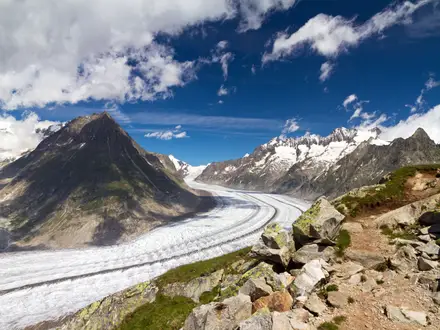
The Swiss Glacier Trail is the official English name for the Aletsch Panoramaweg, a 30 km, 3-day waymarked mountain route in the Aletsch Arena of Upper Valais, Switzerland. It runs point-to-point from Belalp to Bellwald above the Great Aletsch Glacier, the longest glacier in the Alps. Expect moderate Swiss T2 mountain hiking with short T3 sections, sustained ascent and descent, rocky paths and big glacier views. It suits fit, surefooted hikers who want a compact hut- or village-to-village alpine trek without glacier travel.
Route Overview
The route starts at Belalp, reached by cable car from Blatten bei Naters above Brig, and finishes at Bellwald, with cable-car descent to the Rhone valley. A common alternative finish is Fiescheralp or Fiesch. Over three stages, the trail links Belalp, Riederalp, the Aletschwald forest reserve, Hohfluh, Moosfluh, Bettmeralp, Bettmerhorn, Märjelensee, Fiescheralp and Bellwald. It is a linear stage trail, not a loop, with car-free villages and lift access making individual stages possible as day hikes. If you only want a shorter Aletsch outing, compare the Aletsch Glacier Panorama Trail or the Aletsch Glacier UNESCO Trail; for a glacier walk in a different Swiss region, see the Diavolezza Glacier Trail in the Engadin.
History of the Swiss Glacier Trail
The Swiss Glacier Trail was developed by Switzerland Tourism and the Aletsch Arena as a flagship panorama route above the Great Aletsch Glacier. The glacier has been studied for more than a century and has retreated markedly, a change visible from viewpoints such as Moosfluh. The surrounding Jungfrau-Aletsch area became the first UNESCO World Natural Heritage Site in the Alps in 2001 and was extended in 2007.
Notable highlights
- Great Aletsch Glacier panoramas: The trail follows a moraine ridge with near-continuous views over the Great Aletsch Glacier, about 22.6 km long and often rounded to 23 km. This is the defining reason to hike the route.
- Moosfluh and the moving mountainside: Moosfluh is a major viewpoint over the glacier’s bend. The slope is actively slipping as the retreating ice no longer buttresses it, making glacial change unusually visible.
- Aletschwald forest reserve: This protected old-growth Arolla-pine and larch forest sits above the ice and forms part of the UNESCO-listed landscape. It gives the route a quieter forested contrast to the open ridge sections.
- Märjelensee lake: Märjelensee is a turquoise glacier-fed lake near the glacier’s flank. It is a classic rest and photo stop on the eastern part of the trail.
- Car-free Aletsch villages: Riederalp, Bettmeralp and Fiescheralp are traffic-free alpine villages reached by cable car. They make logistics easier and keep the walking stages relatively quiet.
- Bettmerhorn viewpoint: Bettmerhorn is an optional high side-trip with a viewing platform and glacier exhibition. It looks straight down the length of the Aletsch.
Challenges to expect
This is moderate mountain hiking, not a technical glacier route, but it is still alpine terrain. Expect about 1650 m of ascent and 2180 m of descent over three days, with rocky and stony paths, grassy alps, a short tunnel section and some short T3 passages. Snow can linger outside the July to September high-season window. Cable-car timetables matter for access, exits and any shortened day-hike plan.
HikeList Score
Swiss Glacier Trail scored 89/100 on HikeList's trail-quality metrics.
See score breakdownHide breakdown
- Ideal length 70
- Balanced challenge 100
- Scenery & wildness 98
- Varied terrain 89
- Accommodation 92
- Food & support 81
- Path quality 98
- Season flexibility 76
Computed from length, challenge, scenery & wildness, terrain variety, accommodation, food & support, path quality and season flexibility.
 Switzerland
Show more data Show less
- Mountainous
- Alpine
- Forest
- Rocky
- Stony
- Dirt
- Grass
- Hotels
- Guesthouses
- Huts
- Mountain Inns
- Family Friendly
- Restrooms
- Water Sources
- Shelters
Download Our Full Guide to Swiss Glacier Trail FREE!
Get our comprehensive guide to this hike for free. Save it for later reading or print out at home.
In these collections
Photos from hikers
Taken on the trail by people who've reviewed Swiss Glacier Trail.
Swiss Glacier Trail: The Complete Guide
The Swiss Glacier Trail, better known on the ground as the Aletsch Panoramaweg, is a compact three-day traverse above the Grosser Aletschgletscher in Upper Valais. It follows SchweizMobil National Route 39 from car-free Belalp to Bellwald, linking high balcony paths, Aletschwald forest and lift-served alpine villages.
The route is built around glacier views rather than glacier travel. The path stays above the ice, running through rocky alpine terrain and along moraine-edge balconies within the Jungfrau-Aletsch UNESCO World Natural Heritage Site.
Its big moments are practical as well as scenic: the Massa Gorge suspension bridge early on, the viewpoints around Hohfluh, Moosfluh and the Bettmerhorn flank, Märjelensee near the glacier, and the Aspi-Titter suspension bridge before Bellwald. Riederalp, Bettmeralp and Fiescheralp make the route unusually flexible for overnight stops, shortcuts and cable-car exits.
This is a moderate Swiss mountain hike, not a technical alpine route. The challenge is fitness, sure-footedness and judgement on stony T2 terrain with short T3 passages, exposed sections, altitude around 1,900–2,490 m, and weather that can change quickly.
This guide covers stages, days, accommodation, food, transport, terrain and common planning mistakes.
Stage-by-Stage Guide
Stage 1: Belalp to Riederalp via the Massaschlucht and Riederfurka
Approximate distance: 10 km
The opening stage leaves the car-free resort of Belalp and quickly establishes the character of the Aletsch Panoramaweg: a signed Swiss mountain path linking lift-served alpine settlements, forested slopes and open viewpoints above the glacier landscape. It is not a warm-up valley walk; expect a proper mountain-hiking day on uneven ground, with descent and ascent around the Massaschlucht before the route reaches Riederfurka and Riederalp.
The signature feature is the Massa Gorge suspension bridge, a 124 m footbridge hanging roughly 50 m above the Massa, the meltwater river draining the Grosser Aletschgletscher. It is a secure mountain footbridge, but walkers uncomfortable with height or movement underfoot should treat it as a serious psychological obstacle rather than a casual photo stop.
After the gorge crossing, the route continues towards Riederfurka, where Villa Cassel and the Pro Natura nature centre sit at the edge of the protected Aletschwald landscape. The approach to Riederalp brings a marked change in atmosphere, from wilder gorge and forest terrain into one of the car-free Aletsch Arena villages.
Terrain is typical red-and-white Swiss mountain-path terrain: stony tracks, narrower footpaths, forest sections and open alp ground. The route is waymarked as SchweizMobil National Route 39, with standard Swiss yellow signposts and red-white mountain-path markings, but a map or offline route should still be carried because side paths around the resorts and viewpoints can be numerous.
Food and water are best planned around the settlements. Belalp has start-of-stage services, and Riederalp has accommodation, food and lift access at the end. Do not rely on finding water or refreshments at every point between them; carry enough for the full stage, especially in hot weather.
Riederalp is the practical overnight hub for this stage, with hotels, guesthouses and mountain accommodation in the car-free village. Rooms should be booked ahead in the July–September high season.
Access is straightforward but lift-dependent. Belalp is reached from Blatten bei Naters by the Blatten–Belalp cable car, after travelling via Brig and PostBus to Blatten bei Naters. Riederalp has its own valley cable-car access from Mörel, making this stage easy to start, finish or use as a day walk if lift times suit. Cable-car operating dates and last descents should be checked before travelling.
Main cautions on this stage are the suspension bridge, uneven mountain terrain and weather exposure once away from the forest. After rain, stony and rooty sections can be awkward. Outside the main summer season, snow or storm damage can affect higher or shaded paths; current path conditions should be checked before relying on the route.
Stage 2: Riederalp to Märjelensee via Hohfluh, Moosfluh and Hohbalm
Approximate distance: 11 km
This is the core panorama stage of the route, linking Riederalp with the glacier-side area of Märjelensee by way of the Aletschwald, Hohfluh, Moosfluh, Bettmeralp and the high flank below the Bettmerhorn. It contains the route’s highest ground at Hohbalm, around 2,487 m, below the Bettmerhorn rather than on its summit.
The walking is sustained and more alpine than the distance suggests. Much of the day sits between roughly 1,900 m and 2,490 m, with stony paths, open slopes, exposed balcony sections and long views over the Grosser Aletschgletscher. This is where fitness, sure-footedness and weather judgement matter most.
The route passes through or close to the Aletschwald, a protected forest reserve of Arolla pine and larch, before reaching the high glacier viewpoints of Hohfluh and Moosfluh. Moosfluh is one of the major viewpoints over the great bend of the glacier, and the slope here is known for visible movement linked to the retreating ice no longer supporting the mountainside.
Bettmeralp provides a useful mid-stage settlement with lift access and services. Above it, the Bettmerhorn is an optional cable-car-served viewpoint at 2,872 m with a viewing platform and glacier exhibition, but it is not part of the standard trail’s high point. Adding it changes the day’s timing and should only be done if weather, lift times and energy levels allow.
The onward traverse towards Hohbalm and Märjelensee is one of the most memorable sections of the whole route, with the path running as a high balcony above the glacier’s lateral moraine. Märjelensee itself is a classic turquoise, glacier-fed lake on the eastern side of the Aletsch, with the Gletscherstube nearby.
Food and water planning should be deliberate on this stage. Riederalp and Bettmeralp are the main settlement-based options before the higher traverse, and the Gletscherstube at Märjelensee offers refreshment and beds near the stage end. Carry enough water and food for the exposed middle section, particularly because heat, altitude and wind can make the day more demanding than its length implies.
Accommodation at the end is centred on the Gletscherstube/Märjelen area. Some walkers may choose to structure the day differently by staying in Bettmeralp or another lift-served Aletsch Arena village, but the standard three-stage itinerary uses Märjelensee as the overnight stop. Beds in mountain accommodation should be booked in advance.
Public transport escape options are unusually good for a high route. Riederalp, Bettmeralp and Fiescheralp each connect to the valley by cable car, although this stage’s practical mid-route exit is most naturally via Bettmeralp. Operating times are a key planning constraint; missing a final lift can turn a short stage into a logistical problem.
Navigation is generally clear on National Route 39, but this stage has several tempting viewpoint and cable-car paths. Pay attention at junctions around Hohfluh, Moosfluh, Bettmeralp and the Bettmerhorn area so that an optional viewpoint route is not accidentally confused with the through route to Märjelensee.
The main warnings are altitude, exposure, afternoon thunderstorms and lingering snow. The route involves no glacier travel, but it does cross high, open mountain terrain where weather can change quickly. In poor visibility, the balcony sections and moraine-edge terrain demand careful navigation and conservative decision-making.
Stage 3: Märjelensee to Bellwald via Fiescheralp and the Aspi-Titter suspension bridge
Approximate distance: 9 km
The final stage leaves the Märjelensee area and heads towards Fiescheralp before continuing across the high ground and ravines towards Bellwald. Although it is the shortest of the three stages by distance, it includes a long net descent overall and finishes with one of the route’s most exposed-feeling man-made features.
From Märjelensee, the path passes through high alpine terrain with stony and rocky sections before reaching Fiescheralp, another car-free, lift-served Aletsch Arena resort. This is an important logistical point: it offers services and cable-car access to Fiesch, and it is the most obvious place to shorten or exit the final stage if weather, fatigue or timing becomes an issue.
Beyond Fiescheralp, the route continues towards the Aspi-Titter suspension bridge, a 160 m footbridge around 120 m above the Wysswasser/Weisswasser ravine below the Fieschergletscher. Like the Massa bridge on Stage 1, it is a defined part of the route, but it is not ideal for walkers with severe vertigo.
The bridge crossing marks the transition towards Bellwald, a traditional Goms mountain village at around 1,560 m. The final approach gives a strong sense of leaving the high glacier balcony and descending towards the Rotten/Rhône valley corridor.
Food and water are available at the stage ends and at Fiescheralp, but the walking between these points should still be treated as mountain terrain rather than a serviced valley path. Start with enough water from Märjelensee/Gletscherstube and do not assume every intermediate alp or building offers public refreshments.
Bellwald has hotels, guesthouses and village accommodation, and makes the natural end point for the three-day route. From Bellwald, the Fürgangen–Bellwald cable car descends to Fürgangen-Bellwald station on the Matterhorn Gotthard Bahn in the Goms, with rail connections back towards Brig.
Navigation remains on the signed Aletsch Panoramaweg / National Route 39, but attention is needed around Fiescheralp where local resort paths, lift access and hiking routes meet. In poor visibility, keep checking the onward direction rather than following the most obvious track downhill.
The key cautions are the long descent, tired legs on stony ground, the Aspi-Titter suspension bridge and weather. Afternoon storms are a real concern on exposed alpine paths, so an early start is sensible. Cable-car times at both Fiescheralp and Bellwald should be checked before setting off, particularly late in the season or if using the stage as a day walk.
Recommended Itinerary
Standard 3-day itinerary
This is the most practical way to walk the Swiss Glacier Trail / Aletsch Panoramaweg: short but serious mountain stages, each ending at a place with accommodation or straightforward lift access. It suits most fit walkers who want time for the glacier viewpoints, the two suspension bridges and possible weather delays.
| Day | From | To | Approx. distance | Why this stage makes sense | Services/accommodation notes |
|---|---|---|---|---|---|
| 1 | Belalp | Riederalp, via the Massaschlucht suspension bridge and Riederfurka | 10 km | A compact opening stage after reaching Belalp by the Blatten–Belalp cable car. It crosses the Massa Gorge suspension bridge early, then gives time for Riederfurka, Villa Cassel and the Aletschwald before continuing to the practical overnight hub of Riederalp. | Belalp and Riederalp both have accommodation, but Belalp is the start rather than the usual first overnight for this itinerary. Riederalp is car-free and lift-served from the valley, making it a strong first stop for hotels, guesthouses and exit options. Book ahead in July–September. |
| 2 | Riederalp | Märjelensee / Märjelen, via Hohfluh, Moosfluh and the Bettmerhorn flank | 11 km | This is the main high panorama day, with repeated views over the Grosser Aletschgletscher and the route high point at Hohbalm, below the Bettmerhorn. The stage is short enough to allow a Bettmerhorn cable-car side trip if weather, time and lift operation allow. | Riederalp and Bettmeralp are the main service villages before the higher section. Beds and refreshments are available at the Gletscherstube near Märjelensee, but capacity and opening dates should be checked before travelling. |
| 3 | Märjelensee / Märjelen | Bellwald, via Fiescheralp and the Aspi-Titter suspension bridge | 9 km | A shorter final distance, but not a throwaway day: the route includes rocky mountain terrain, the descent towards Fiescheralp and the 160 m Aspi-Titter suspension bridge above the Wysswasser / Weisswasser ravine before reaching Bellwald. | Fiescheralp is lift-served and can be used as an exit or bad-weather fallback. Bellwald has accommodation and the Fürgangen–Bellwald cable car descends to Fürgangen-Bellwald station for rail connections through the Goms and back towards Brig. Check the final cable-car timetable before committing to a same-day onward journey. |
Slower variant
A slower plan suits walkers who want shorter days, more time at the glacier viewpoints, or extra flexibility around afternoon thunderstorms. It is also useful if accommodation at Märjelensee is unavailable or if the Bettmerhorn side trip is a priority.
A practical slower approach is to use the lift-served Aletsch Arena villages as staging points, especially Riederalp, Bettmeralp and Fiescheralp. For example, Day 2 can be shortened by stopping at Bettmeralp instead of continuing all the way to Märjelensee, then continuing over the high section towards Märjelensee and Fiescheralp the following day. Exact distances for any altered stage should be checked on official mapping before booking.
This variant works best for hikers who prefer hotels and guesthouses in villages rather than relying on the Gletscherstube at Märjelensee. It also gives more options to descend by cable car if snow, storms or path closures affect the higher sections.
Faster variant
A 2-day traverse is possible for strong, sure-footed hikers, but it removes much of the margin that makes the route enjoyable and safe. The most straightforward faster structure is:
| Day | From | To | Approx. distance | Why this stage makes sense | Services/accommodation notes |
|---|---|---|---|---|---|
| 1 | Belalp | Riederalp | 10 km | Keeps the first day manageable after travelling to Blatten bei Naters and taking the cable car to Belalp. It avoids starting the main high panorama section too late in the day. | Overnight in Riederalp, with lift access if plans change. Book ahead in high season. |
| 2 | Riederalp | Bellwald, via Märjelensee, Fiescheralp and the Aspi-Titter suspension bridge | About 20 km | Combines the standard second and third stages, including the highest ground at Hohbalm and the long onward traverse to Bellwald. This is the demanding day of the 2-day version and should only be attempted in settled weather with an early start. | There are potential bail-out points in the lift-served Aletsch Arena, including Bettmeralp and Fiescheralp, but cable-car operating times must be checked before relying on them. Finish logistics depend on the Fürgangen–Bellwald cable car. |
The faster version is best for experienced mountain walkers carrying light packs. It is not a good choice if snow remains on the high sections, if thunderstorms are forecast, or if the aim is to spend time at Moosfluh, Bettmerhorn or Märjelensee rather than simply complete the line.
Planning the Route
The cleanest way to plan the Swiss Glacier Trail is as a three-stage traverse: Belalp to Riederalp, Riederalp to Märjelensee, then Märjelensee to Bellwald. Those stages fit the terrain well, give time for the glacier viewpoints, and avoid turning a scenic high-level route into a rushed cable-car transfer exercise.
Strong, well-acclimatised hikers can combine stages into two longer days, but that is not the best default plan. The route’s difficulty is not technical glacier travel; it is the cumulative effect of altitude, stony mountain path, exposed sections, suspension bridges, weather and descent. A three-day plan gives more margin if cloud, thunderstorms or lingering snow affect the higher ground.
Stage planning and overnight logic
The overnight points are partly dictated by the car-free Aletsch Arena villages and lift-served access points. Riederalp is the practical hub after the first stage, while Märjelensee keeps the second stage close to the glacier and sets up the final crossing towards Fiescheralp and Bellwald.
Belalp, Riederalp, Bettmeralp, Fiescheralp and Bellwald all work as useful access or exit points because they are connected to the valley by cable car. That makes the route unusually flexible for a high-alpine panorama walk, but it also means cable-car operating dates and last departures matter as much as walking time.
| Planning choice | Best use | Practical notes |
|---|---|---|
| Standard 3-day traverse | Most walkers | Best balance of walking time, viewpoints and weather margin. |
| 2-day traverse | Strong hikers only | Feasible for fit walkers, but gives less room for delays, side trips or poor weather. |
| Day-hike sections | Very practical | Use the lift-served villages to walk individual sections from Belalp, Riederalp, Bettmeralp, Fiescheralp or Bellwald. |
| Extra viewpoint time | Worth considering | The Bettmerhorn is an optional cable-car-served viewpoint above the trail, not the route’s high point. Allow extra time if including it. |
Accommodation planning
Accommodation should be booked before committing to transport, especially in July to September. The car-free resorts are popular in the summer season, and the route depends on a small set of convenient overnight hubs rather than a long chain of villages every few kilometres.
Riederalp is the most practical first-night stop for the standard itinerary. For the second night, the Gletscherstube at Märjelensee/Märjelen places you close to the glacier and the final stage towards Fiescheralp, the Aspi-Titter suspension bridge and Bellwald. Bettmeralp can also be useful when adapting the middle part of the route, but changing the overnight pattern may alter the balance of the walking days.
Book using Swiss francs (CHF / Fr.) as the working currency, and confirm current prices, meal arrangements and cancellation terms before booking. In mountain inns and huts, check whether bedding, evening meals and breakfast are included or need to be reserved separately.
Shortening, exiting and section-hiking
This route is easy to break into sections by Swiss mountain standards. The key reason is the cable-car network: Belalp is reached from Blatten bei Naters, Riederalp from the valley via Mörel, Bettmeralp via Betten/Betten Talstation, Fiescheralp via Fiesch, and Bellwald via the Fürgangen–Bellwald cable car down to Fürgangen-Bellwald station.
That flexibility is useful in poor weather or if snow remains on higher parts of the route. It also makes the trail suitable for walkers based in one of the Aletsch Arena villages who want to complete it over separate days rather than as a continuous trek.
Do not assume every cable car runs late, daily or throughout the whole hiking season. Operating dates and timetables for Blatten–Belalp, the Aletsch Arena lifts and Fürgangen–Bellwald should be checked before travelling.
Food and water
The main resupply points are the car-free villages and staffed mountain stops, not remote shops along the path. Plan to start each day with enough food for the full stage, especially on the higher sections between the glacier viewpoints and Märjelensee.
Refreshment and beds are available at the Gletscherstube near Märjelensee/Märjelen, but opening dates and services should be checked before relying on it. Carry water capacity for a full mountain day; do not plan around untreated streams or meltwater near glacier-fed terrain.
Navigation
Navigation is straightforward in normal visibility because the Aletsch Panoramaweg is signposted as SchweizMobil National Route 39 and uses standard Swiss yellow hiking signs with red-white mountain-path markings. A map is still important, particularly if cloud drops onto the ridge and moraine-edge sections or if diversions are in place.
Use the SchweizMobil online map or the relevant swisstopo mapping, and keep an offline copy available. The route follows mountain paths above the Grosser Aletschgletscher; it does not require glacier travel, crampons or ropework.
Weather and seasonal checks
The most important condition check is snow on the high sections around Hohfluh, Moosfluh, the Bettmerhorn flank, Hohbalm and the approach to Märjelensee. The route is best planned for the main summer and early autumn window, once the high paths are snow-free and the lifts are operating.
Afternoon thunderstorms are a normal risk at this altitude. Start early, avoid committing to exposed sections in deteriorating weather, and keep enough timetable margin to descend by cable car if the forecast changes.
Permits and restrictions
There is no glacier crossing or technical access arrangement to plan for on the standard route. The practical checks are accommodation, lift operation, weather, snow conditions and any current path diversions.
Because the route passes through the Jungfrau-Aletsch UNESCO World Natural Heritage landscape and the Aletschwald reserve area, stay on marked paths and follow local signage. Any seasonal closures, diversions or protected-area instructions should be checked before travelling.
Towns, Villages and Overnight Stops
The Swiss Glacier Trail is unusually flexible for a high-level alpine route because most practical overnight stops are car-free, lift-served resorts rather than remote huts. The standard three-day itinerary uses Belalp, Riederalp, Märjelensee and Bellwald, but Riederalp, Bettmeralp and Fiescheralp give useful options for shortening, rejoining or turning stages into day hikes.
Rooms in Belalp, Riederalp, Bettmeralp and Bellwald should be booked well ahead in the July–September high season. Cable-car operating dates and last departures matter as much as room availability, especially if using a valley base or planning to exit part-way along the route.
| Place | Best use for hikers | Transport relevance |
|---|---|---|
| Belalp | Start-night or first morning start point | Blatten–Belalp cable car from Blatten bei Naters |
| Riederfurka | Useful pause point near Villa Cassel and Aletschwald | On the walking route; not the most practical main overnight hub |
| Riederalp | Standard Stage 1 overnight | Cable car access from Mörel |
| Bettmeralp | Alternative overnight between Stages 1 and 2 | Cable car access from Betten / Betten Talstation |
| Märjelensee / Märjelen | Standard Stage 2 overnight or refreshment stop | Remote high-level stop; no direct valley village access stated for the route |
| Fiescheralp | Useful final-stage bail-out or alternative overnight | Cable car access from Fiesch |
| Bellwald | Finish-night or immediate exit point | Fürgangen–Bellwald cable car to Fürgangen-Bellwald station |
Belalp
Belalp is the start of the route, above Blatten bei Naters, and is reached by the Blatten–Belalp cable car. The trail is waymarked from the Belalp mountain station, so it is the simplest place to stay before beginning Stage 1, particularly if arriving late in the day or wanting an unhurried start.
Belalp is a car-free alpine resort with hotels, guesthouses and mountain-inn style accommodation. It is a practical overnight stop rather than just a trailhead, but the lack of road access means luggage, food shopping and late arrivals need to be planned around the cable car.
Most walkers should treat Belalp as the last straightforward place to sort out breakfast, water and packed food before the first stage. Specific shop and restaurant opening times vary by season and should be checked before travelling.
For public transport, the usual approach is by train to Brig, PostBus to Blatten bei Naters, then the cable car to Belalp. Anyone driving still has to leave the car below the resort and use the lift, as Belalp itself is car-free.
Riederfurka and Villa Cassel
Riederfurka sits between the Massa Gorge crossing and Riederalp, making it an important point on Stage 1 rather than the main practical overnight hub for most itineraries. It is also the access point for Villa Cassel, which houses the Pro Natura nature centre, and for the Aletschwald forest reserve.
This is a good place to pause before continuing through or around the Aletschwald towards Riederalp. It is especially useful if the weather is unsettled, as the route has already crossed the Massaschlucht suspension bridge and is approaching the more established Aletsch Arena villages.
Accommodation and food options should not be assumed here in the same way as in Riederalp or Bettmeralp. For a normal three-day walking plan, Riederalp is the more reliable Stage 1 overnight target.
Riederalp
Riederalp is the standard overnight stop after Stage 1 from Belalp. It sits beyond Riederfurka and the Aletschwald section, making it the most practical village base before the route continues towards Hohfluh, Moosfluh and the Bettmerhorn flank.
As one of the car-free Aletsch Arena villages, Riederalp has accommodation suitable for walkers, including hotels and guesthouses. Food and basic hiker logistics are easier here than at the smaller high-level stopping points, though exact restaurant, café and shop opening times should be checked before travelling.
Riederalp is reached from the valley by cable car from Mörel. This makes it useful not only as an overnight stop, but also as an entry or exit point for section hikers and for anyone needing to abandon or shorten the route.
It is a strong choice for hikers who want the classic three-day version without turning Stage 1 into a longer push. Booking ahead is important in the main summer walking season, as the village also serves cable-car-assisted day hikers and holiday visitors.
Hohfluh and Moosfluh
Hohfluh and Moosfluh are high viewpoint areas on the route between Riederalp and the Bettmerhorn flank. They are important for navigation and pacing on Stage 2, but they are not the primary overnight stops for this itinerary.
Moosfluh is one of the key places to view the Great Aletsch Glacier, including the great bend of the ice. The slope here is affected by slow movement linked to glacial retreat, so path alignments or diversions may change; current route conditions should be checked before travelling.
Treat these points as exposed, high-level walking sections rather than service centres. Carry enough water, food and weather protection from Riederalp or Bettmeralp, especially if storms are forecast in the afternoon.
Bettmeralp
Bettmeralp is not the standard overnight stop in the three-day itinerary listed here, but it is one of the most useful alternative bases on the route. It lies between Riederalp and the Bettmerhorn area, and can be used to adjust the trip if accommodation is unavailable in Riederalp or if a shorter walking day is preferred.
The village is car-free and lift-served, with hotels, guesthouses and mountain-resort services. Food and accommodation logistics are generally straightforward by alpine-route standards, but individual opening times and room availability should be checked before booking travel.
Bettmeralp is reached by cable car from Betten / Betten Talstation. This makes it a practical access point for walkers joining the route for a day stage, exiting in poor weather, or using a valley-based itinerary rather than sleeping every night on the mountain.
It is also the logical place for hikers considering the Bettmerhorn cable-car side trip. The Bettmerhorn summit is not the high point of the walking route itself; the trail’s high point is Hohbalm on the flank below it.
Bettmerhorn Area and Hohbalm
The route passes below the Bettmerhorn, with Hohbalm forming the high point of the Swiss Glacier Trail at about 2,487 m. This is a high, exposed mountain section rather than an overnight location.
The Bettmerhorn itself is an optional cable-car-served viewpoint above the trail, with a viewing platform and glacier exhibition. Adding it can be worthwhile in stable weather, but it should not be confused with the waymarked through-route to Märjelensee.
There are no practical overnight details for Hohbalm itself, so plan this part as a committing high-level traverse between serviced stops. Snow, wind, poor visibility and thunderstorms can all matter here; conditions should be checked before travelling, especially outside the core July–September season.
Märjelensee / Märjelen and the Gletscherstube
Märjelensee is the standard overnight stop at the end of Stage 2 and one of the most distinctive places to stay on the route. It sits near the eastern side of the Great Aletsch Glacier, with the Gletscherstube nearby offering refreshment and beds.
This is the most hut-like stop on the standard itinerary, so it should be booked in advance rather than treated like a large resort village. It is also the place where walkers need to be most self-contained with timing, weather decisions and onward plans.
Food is available at the Gletscherstube, but exact meal arrangements, opening dates and bed availability should be checked before travelling. Carrying some spare food is sensible, particularly early or late in the season.
Staying here keeps the classic three-stage rhythm intact: Belalp to Riederalp, Riederalp to Märjelensee, then Märjelensee to Bellwald. Strong walkers who do not stay here may use Fiescheralp or Bettmeralp to reshape the itinerary, but that changes the balance of the stages.
Fiescheralp
Fiescheralp lies on the final stage between Märjelensee and the Aspi-Titter suspension bridge approach to Bellwald. It is a car-free Aletsch Arena resort and one of the most useful escape or adjustment points on the route.
The village has lift access from Fiesch, so it can be used to leave the trail before the final descent and bridge crossing, or to start a shorter final-day walk. This is particularly useful if weather deteriorates after the high section around Märjelensee.
Fiescheralp can also work as an alternative overnight stop, especially for hikers who prefer resort services to a more remote high-level night at Märjelensee. Accommodation and food availability should be checked before travelling, as seasonal operations and opening hours can affect plans.
Do not confuse this finish-area option with the longer four-day Belalp–Fiesch variant that appears in some itineraries. The 30 km route described here continues past Fiescheralp to Bellwald via the Aspi-Titter suspension bridge.
Aspi-Titter Suspension Bridge Area
The Aspi-Titter suspension bridge is a major feature of the final approach to Bellwald, crossing about 120 m above the Wysswasser / Weisswasser ravine below the Fieschergletscher. It is a route feature, not an overnight stop.
Because it comes late in the walk, it is worth checking weather and personal energy levels before committing beyond Fiescheralp. The final stage includes a long net descent, and tired legs make exposed bridges and stony paths feel more demanding.
There are no services to rely on at the bridge itself. Carry water and snacks from Märjelensee or Fiescheralp, and allow enough time to reach Bellwald before onward transport plans.
Bellwald
Bellwald is the finish of the route and a practical place to stay after completing the trail. It is a traditional Goms mountain village at 1,560 m, reached after crossing the Aspi-Titter suspension bridge and completing the final descent.
Accommodation is available in Bellwald, making it a sensible finish-night option if transport connections are tight or if the final day has been affected by weather. Food and village services are more useful here than on the high approach, though current opening hours should be checked before travelling.
For onward travel, the Fürgangen–Bellwald cable car descends to Fürgangen-Bellwald station on the Matterhorn Gotthard Bahn in the Rotten / Rhône valley. From there, rail connections lead back towards Brig.
Bellwald is also the best place to build in a buffer at the end of the walk. If the final stage takes longer than planned, staying in the village avoids the pressure of catching the last lift and onward train connection the same evening.
Getting to the Start
The Swiss Glacier Trail / Aletsch Panoramaweg starts at Belalp, the car-free alpine resort above Blatten bei Naters. The walking route is waymarked from the Belalp mountain station, so the key logistical chain is: train to Brig → PostBus to Blatten bei Naters → Blatten–Belalp cable car.
Because the route is point-to-point and finishes at Bellwald, public transport is usually the simplest way to organise the walk. Cable-car operating dates and times are central to the plan and should be checked before travelling.
By train
The main rail gateway is Brig, on the Rhône-valley / Lötschberg rail corridor in Oberwallis. From Brig, continue by PostBus to Blatten bei Naters, then take the cable car up to Belalp.
For hikers arriving from elsewhere in Switzerland, the practical aim is to reach Brig early enough to connect with the onward bus and the Blatten–Belalp cable car. Evening arrivals can be awkward if the last cable-car departure has passed, so check the full through-journey rather than only the train to Brig.
By bus
From Brig, take the PostBus to Blatten bei Naters. Blatten is the valley access point for Belalp; the trail itself does not start in Blatten.
At Blatten bei Naters, transfer to the Blatten–Belalp cable car. Belalp is car-free and this cable car is the start-access link, so missed connections can mean a delayed start or an unplanned overnight in the valley. This should be checked before travelling.
By car
Driving is possible only as far as the valley access at Blatten bei Naters; Belalp is car-free. From Blatten, use the Blatten–Belalp cable car to reach the start.
A car is less convenient than rail for the full trail because the walk ends at Bellwald, not back at Blatten. From Bellwald, the normal exit is by the Fürgangen–Bellwald cable car down to Fürgangen-Bellwald station on the Matterhorn Gotthard Bahn, then by rail back towards Brig. If leaving a vehicle at the start, factor in the time needed to return from the finish to the Blatten/Brig side of the route.
Parking arrangements, long-stay rules and any charges at Blatten bei Naters should be checked before travelling.
From the nearest airport
No airport sits close to the trailhead in a practical hiking sense; the start is reached by Swiss public transport via Brig. From any arrival airport, plan the journey as a rail connection to Brig, followed by PostBus to Blatten bei Naters and the cable car to Belalp.
The critical point is not the airport itself but the final mountain connection. Make sure the flight arrival time leaves enough margin for the train to Brig, the PostBus and the last Blatten–Belalp cable car. This should be checked before travelling.
Where to stay before starting
The most convenient pre-walk overnight is Belalp, as this puts you at the trailhead and avoids needing a morning bus-and-cable-car connection before Stage 1. Belalp has hotels, guesthouses and mountain inns, but rooms in the car-free resorts should be booked well ahead in the July–September high season.
Staying lower down in the valley can also work, especially after a late arrival by train, but it adds the Brig–Blatten bei Naters bus and Blatten–Belalp cable car to the morning of the first stage. That is manageable only if the timetables align with the planned walking day.
If using accommodation in Riederalp, Bettmeralp or Fiescheralp to shorten or reconfigure stages, remember that these villages are also cable-car accessed. Their lift operating dates and times matter just as much as the start cable car and should be checked before travelling.
Getting Home from the Finish
The route finishes in Bellwald, above the Rhône valley in the Goms. The normal exit is not by walking down to the valley: take the Fürgangen–Bellwald cable car down to Fürgangen-Bellwald station, then continue by train on the Matterhorn Gotthard Bahn.
Cable-car operating dates and times are the key constraint at the end of the hike. If there is any risk of reaching Bellwald after the last descent, plan to stay in Bellwald rather than relying on a late onward connection. This should be checked before travelling.
By train
The nearest railway station is Fürgangen-Bellwald, in the Rhône/Rotten valley below Bellwald. From the village, use the Fürgangen–Bellwald cable car to reach the station.
Fürgangen-Bellwald is on the Matterhorn Gotthard Bahn Furka–Oberalp line through the Goms. The usual onward route is by rail back towards Brig, the main hub for the valley and the same town used for access to the start via Blatten bei Naters and Belalp.
For anyone returning to the start area, travel from Fürgangen-Bellwald by train to Brig, then continue by PostBus to Blatten bei Naters and the Blatten–Belalp cable car if required. Timings depend on the day’s cable-car and rail timetable, so do not assume a same-evening return to Belalp is possible after a late finish.
By bus
No bus is needed for the standard exit from Bellwald: the practical public-transport link is the Fürgangen–Bellwald cable car down to the railway station. Bus options from Bellwald or the valley should not be relied on without checking current timetables.
If returning to the start-side valley, the relevant bus leg is from Brig to Blatten bei Naters. This is the access route for Belalp, but onward cable-car times also need to line up.
By car/taxi
This is a point-to-point hike, so leaving a car at the start creates a return journey from Bellwald back across the valley transport network. Public transport is normally the cleaner option: cable car to Fürgangen-Bellwald, train to Brig, then onward to Blatten bei Naters if returning to the Belalp side.
Taxi use is best treated as a fallback rather than the main plan, especially if finishing late or outside the core summer season. Availability, pick-up points and prices in Bellwald or at Fürgangen-Bellwald station should be checked before travelling.
From the nearest airport
Airport logistics are best planned through Brig and the Swiss rail network. No airport sits directly on the route; from Bellwald the first step is still the cable car to Fürgangen-Bellwald station, followed by rail through the Goms towards Brig.
Exact airport choice, journey time and last connections depend on the wider Swiss timetable and flight plans. This should be checked before travelling, particularly if aiming to fly out on the same day as finishing the hike.
Where to stay at the finish
Staying in Bellwald is the simplest option if the final stage runs late, the weather slows progress, or the last cable car connection is tight. Bellwald has accommodation and is a more comfortable end point than trying to force an evening transfer after the Aspi-Titter suspension bridge and final approach.
Rooms should be booked ahead in the July–September high season, especially if the hike is being used as part of a hut- or village-to-village itinerary. If onward travel is essential the same day, check the Fürgangen–Bellwald cable car timetable before setting out from Märjelensee.
Which Direction Should You Walk?
Standard direction: Belalp to Bellwald
The Aletsch Panoramaweg is best treated in its standard direction, from Belalp to Bellwald. This matches the route described as SchweizMobil National Route 39 and gives the most natural three-stage flow: Belalp to Riederalp, Riederalp to Märjelensee, then Märjelensee to Bellwald.
Logistically, this direction works cleanly. You reach Belalp from Brig via Blatten bei Naters and the Blatten–Belalp cable car, then finish at Bellwald with the Fürgangen–Bellwald cable car down to Fürgangen-Bellwald station on the Matterhorn Gotthard Bahn. Cable-car operating times should always be checked before travelling, especially for the first and last day.
The scenery also builds well in this direction. The route begins with the Massa Gorge suspension bridge, moves through Riederfurka and the Aletschwald, then opens out onto the main glacier-balcony sections around Hohfluh, Moosfluh, Hohbalm and Märjelensee. The final day still has a strong finish, with Fiescheralp, the Aspi-Titter suspension bridge and the descent into Bellwald.
The standard direction is also the easier direction in terms of total climbing. The route has about 1,650 m of ascent and a larger overall descent towards Bellwald, so the work is more manageable than reversing it. The trade-off is that the final stage includes a long net descent, which can be harder on knees than lungs.
Reverse direction: Bellwald to Belalp
Walking from Bellwald to Belalp is possible, but it is usually the less convenient and physically harder choice. In reverse, the route turns much of the standard descent into ascent, so expect a tougher climbing profile even though the distance is unchanged.
Transport still works well because Bellwald, Fiescheralp, Bettmeralp, Riederalp and Belalp are all lift-served. However, a reverse finish at Belalp leaves you needing the Blatten–Belalp cable car down to Blatten bei Naters and onward travel to Brig, so the final connection chain matters. This should be checked before travelling.
The reverse direction also changes the way the route feels. You get the Aspi-Titter suspension bridge early, then climb into the high glacier country, before finishing with the Massa Gorge crossing and Belalp. That is still scenic, but it gives less of the natural west-to-east progression from Aletschwald and the main Aletsch viewpoints towards the Goms.
Accommodation is workable either way, as the car-free Aletsch Arena villages and Märjelensee give flexible overnight options. In high season, rooms should be booked well ahead whichever direction is chosen.
Weather and timing
There is no clear direction advantage for prevailing wind or weather on this route. The important factor is timing: the trail sits mostly high above the valley, with exposed sections, rocky ground and rapid weather changes possible. Start early, avoid being on exposed ridges or suspension-bridge approaches during thunderstorms, and check snow conditions on the higher sections outside the main July–September season.
Recommendation
Walk the Swiss Glacier Trail from Belalp to Bellwald unless there is a specific accommodation or transport reason to reverse it. The standard direction has the better overall flow, slightly easier climbing, straightforward public-transport logic, and a satisfying finish via the Aspi-Titter suspension bridge into Bellwald.
Accommodation Along the Route
The Swiss Glacier Trail works well as an inn-to-inn walk. Accommodation is available at the practical stage hubs, with a mix of hotels, guesthouses, mountain inns and one more remote mountain-hut-style stop near Märjelensee.
The main constraint is not distance between beds, but availability. Belalp, Riederalp, Bettmeralp, Fiescheralp and Bellwald are car-free or lift-served mountain resorts, and rooms should be booked well ahead for July–September, especially at weekends. The Gletscherstube at Märjelensee/Märjelen is the key limited-capacity overnight on the standard three-day itinerary and should be treated as the priority booking.
Best overnight pattern
For the classic three-stage walk, the most logical overnight sequence is:
- Belalp — useful for staying at the start before an early departure, reached by the Blatten–Belalp cable car.
- Riederalp — the practical first-night stop after the Belalp–Riederalp stage via the Massa Gorge suspension bridge and Riederfurka.
- Märjelensee / Märjelen — the standard second-night area, with the Gletscherstube offering refreshments and beds near the glacier.
- Bellwald — useful if not travelling straight down to the Rhône/Rotten valley after finishing.
There is flexibility because the Aletsch Arena villages are lift-served. Bettmeralp and Fiescheralp can be used to reshape the itinerary if Riederalp or the Gletscherstube is full, or if you want shorter walking days. Changing the overnight pattern can make one stage noticeably longer or shorter, so check the walking time and cable-car timetable before committing.
Accommodation by place
| Place | Accommodation level | Best for | Notes |
|---|---|---|---|
| Belalp | Good | Night before the start | Car-free alpine resort above Blatten bei Naters, reached by the Blatten–Belalp cable car. Staying here removes the need for a morning valley transfer before Stage 1. |
| Massaschlucht / Massa Gorge area | None | Passing through only | The suspension bridge is a trail feature, not an overnight stop. Plan to continue to Riederfurka/Riederalp. |
| Riederfurka / Villa Cassel area | Limited | Break point rather than main overnight hub | Useful as a landmark between Belalp and Riederalp. Riederalp is the more practical accommodation base for most walkers. |
| Riederalp | Good | Standard first night | Car-free Aletsch Arena resort and the most practical end point for Stage 1. Also works as a base for cable-car-assisted day walks. |
| Bettmeralp | Good | Flexible alternative or extra comfort stop | Another car-free resort on the route corridor, lift-served from Betten/Betten Talstation. Useful if re-splitting the walk or avoiding a limited high-hut booking. |
| Hohfluh, Moosfluh, Hohbalm and the high balcony sections | None | Daytime walking only | These are viewpoint and mountain-path sections above the glacier. Do not plan on finding accommodation here. |
| Märjelensee / Märjelen — Gletscherstube | Limited | Standard second night; closest overnight to the glacier section | The Gletscherstube offers refreshments and beds near Märjelensee. Capacity is limited compared with the resort villages, so book early and do not rely on turning up. |
| Fiescheralp | Good | Alternative to Märjelensee or a shortened final day | Car-free and lift-served from Fiesch. Continuing here instead of staying at Märjelensee can solve a full Gletscherstube, but it changes the stage balance. |
| Aspi-Titter suspension bridge area | None | Passing through only | The bridge is crossed on the final approach towards Bellwald; it is not an accommodation point. |
| Bellwald | Good | Finish night | Traditional Goms mountain village at the end of the trail. The Fürgangen–Bellwald cable car gives onward access down to Fürgangen-Bellwald station. |
Booking strategy
Book the whole route before setting out if walking in the main summer season. The short stages make the route feel forgiving, but the car-free resorts and the limited Märjelensee option mean a casual “find something on arrival” approach is risky in July, August and September.
If the Gletscherstube is full, look first at Fiescheralp or Bettmeralp and adjust the walking stages around the lift system. This is usually more realistic than trying to force a road-based transfer, because Belalp, Riederalp, Bettmeralp and Fiescheralp are car-free or cable-car-served.
Accommodation and lift operating dates matter at both ends of the season. Snow can linger on the higher sections outside roughly July to September, and cable-car operating times govern access to Belalp, Riederalp, Bettmeralp, Fiescheralp and Bellwald. This should be checked before travelling.
Luggage and transfers
The route suits walkers carrying a light overnight pack. Because the main villages are car-free, standard taxi transfers are not a simple substitute for staying on route, and they will not take you directly along the high mountain trail or to Märjelensee.
If luggage transfer is important, arrange it directly with the accommodation providers before booking the itinerary. Do not assume that bags can be moved between every high stop, especially where the night is at Märjelensee rather than in one of the larger lift-served resorts. This should be checked before travelling.
Camping and Wild Camping
The Swiss Glacier Trail / Aletsch Panoramaweg is primarily a hut-, hotel- and village-to-village walk, not a natural camping route. The practical stage ends are Belalp, Riederalp, Märjelensee / Märjelen, Fiescheralp and Bellwald, with mountain inns, hotels, guesthouses and the Gletscherstube at Märjelensee forming the normal accommodation pattern.
Campsites on or near the route
There are no campsite-based stage stops built into the standard 3-day itinerary. The route stays high, mostly between about 1,900 m and 2,490 m, and passes through car-free resorts, alpine pasture, the Aletschwald forest reserve and the protected Jungfrau-Aletsch UNESCO landscape.
If camping is essential, the safest planning approach is to use official campsites in the Rhône / Rotten valley or Goms, then use the cable cars to reach or leave the trail. Possible access points include the valley links for Belalp, Riederalp, Bettmeralp, Fiescheralp and Bellwald, but current campsite availability and cable-car operating times must be checked before travelling.
Wild camping legality and practical reality
Do not assume wild camping is allowed on this route. Swiss camping rules vary locally, and this walk crosses sensitive high-alpine terrain, protected forest and a UNESCO World Natural Heritage Site, where restrictions are likely to be stricter than in ordinary mountain areas.
Wild camping should only be considered if it is explicitly permitted by the relevant local authority, landowner or protected-area management. This should be checked before travelling. If permission is not clear, book accommodation instead.
The Aletschwald forest reserve, moraine-edge paths above the Grosser Aletschgletscher, exposed ridge sections, pastureland and areas close to the suspension bridges are poor places to camp in any case. They are environmentally sensitive, exposed to weather, and not designed for overnight use.
Does the route suit camping?
For most walkers, no. The trail is short, well served by lift-accessed villages, and the stage lengths are deliberately manageable without carrying full camping equipment.
A tent, sleeping mat, stove and extra food add unnecessary weight on a route with sustained ascent and descent, rocky alpine paths, exposed sections and a long descent towards Bellwald. In poor weather, a booked bed in Riederalp, Bettmeralp, Fiescheralp, Märjelensee or Bellwald is far more practical than trying to find a legal, sheltered pitch.
Water, cooking and fires
Carry enough water between serviced stops rather than relying on untreated natural sources. The route passes villages and the Gletscherstube at Märjelensee, but high-alpine water availability can vary, and glacier-fed or pasture-affected water should be treated before drinking.
Open fires are inappropriate on this route unless a clearly designated place allows them. This is especially important near the Aletschwald reserve, in dry summer weather, and anywhere within protected or forested areas. Use a stove only where permitted, and avoid cooking close to huts, private buildings, grazing animals or fragile vegetation.
Leave No Trace on the Aletsch Panoramaweg
If using any legal camping option near the route, keep the impact minimal:
- Camp only where it is expressly allowed.
- Arrive late and leave early if using a permitted temporary bivouac.
- Never pitch on fragile alpine vegetation, in the Aletschwald reserve, on moraine edges or beside signed protected areas.
- Pack out all rubbish, including food scraps and toilet paper.
- Use toilets in villages, huts and lift stations where available.
- Keep well away from livestock, private buildings and marked paths.
- Do not wash dishes or use soap in streams, lakes or glacier-fed water.
- Avoid noise and lights that disturb wildlife or other walkers.
Best camping strategy
The most reliable strategy is not to wild camp on the trail itself. Book beds in the car-free Aletsch Arena villages or at Märjelensee, and use the excellent cable-car network if stages need to be shortened.
For hikers determined to combine the walk with camping, plan around official, legal campsites off the high route and treat the Aletsch Panoramaweg as a day-hiking or light-pack traverse from those bases. Current local rules, campsite openings and lift timetables should be checked before booking travel.
Food, Water and Resupply
Food logistics are straightforward for a short Swiss alpine trek, but the route should still be treated as a mountain walk rather than a village promenade. The dependable resupply points are the car-free resort villages and booked accommodation; between them, there are exposed, rocky sections where there may be no food available at all.
Petrol stations are not a useful resupply option on this route, as the main overnight hubs are car-free alpine resorts reached by cable car. Plan around hotels, guesthouses, mountain inns and the Gletscherstube at Märjelensee/Märjelen instead.
Food availability
Belalp, Riederalp, Bettmeralp, Fiescheralp and Bellwald are the main places to eat or restock, with the greatest certainty around accommodation and resort services. The Gletscherstube near Märjelensee is the key mountain stop on the higher part of the trail, offering refreshments and beds.
Do not assume every café, restaurant or shop will be open just because the trail is in season. Mountain businesses can keep seasonal hours, and Sunday or shoulder-season opening may be limited. This should be checked before travelling, especially if relying on a particular lunch stop.
For most walkers, the simplest approach is to book breakfast and evening meals with accommodation, then carry lunch and snacks each day. Ask accommodation in advance about packed lunches if the next stage has limited services.
Water availability
Start each stage with full bottles. In warm, clear weather the balcony sections above the Grosser Aletschgletscher can feel very exposed, and the combination of altitude, sun and wind increases water needs even though the daily distances are short.
Most walkers should carry at least 1.5–2 litres per stage, with more in hot weather or if walking slowly. Refill where possible at accommodation, village services and the Gletscherstube rather than depending on streams or lakes.
Natural water exists in this alpine landscape, including glacier-fed watercourses and lakes, but it should not be treated as automatically drinkable. Glacial sediment, livestock on Alpweiden and normal mountain contamination all make filtering or treating sensible if using natural sources.
| Section | Food availability | Water availability | Notes |
|---|---|---|---|
| Belalp → Riederalp | Food is easiest at Belalp before starting and at Riederalp at the end of the stage. Do not rely on finding food during the crossing unless arranged in advance. | Fill bottles before leaving Belalp; refill at Riederalp or accommodation. Treat any natural water if used. | Carry lunch and snacks. The Massaschlucht suspension bridge and Aletschwald sections are scenic mountain terrain, not resupply stops. |
| Riederalp → Märjelensee | Riederalp is the main start-point supply hub. Bettmeralp is another resort village on the route corridor, and the Gletscherstube at Märjelensee offers refreshments and beds. | Fill at Riederalp and again at village/accommodation points where possible. Refill at the Gletscherstube if using its services. | This is the highest and most exposed stage, passing Hohfluh, Moosfluh and Hohbalm. Carry enough water for a full alpine day and check Gletscherstube opening before relying on it. |
| Märjelensee → Bellwald | Food may be available at the Gletscherstube if open, then at Fiescheralp and Bellwald. | Leave Märjelensee with full bottles and refill at Fiescheralp where possible. Treat natural water if used. | The final stage is shorter but includes descent, open ground and the Aspi-Titter suspension bridge approach. Do not start with minimal water just because the day is under 10 km. |
Practical resupply strategy
There is no need for food parcels or multi-day wilderness rations. Carry one day’s hill food at a time: lunch, high-energy snacks and an emergency reserve in case weather, pace or a missed cable car extends the day.
A small amount of CHF cash is sensible for mountain stops, even where cards are commonly accepted. Do not depend on late-evening shopping after arriving by cable car; resort opening hours can be shorter than in valley towns.
All rubbish should be carried to the next village or accommodation. The trail passes through the Jungfrau-Aletsch UNESCO World Natural Heritage landscape, and the exposed moraine and alpine sections have no place for waste disposal.
Terrain, Conditions and Difficulty in Practice
The Swiss Glacier Trail / Aletsch Panoramaweg is a mountain walk, not a technical glacier route. The whole line is waymarked as SchweizMobil National Route 39 using Swiss yellow hiking signposts and red-white mountain-path markings, and there is no glacier crossing, scrambling pitch or climbing section on the standard route.
In practice, the challenge comes from the combination of altitude, stony ground, exposure and cumulative descent. Most of the route sits high above the Rhône / Rotten valley at roughly 1,900–2,490 m, with the high point at Hohbalm below the Bettmerhorn, so weather and underfoot conditions matter more than the modest daily distances suggest.
Path surfaces and walking character
Expect a varied high-alpine path: rocky and stony mountain trail, grassy alps, old-growth forest through the Aletschwald, balcony paths along the lateral moraine above the Grosser Aletschgletscher, and a short tunnel or gallery section. The route also passes through or near lift-served car-free villages such as Riederalp, Bettmeralp and Fiescheralp, where the walking briefly feels more managed and less remote.
Road walking is not a defining feature of this hike. The route is best understood as a mountain path linking alpine resorts, viewpoints and hut or village stops, rather than a valley road itinerary.
Muddy or boggy ground is not the main difficulty. After rain, however, the rocky and stony sections can become slippery, and forest paths in the Aletschwald can feel more enclosed and shaded than the open glacier-balcony terrain.
Exposure, suspension bridges and sure-footedness
The difficulty rating of T2 with short T3 passages is appropriate: most reasonably fit hillwalkers should find the route straightforward in dry summer conditions, but it is not a flat tourist promenade. The exposed moraine-edge balcony paths above the Great Aletsch Glacier require steady footing and comfort with open slopes.
There are two major suspension bridges. The Massa Gorge suspension bridge is crossed early between Belalp and Riederalp, around 50 m above the Massa, while the Aspi-Titter suspension bridge near the end of the route spans the Wysswasser / Weisswasser ravine at a much greater height. Neither is technical, but both can be uncomfortable for walkers who dislike height, movement underfoot or looking down into a ravine.
The most important practical skill is sure-footedness on loose, uneven mountain ground. Trekking poles can be useful on the longer descents, especially with a multi-day pack.
Climbs, descents and effort
The route is only about 30 km over three days, but it still has around 1,650 m of ascent and a larger overall descent. The short stage distances should not be mistaken for easy lowland walking: the altitude, stony surface and frequent height changes make each day more demanding than the map distance implies.
The final stage has a notable net descent towards Bellwald, with the Aspi-Titter bridge coming late in the day. Tired legs, loose stones and a heavy pack can make this section feel harder than its distance suggests.
Strong hikers sometimes combine the route into two days, but this increases the pressure on knees and feet. For most walkers, the three-stage schedule gives a better margin for weather, cable-car timings and time spent at the glacier viewpoints.
Stage-by-stage terrain notes
| Stage | Terrain and difficulty in practice |
|---|---|
| Belalp to Riederalp | Starts as a high mountain traverse from the Belalp lift area, then includes the Massa Gorge suspension bridge before continuing towards Riederfurka and Riederalp. Expect mixed mountain path, exposure at the bridge and a transition towards the Aletschwald / Riederfurka area. |
| Riederalp to Märjelensee | The most sustained high-level panorama day, passing Hohfluh, Moosfluh and the Bettmerhorn flank towards Hohbalm and Märjelensee. This is where altitude, rocky ground and the exposed glacier-balcony character are most prominent. |
| Märjelensee to Bellwald | Begins near the glacier-fed Märjelensee / Märjelen area, passes Fiescheralp and then descends towards the Aspi-Titter suspension bridge and Bellwald. The distance is short, but the cumulative descent and late exposed bridge crossing make it a day to take steadily. |
Seasonal conditions
The normal walking season is roughly late June or July to early October, once the higher sections are snow-free. Snow can linger outside the main July–September window, especially around the higher parts of the route near Hohbalm and the Bettmerhorn flank, and this can change the character of the walk completely.
In early season, a route that is technically only T2/T3 in summer may require very different judgement if snow remains on traversing paths. Snow conditions on the high sections should be checked before travelling.
Summer afternoons can bring thunderstorms and rapid weather changes at this altitude. The exposed ridge and moraine-edge sections are poor places to be in lightning, strong wind or dense cloud, so early starts are sensible when storms are forecast.
Autumn can bring clearer air and quieter paths, but shorter days and colder mornings reduce the margin for delays. Cable-car operating dates and times govern both access and escape options, and should be checked before travelling.
What makes the route easier or harder
The route is made easier by excellent waymarking, short official stages, lift-served villages and several possible exit points via Riederalp, Bettmeralp and Fiescheralp. Accommodation and food logistics are also simpler than on a remote hut-to-hut route, provided rooms are booked ahead in the busy summer period.
It becomes harder in poor visibility, after rain, in strong wind on exposed sections, or when snow remains on the high traverse. A heavy pack also makes the stony descents noticeably more tiring.
The Aletsch Panoramaweg suits hikers who are comfortable on red-white Swiss mountain paths and happy with exposed views, suspension bridges and uneven alpine ground. It is less suitable as a first mountain walk for anyone unused to height, rocky surfaces or changing high-altitude weather.
Weather and Best Time to Walk
The Swiss Glacier Trail is a high-alpine summer and early-autumn walk, not a year-round hiking route. Most of the trail sits around 1,900–2,490 m, with the high point at Hohbalm below the Bettmerhorn, so snow, wind, poor visibility and fast weather changes matter far more here than they would on a valley path.
Best months
July to September is the most reliable walking window, once the higher sections are normally snow-free and the cable cars that serve Belalp, Riederalp, Bettmeralp, Fiescheralp and Bellwald are operating for summer access. This is also the busiest period for the car-free Aletsch Arena villages, so accommodation should be booked well ahead.
Late June can work in some years, but lingering snow may still affect higher or shaded sections, especially around Hohfluh, Moosfluh, the Bettmerhorn flank and Hohbalm. Snow conditions and cable-car operating dates should be checked before travelling.
Early October can be a good quieter window if the weather is settled, but daylight is shorter, temperatures are lower and any early snowfall can make the route unsuitable. Cable-car timetables and accommodation availability also become more important at this end of the season. This should be checked before travelling.
| Period | Practical verdict |
|---|---|
| Late June | Possible in some years, but dependent on snow clearance and lift operation. |
| July–August | Main season; best access and services, but expect busier villages and possible afternoon thunderstorms. |
| September | Often the most attractive balance of access, cooler walking and fewer crowds; still book beds in advance. |
| Early October | Possible only in settled conditions; shorter days and early snow risk. |
| Winter to spring | Not realistic as a normal hiking itinerary; the red-and-white mountain path should not be treated as a winter walking route. |
Weather risks on the trail
Afternoon thunderstorms are a normal summer risk at this altitude. The route includes exposed ridge and moraine-edge sections above the Grosser Aletschgletscher, plus two suspension bridges, so an early start is the sensible default on unstable days.
Fog or low cloud can remove the big glacier views and make navigation less comfortable, even though the route is waymarked as SchweizMobil National Route 39. Carry a map or reliable offline mapping rather than depending only on visibility between signposts.
Wind is more significant on the open viewpoints around Hohfluh, Moosfluh, the Bettmerhorn flank and Hohbalm than in the villages. A warm layer and waterproof shell belong in the pack even in settled summer weather.
Trail surface by season
In the main summer season, expect rocky and stony mountain paths, grassy alp terrain, forest paths through the Aletschwald and balcony sections along the lateral moraine above the glacier. Sure-footedness is still required, particularly where the path is exposed or loose underfoot.
Outside the core July–September window, remaining snow patches or fresh snow can change the character of the route quickly. The Swiss mountain-hiking grade is T2 with short T3 passages in normal conditions; snow or ice can make those same sections much more serious.
Wet weather makes the stony and earthy sections slower, especially on descents and in forest. The final stage has a long net descent towards Bellwald, so allow more time if the path is wet.
Daylight and start times
The three stages are relatively short, but the route should still be planned as a mountain walk rather than a late-start sightseeing stroll. Early starts give more margin for weather changes, lift connections, café or hut opening times and the final cable-car descent from Bellwald.
By September and especially October, shorter daylight makes delays more consequential. If adding the Bettmerhorn cable-car viewpoint as a side trip, keep enough time for the onward walk and the relevant lift timetable.
Accommodation and seasonal access
Riederalp, Bettmeralp, Fiescheralp, Belalp and Bellwald are all lift-served mountain villages, which makes the route flexible in good conditions. That flexibility depends on cable-car operating dates and daily timetables, including the Blatten–Belalp cable car at the start and the Fürgangen–Bellwald cable car at the finish.
Rooms in the car-free resorts and at mountain stops such as the Gletscherstube near Märjelensee should be booked well ahead for July to September. Outside the main season, do not assume that every bed, restaurant or lift will be available; opening dates should be checked before travelling.
Safety Notes
The Aletsch Panoramaweg is a waymarked Swiss mountain route, not a technical glacier trek, but it still crosses high-alpine terrain between about 1,900 m and 2,490 m. Treat it as a mountain hike: weather, snow patches, exposure, rocky ground and long descents matter more than the overall 30 km distance suggests.
Emergency and communication
In Switzerland, call 112 for emergencies. Mobile coverage is likely around the lift-served villages, but should not be relied on continuously along the higher balcony paths, in forested sections of the Aletschwald, near Märjelensee or on the final descent towards Bellwald.
Carry an offline map, spare battery power and the current route line on a mapping app such as SchweizMobil or swisstopo. If hiking alone, leave your planned stage, accommodation and expected arrival time with someone who can raise the alarm if needed.
Weather, altitude and snow
Rapid weather changes and afternoon thunderstorms are normal at this altitude. The open sections around Hohfluh, Moosfluh, Hohbalm and the Märjelensee approach are poor places to be in lightning, fog or strong wind, so start early and avoid committing to the high traverse if storms are forecast.
Snow can linger on higher sections outside roughly July to September. Old snow on a red-and-white mountain path can turn a T2/T3 walk into something much more serious, especially on traverses above the glacier or on steep descents. Snow conditions should be checked before travelling and again before each stage.
Temperatures can vary sharply. Sun exposure can be strong on the open moraine-edge paths, while wind, cloud or rain can make the same terrain cold quickly. Carry waterproofs, warm layers, sun protection and enough food to continue safely if progress is slower than planned.
Exposure, bridges and underfoot conditions
The route includes exposed ridge and moraine-edge balcony sections above the Grosser Aletschgletscher. There is no glacier travel and no need to step onto the ice; stay on the marked path and do not shortcut towards glacier edges, ravines or unstable slopes.
Both signature suspension bridges require steady footing and a head for height: the Massa Gorge bridge early on Stage 1 and the Aspi-Titter bridge above the Wysswasser/Weisswasser ravine on the final stage. They can feel more serious in wind, rain or when busy, so cross calmly, allow space and avoid stopping unnecessarily in the middle.
Expect rocky, stony and sometimes loose alpine ground, especially around the higher sections and on the long net descent towards Bellwald. Walking poles can help on the descents, but sure-footedness is more important than speed.
Water, ravines and the glacier landscape
There are no planned river fords and the route does not cross the glacier. The main water hazards are steep-sided ravines, glacier-fed watercourses, Märjelensee and viewpoints close to the moraine edge. Keep well back from unprotected drops and avoid scrambling down to water or ice for photos.
Glacier-fed water is cold and fast-changing. Do not assume banks, snow lips or debris near meltwater are stable.
Livestock, forest and shared paths
The route passes through grassy alps and the Aletschwald forest reserve, so livestock may be present on some sections. Give animals plenty of space, keep calm, close any gates as found and never walk between cows and calves.
Road walking is not a major safety issue on this route: Belalp, Riederalp, Bettmeralp and Fiescheralp are car-free alpine villages, and the trail is primarily mountain path. The greater risk is underfoot terrain rather than traffic.
Daily checks before setting off
Before each stage, check:
- the local mountain weather forecast, especially thunderstorm timing and wind;
- snow conditions on the high sections around Hohfluh, Moosfluh, Hohbalm and Märjelensee;
- any path closures or diversions, particularly around the active slope area near Moosfluh;
- cable-car operating dates and times for the day’s start, finish and possible exits;
- that accommodation or onward transport is still realistic if the stage takes longer than expected;
- that enough water, food and warm/wet-weather clothing are packed for a full mountain day.
The lift network at Riederalp, Bettmeralp and Fiescheralp gives useful exit options, but only if operating times are known in advance. This should be checked before travelling.
Gear Recommendations
The Swiss Glacier Trail is an inn-to-inn alpine hike, not a technical glacier route. Gear should be chosen for rocky T2 mountain paths with short T3 passages, exposed balcony sections, suspension bridges, rapid weather changes and walking mostly between about 1,900 m and 2,490 m.
Footwear
Wear proper mountain walking footwear with a grippy sole and good edging on rock. Lightweight trail shoes can work for sure-footed hikers in stable summer conditions, but many walkers will be better served by supportive hiking shoes or boots because the route has stony ground, moraine-edge paths and a long net descent towards Bellwald.
Waterproof footwear is useful after rain, in early-season snowmelt or on wet grassy alp sections, but sole grip matters more than ankle height. Avoid smooth-soled trainers: the short T3 passages, rocky traverses and bridge approaches demand secure footing.
Clothing and Weather Protection
Carry a waterproof jacket even on a clear forecast. Afternoon thunderstorms and fast changes in visibility are normal at this altitude, and the trail has open sections where there is little shelter between villages, lifts or the Gletscherstube near Märjelensee.
A warm layer is essential. Conditions on the Bettmerhorn flank and around Hohbalm can feel cold in wind or cloud even in summer, especially if stopping for photos above the Grosser Aletschgletscher.
A practical clothing system is:
| Item | Why it matters here |
|---|---|
| Waterproof jacket | Thunderstorms, wind and exposed high-level sections |
| Light insulating layer | Cool starts, high-altitude stops, sudden cloud |
| Hat or buff | Wind protection on ridges and open viewpoints |
| Gloves | Useful early/late season and in poor weather |
| Sun hat and sunglasses | Strong high-alpine sun and glare from glacier ice and pale rock |
Waterproof trousers are sensible in unsettled weather, especially if walking the route over three booked days where waiting for a perfect forecast is not always possible.
Navigation
The route is waymarked as SchweizMobil National Route 39, using standard Swiss yellow signposts and red-white mountain-path markings. Even so, carry independent navigation: the SchweizMobil online map or a swisstopo 1:50,000 map is appropriate for this route.
A phone-only setup should include offline maps and enough battery for a full day. Cloud, rain or a missed turn near lift infrastructure can make a simple waymarked trail feel less obvious, especially when cutting stages short via Riederalp, Bettmeralp or Fiescheralp.
Water and Food
The stages are short by alpine trekking standards, but the high balcony sections can be dry, sunny and exposed. Most walkers should carry capacity for around 1.5–2 litres of water, adjusting upwards in hot weather.
Food logistics are straightforward compared with remote hut treks because Belalp, Riederalp, Bettmeralp, Fiescheralp and Bellwald are lift-served resort villages, and the Gletscherstube near Märjelensee offers refreshment and beds. Opening times vary by season, so do not rely on every stop being open without checking ahead.
Carry enough snacks and at least one simple lunch option for each day. This is particularly important on Stage 2 between the Riederalp/Bettmeralp area, Hohbalm and Märjelensee, and on the final stage if planning to keep moving through Fiescheralp towards Bellwald.
Trekking Poles
Trekking poles are strongly recommended if knees or balance are a concern. The route has about 1,650 m of ascent and a substantial overall descent, with rocky footing and the long finish towards Bellwald after Fiescheralp.
Poles are also useful on stony moraine paths and in wet conditions. They should be collapsed or handled carefully on the Massa Gorge and Aspi-Titter suspension bridges so they do not catch in the bridge deck or disturb other walkers.
Glacier and Snow Equipment
No glacier equipment is required for the normal summer route. The Aletsch Panoramaweg stays above the Grosser Aletschgletscher and does not involve glacier travel, crampons, ropes or technical climbing.
Snow can linger on higher sections outside roughly July to September. If significant snow remains near Hohbalm or on the Bettmerhorn flank, conditions may move beyond normal summer hiking gear; snow conditions and path status should be checked before travelling.
For Inn-to-Inn Hikers
Pack light. With hotels, guesthouses, mountain inns and the Gletscherstube available along the route, there is no need to carry camping equipment if accommodation is booked.
A 25–35 litre pack is usually enough for spare clothing, waterproofs, food, water, toiletries, charging kit and evening essentials. If staying in mountain-style accommodation, check before travelling whether a sleeping bag liner or specific hut items are required.
Do not overpack just because the route is alpine. The practical challenge is carrying enough for weather changes while keeping the pack light for rocky ground and descents.
For Campers
This route is not primarily planned as a camping trek. The practical structure is built around lift-served villages and mountain accommodation, and no camping locations or rules are assumed for the standard itinerary.
Anyone intending to camp should check local regulations, permitted sites and bivouac rules before travelling. Do not plan to camp casually in the UNESCO landscape, around the Aletschwald reserve or beside Märjelensee without clear permission.
If camping is legally arranged, keep the load disciplined. A heavy pack will make the T3 passages, stony traverses and final descent significantly harder than the distance suggests.
For Fast and Section Hikers
Fast hikers and cable-car-assisted day walkers should not strip the kit down to town-walk levels. Each section still crosses high alpine terrain where weather can change quickly and exits depend on cable-car operating times.
A light day pack should still include waterproofs, a warm layer, map or offline navigation, water, food, sun protection and a charged phone with a small power bank. Check the day’s last cable-car times before committing to a high-level traverse or optional viewpoint.
Trail-running style footwear is only suitable for hikers who are confident on rocky mountain paths. The route is waymarked and compact, but the exposure, suspension bridges and uneven ground make sure-footedness more important than speed.
Small Items Worth Carrying
A few compact items are especially useful on this route:
- Power bank and charging cable for navigation, photos and lift-timetable checks.
- Sunglasses and high-factor sun cream for exposed paths above the glacier.
- Cap or sun hat for open sections around Hohfluh, Moosfluh and Hohbalm.
- Small first-aid kit, including blister treatment for stony descents.
- Headtorch if staying overnight, starting early or risking a late arrival near cable-car closing time.
- Light insect repellent if prone to bites around forest, pasture or lakeside stops in summer.
The best kit setup is a light alpine hiking pack: stable footwear, full weather protection, warm layers, reliable navigation and enough food and water to be self-sufficient between the lift-served villages.
Budget and Costs
Costs on the Swiss Glacier Trail should be planned in Swiss francs (CHF / Fr.). This is a short route, but it is not a cheap wild-camping trek: the main costs are village or mountain accommodation, meals in car-free resorts, and the cable cars needed to reach and leave the trail.
Exact prices change by season, booking class, half-board arrangement and lift operator, so current rates should be checked before booking.
Main cost items
| Cost item | What to budget for | Planning notes |
|---|---|---|
| Accommodation | Hotels, guesthouses, Berggasthäuser and the Gletscherstube at Märjelensee/Märjelen | Book well ahead in July–September, especially in the car-free Aletsch Arena villages. Half-board can be good value where evening meal options are limited. |
| Food | Breakfasts, packed lunches, snacks and evening meals | Riederalp, Bettmeralp, Fiescheralp and Bellwald have village services, while Märjelensee is more limited. Carry enough food for each walking day rather than relying on every high-altitude refreshment stop being open. |
| Start access | Train to Brig, PostBus to Blatten bei Naters, then the Blatten–Belalp cable car | Belalp is car-free and the cable car is the essential final access leg. Operating dates and times should be checked before travelling. |
| Finish exit | Fürgangen–Bellwald cable car down to Fürgangen-Bellwald station, then rail towards Brig | Check the final cable-car timetable before committing to a late finish in Bellwald. |
| En-route lifts | Riederalp, Bettmeralp and Fiescheralp valley cable cars; optional Bettmerhorn cable-car side trip | These lifts make shortening or exiting stages easy, but they can add noticeably to the total budget. The Bettmerhorn viewpoint is optional and should be budgeted separately. |
| Maps / navigation | SchweizMobil online mapping and/or swisstopo mapping | The route is waymarked as National Route 39, but a proper map remains worthwhile in poor weather or if using lift-assisted variations. |
| Insurance | Mountain walking cover appropriate for Switzerland | Check that cover includes mountain hiking and evacuation where relevant. |
Budget approach
The lowest-cost realistic version is to keep the itinerary short, sleep in the simplest available rooms or shared accommodation where offered, and use only the essential lifts: Blatten–Belalp at the start and Fürgangen–Bellwald at the finish. Staying in Riederalp or Bettmeralp rather than seeking more expensive hotel categories can help, but prices vary heavily by date.
Food costs can be reduced by buying lunch supplies in the larger villages rather than relying entirely on mountain restaurants. Do not cut the budget by assuming camping or bivouacking is possible; this is a car-free resort and protected alpine landscape, and legal camping options for this itinerary should be checked before travelling.
Mid-range approach
Most independent hikers should budget for simple hotels, guesthouses or mountain inns, often with breakfast and possibly half-board. This is the most practical style for a three-day traverse because it reduces the food carried and keeps the stages straightforward.
A mid-range budget should also allow for one or two convenience lift journeys if the weather turns, if a stage needs shortening, or if accommodation availability forces a change of overnight stop. The en-route cable cars at Riederalp, Bettmeralp and Fiescheralp are useful escape and resupply options, but their current prices should be checked before travelling.
Comfortable approach
A more comfortable trip uses better hotel rooms in Belalp, Riederalp, Bettmeralp or Bellwald, more restaurant meals, and optional lift-assisted viewpoints such as the Bettmerhorn. This style suits walkers who want shorter walking days, easier bad-weather options and less pressure around meal logistics.
The main extra costs are accommodation category and cable-car use. In high season, the difference between a simple room and a comfortable hotel stay can be significant, so book early and compare whether half-board is included.
Taxis, luggage transfer and packages
Taxis are of limited use on the core route because Belalp, Riederalp, Bettmeralp and Fiescheralp are car-free and reached by cable car. Valley taxis may help with wider travel logistics, but they are not a substitute for the essential lift access to the trailheads. This should be checked before travelling.
Luggage transfer is not something to assume on this route. If walking with minimal weight is important, ask accommodation providers or any booking operator directly before committing to the itinerary.
Guided or self-guided packages may be offered for the Aletsch Panoramaweg, but they are not necessary for navigation on the waymarked National Route 39. They may still be useful for hikers who want accommodation booking, baggage arrangements or local support handled for them; inclusions and current prices should be checked before booking.
Luggage Transfer, Guided Tours and Support Services
Luggage transfer
The Swiss Glacier Trail is short enough for many walkers to carry their own overnight kit, especially because the stages are only around 9–11 km and the overnight stops are in lift-served villages or mountain accommodation. A light hut-to-hotel pack is usually simpler than arranging a courier for such a compact three-day route.
Luggage transfer is not as straightforward as on lower-level inn-to-inn routes. Belalp, Riederalp, Bettmeralp and Fiescheralp are car-free, so any bag movement has to work around cable cars, hotel handling arrangements and valley access points such as Blatten bei Naters, Mörel, Betten/Betten Talstation, Fiesch and Fürgangen-Bellwald station.
Do not assume there is a standard end-to-end baggage service for National Route 39. If luggage transfer is important, ask each accommodation directly before booking whether it can receive, send or help arrange bags by cable car, local courier or hotel transfer. This should be checked before travelling.
A practical compromise is to travel with one walking pack and leave non-walking luggage in Brig or at a valley accommodation before starting. This is often easier than trying to move a suitcase through several car-free alpine villages.
| Option | Best for | Planning notes |
|---|---|---|
| Carry overnight kit | Most independent hikers | Simplest option; keep the pack small enough for rocky T2/T3 ground and suspension bridges. |
| Accommodation-arranged bag movement | Walkers using hotels/guesthouses rather than huts | Ask before booking; car-free resorts mean arrangements depend on cable-car access and local handling. |
| Leave spare luggage in Brig or the Rhône/Rotten valley | Travellers continuing around Switzerland | Useful if arriving with a larger suitcase; storage availability and hotel policies should be checked before travelling. |
| Valley taxi plus cable car | Hikers needing a shortcut or recovery plan | Taxis can help between valley stations, but they do not remove the need to use cable cars into the car-free villages. |
Self-guided walking packages
Self-guided packages can suit walkers who want accommodation pre-booked, route notes and help with the transport chain, without joining a guided group. On this trail, the main value is logistical rather than navigational: the Aletsch Panoramaweg is a waymarked Swiss national route, but the cable-car timings, car-free resorts and high-season room availability need careful coordination.
A typical package, where offered, would usually include accommodation, daily route information and pre-walk advice. Luggage transfer may or may not be included because of the car-free village layout, so this must be clarified before paying a deposit.
Independent booking is very feasible for confident hikers. The key tasks are reserving rooms in Belalp/Riederalp/Bettmeralp or around Märjelensee as needed, checking the Blatten–Belalp and Fürgangen–Bellwald cable cars, and confirming any en-route lifts if planning to shorten a stage.
Guided walking
A guide is not normally necessary for fit, sure-footed hikers in settled summer conditions. The route is waymarked as SchweizMobil National Route 39 and does not involve glacier travel, ropes or technical climbing.
Guided walking is worth considering for less experienced mountain walkers, groups with mixed ability, or anyone wanting interpretation of the Jungfrau-Aletsch UNESCO landscape, glacier retreat, Aletschwald and the high-alpine environment. It can also be useful if walking near the edges of the normal season, when snow patches or path diversions may affect the higher sections around Hohfluh, Moosfluh, Hohbalm and Märjelensee.
Private guiding or guided day hikes should be arranged through local tourism offices, accommodation or qualified Swiss mountain-walking providers. Availability, language, group size and prices vary, so current details should be checked when booking.
Taxis, cable cars and bail-out support
Cable cars are the real support network on this route. Belalp is reached only by the Blatten–Belalp cable car, and the finish at Bellwald links down to Fürgangen-Bellwald station by the Fürgangen–Bellwald cable car. Riederalp, Bettmeralp and Fiescheralp also have valley cable-car links, making it possible to shorten, exit or rejoin the route if weather, fatigue or timing becomes a problem.
Taxis are mainly useful in the valley, for example between railway stations, accommodation and cable-car base stations. They are not a substitute for the mountain sections and cannot drive into the car-free Aletsch Arena villages.
Before relying on any support option, check the operating dates and last departures of the relevant cable cars. This matters especially outside the core July–September season, after thunderstorms, or if a stage is delayed on the higher ground.
Shorter Hikes and Best Sections
The Aletsch Panoramaweg is unusually easy to break into shorter pieces because Belalp, Riederalp, Bettmeralp, Fiescheralp and Bellwald are all lift-served. That makes it practical to walk a single stage, build a weekend around the glacier viewpoints, or use the full 3-day route without carrying camping gear.
Cable-car operating dates and last descents are the key constraint on any shortened itinerary. Check the Blatten–Belalp, Riederalp, Bettmeralp, Fiescheralp and Fürgangen–Bellwald timetables before travelling, and avoid relying on high sections outside the normal snow-free summer season.
| Best for | Section | Approx. distance | Why choose it | Transport notes |
|---|---|---|---|---|
| Best self-contained day walk | Belalp → Riederalp via the Massaschlucht suspension bridge and Riederfurka | 10 km | The most straightforward one-day taste of the route: a lift-served start and finish, the Massa Gorge bridge, Riederfurka, Villa Cassel nearby, and the Aletschwald forest reserve. | Reach Belalp by train to Brig, PostBus to Blatten bei Naters, then the Blatten–Belalp cable car. Leave from Riederalp by cable car down to Mörel. |
| Best glacier-view section | Riederalp → Märjelensee via Hohfluh, Moosfluh and Hohbalm | 11 km | This is the strongest pure panorama stage, with the Moosfluh glacier viewpoint, the high point at Hohbalm and the approach to Märjelensee. It gives the biggest sustained views over the Grosser Aletschgletscher. | Start from Riederalp using the cable car from Mörel. Märjelensee is not a simple valley-exit finish, so plan either accommodation at/near Märjelensee, an onward walking exit, or a longer linked day using current lift timetables and maps. |
| Best weekend section | Riederalp → Bellwald, usually split at Märjelensee | 20 km | A compact 2-day version with the main high-level glacier balcony, Märjelensee, Fiescheralp and the Aspi-Titter suspension bridge into Bellwald. It skips the Belalp approach but keeps much of the route’s signature scenery. | Start with the Riederalp cable car from Mörel. Finish in Bellwald, then descend by the Fürgangen–Bellwald cable car to Fürgangen-Bellwald station on the Matterhorn Gotthard Bahn. |
| Best 3–5 day option | Belalp → Bellwald | 30 km | For 3 days, the full National Route 39 traverse is already short enough to be the best complete option. Extra days are better used for later starts, weather flexibility, or optional viewpoint time around Bettmerhorn rather than forcing longer stages. | Start via Brig, Blatten bei Naters and the Blatten–Belalp cable car. Finish via the Fürgangen–Bellwald cable car and rail from Fürgangen-Bellwald back towards Brig. |
| Best for beginners with mountain fitness | Belalp → Riederalp | 10 km | This is the least committing stage because both ends are lift-served and the distance is modest. It is still a red-and-white Swiss mountain path, with a suspension bridge and alpine terrain, so it suits fit walkers building confidence rather than complete beginners. | Same access as the day-walk option: Belalp cable car at the start, Riederalp cable car at the end. If weather deteriorates, ending in a lift-served village keeps the logistics simple. |
| Best for public transport | Belalp → Riederalp, or any single stage ending at a lift-served village | 10 km for Belalp → Riederalp | The route’s lift network makes linear day walking realistic without a car. Belalp → Riederalp is the cleanest single-stage example because both the start and finish have direct lift access. | Use Brig, PostBus to Blatten bei Naters and the Blatten–Belalp cable car to start; descend from Riederalp to Mörel. For other stages, check the relevant Riederalp, Bettmeralp, Fiescheralp and Bellwald lift times before committing. |
| Best for villages and accommodation | Riederalp → Bellwald over 2 days, or the full 3-day route | 20 km or 30 km | Riederalp, Bettmeralp, Fiescheralp and Bellwald give the easiest access to rooms, food and lift exits. Märjelensee/Gletscherstube is the more mountain-based overnight option near the glacier. | Book rooms well ahead in July–September, especially in the car-free resorts. Luggage-light walking is realistic because the route repeatedly passes or nears serviced alpine villages. |
Camping
Camping is not the natural way to plan this route. The practical accommodation pattern is hotels, guesthouses, Berggasthäuser and the Gletscherstube near Märjelensee, supported by frequent cable-car access.
No camping-specific itinerary is recommended for the standard 30 km Aletsch Panoramaweg. Wild-camping rules, permitted sites and local restrictions are not covered by the route waymarking and should be checked before travelling.
Highlights and Points of Interest
Great Aletsch Glacier (Grosser Aletschgletscher)
The Great Aletsch Glacier is the defining feature of the route. About 23 km long, it is the longest and largest glacier in the Alps, and the Aletsch Panoramaweg spends much of its length on high balcony paths above the ice rather than crossing it.
The best strategy is to allow time at the major viewpoints rather than treating the trail as a fast transit between villages. Visibility matters: on clear days the glacier views are vast, while cloud can hide the scale of the landscape quickly at this altitude.
Stage 1: Belalp to Riederalp — Massa Gorge and Riederfurka
The first major landmark is the Massa Gorge suspension bridge in the Massaschlucht. The bridge is 124 m long and sits roughly 50 m above the Massa, the meltwater river draining the Aletsch Glacier. It is crossed early in the walk between Belalp and Riederalp and is one of the route’s signature moments.
Beyond the bridge, the route continues towards Riederfurka, an excellent place to pause before dropping towards Riederalp. Riederfurka is also home to Villa Cassel, which houses the Pro Natura nature centre.
The surrounding Aletschwald forest reserve is one of the most distinctive non-glacier sections of the trail. Its old-growth Arolla pine (Arve) and larch forest sits above the ice within the Jungfrau-Aletsch UNESCO World Natural Heritage landscape, giving a very different feel from the open moraine and high alpine sections elsewhere on the route.
Stage 2: Riederalp to Märjelensee — Hohfluh, Moosfluh and the glacier balcony
The second stage contains some of the strongest glacier viewpoints on the whole route. The path passes the Hohfluh and Moosfluh areas before continuing across the flank below the Bettmerhorn towards Hohbalm and Märjelensee.
Moosfluh is particularly worth time if conditions are clear. It looks over the great bend of the Aletsch Glacier, and the slope here is actively slipping as the retreating ice no longer supports the mountainside. Few places on a waymarked hiking route make glacial retreat and landscape movement so visible.
The route’s high point is Hohbalm, at about 2,487 m, on the north-facing flank below the Bettmerhorn. This is not the Bettmerhorn summit, but it is the highest point reached by the 30 km Aletsch Panoramaweg itself.
Bettmerhorn optional viewpoint
The Bettmerhorn is an optional cable-car-served viewpoint above the trail at 2,872 m. It has a viewing platform and glacier exhibition, with a direct outlook down the length of the Aletsch Glacier.
This is a good addition for walkers with spare time, stable weather and suitable cable-car operating hours. It should not be confused with the main route’s high point at Hohbalm; the Aletsch Panoramaweg does not require summiting the Bettmerhorn.
Märjelensee and the Gletscherstube
Märjelensee is a turquoise glacier-fed lake on the eastern flank of the Aletsch Glacier. It is one of the classic rest and photo stops on the route, especially after the high traverse from the Bettmerhorn flank.
The nearby Gletscherstube offers refreshment and beds close to the glacier. If staying there, book ahead in the main summer season and check current opening arrangements before travelling.
Stage 3: Märjelensee to Bellwald — Fiescheralp and the Aspi-Titter bridge
The final stage leaves the glacier-side terrain and heads via Fiescheralp towards Bellwald. Fiescheralp is one of the car-free Aletsch Arena resorts and can also serve as a practical access or exit point by cable car.
The standout feature late in the route is the Aspi-Titter suspension bridge. This 160 m footbridge crosses roughly 120 m above the Wysswasser / Weisswasser ravine below the Fiescher Glacier (Fieschergletscher), making it the second major suspension bridge of the walk.
After the bridge, the route continues into Bellwald, a traditional Goms mountain village at 1,560 m. From here the Fürgangen–Bellwald cable car descends to the Rhône / Rotten valley for onward rail connections.
Car-free Aletsch Arena villages
Riederalp, Bettmeralp and Fiescheralp are traffic-free alpine resorts reached by cable car. They are practical as well as scenic: food, accommodation and lift access make it easier to shorten stages, add viewpoints or build in a flexible overnight plan.
Because the villages are car-free and popular in the July–September high season, accommodation should be booked well ahead. Cable-car operating dates and times are also central to any plan that uses these villages as access, exit or side-trip points; this should be checked before travelling.
Common Mistakes and Planning Tips
| Common mistake | Practical fix |
|---|---|
| Treating the Aletsch Panoramaweg as an easy balcony stroll because it is only 30 km | Plan for three proper mountain days. The route is moderate, but it stays mostly high, reaches Hohbalm at about 2,487 m, includes rocky and stony ground, exposed sections and a long net descent on the final stage. |
| Confusing this 30 km Belalp–Bellwald route with longer Aletsch variants | Follow SchweizMobil National Route 39 for the Aletsch Panoramaweg from Belalp to Bellwald. Do not accidentally book or download plans for the longer Belalp–Fiesch variant via Eggishorn and the Goms Bridge. |
| Assuming the Bettmerhorn summit is the route high point | The trail high point is Hohbalm below the Bettmerhorn, not the 2,872 m Bettmerhorn summit. Treat the Bettmerhorn as an optional cable-car viewpoint or side trip, not part of the standard walking line. |
| Leaving accommodation until late | Book rooms early for July to September, especially in the car-free resorts of Belalp, Riederalp, Bettmeralp and Fiescheralp, and for the Gletscherstube near Märjelensee if using it as an overnight stop. Short stages do not mean unlimited beds. |
| Forgetting that lift access controls the logistics | Check cable-car operating dates and times before booking travel: Blatten–Belalp for the start, Fürgangen–Bellwald for the finish, and the Riederalp, Bettmeralp and Fiescheralp lifts if shortening or exiting a stage. Missing a last lift can turn a simple stage into a difficult transport problem. |
| Starting too late on exposed high sections | Begin early enough to be off the higher balcony paths before typical afternoon thunderstorm risk builds. This matters particularly around Hohfluh, Moosfluh, the Bettmerhorn flank, Hohbalm and the approach towards Märjelensee. |
| Assuming snow-free conditions just because it is summer in the valley | The route is best treated as a high-alpine summer and early-autumn walk. Outside roughly July to September, check snow on the higher sections before relying on the itinerary. |
| Underestimating the suspension bridges | The route crosses two major footbridges: the 124 m Massa Gorge suspension bridge, about 50 m above the Massa, and the 160 m Aspi-Titter suspension bridge, about 120 m above the Wysswasser/Weisswasser ravine. Anyone uncomfortable with height and movement on bridges should factor this in before committing to the route. |
| Planning the final day as a gentle walk-out | Märjelensee to Bellwald is only about 9 km, but it includes rough mountain terrain, Fiescheralp and the Aspi-Titter bridge before the finish. Keep enough time and energy for the descent and the onward cable car from Bellwald to Fürgangen-Bellwald station. |
| Relying on waymarks alone | The route is well waymarked with Swiss yellow signposts and red-white mountain-path markers, but carry a current map or offline SchweizMobil/swisstopo mapping. Weather, visibility, snow patches or path diversions can make a signed mountain route less obvious. |
| Using old GPX files without checking the live route | Check the current SchweizMobil Route 39 line and local Aletsch Arena information before travelling. This is especially sensible around high, glacial and landslide-influenced terrain such as the Moosfluh area. |
| Assuming food and water will appear whenever needed | Treat Belalp, Riederalp, Bettmeralp, Fiescheralp, Bellwald and the Gletscherstube near Märjelensee as the main service points, but check opening times before relying on any individual stop. Carry enough food and water for each stage, especially on the higher middle section. |
| Trying to compress the walk into two days without the fitness for it | Strong hikers sometimes combine stages, but the standard three-day plan is the safer fit for most walkers. The ascent, descent, altitude and stony terrain make the route more tiring than the mileage suggests. |
| Forgetting that the villages are car-free | Do not plan to drive directly to Belalp, Riederalp, Bettmeralp or Fiescheralp. Access is by cable car from the valley, with Belalp reached via Blatten bei Naters and the finish linked down from Bellwald to Fürgangen-Bellwald station. |
| Booking around a single fair-weather photo stop | The defining glacier views are weather-dependent. Build in realistic expectations, carry warm and waterproof layers, and keep the itinerary flexible where possible rather than making the whole plan depend on one clear summit-viewpoint moment. |
Final Advice
The Swiss Glacier Trail / Aletsch Panoramaweg is best treated as a compact alpine trek for walkers who are already comfortable on red-and-white Swiss mountain paths. It suits reasonably fit, sure-footed hikers who want big glacier scenery, car-free village overnights and straightforward waymarking without needing crampons, ropework or glacier travel.
The main planning priority is access. The route depends on cable cars at Belalp and Bellwald, with useful exit or shortening points at Riederalp, Bettmeralp and Fiescheralp, so operating dates and last departures matter. Snow on the higher sections, afternoon thunderstorms and any path diversions should also be checked before travelling, especially outside the core July–September season.
Accommodation should be booked ahead in the car-free Aletsch Arena villages and at or near Märjelensee if staying there. The stages are not long, but the high-alpine ground, exposed sections, suspension bridges and sustained descent towards Bellwald make this more demanding than the distance suggests.
For most hikers, the three-day thru-hike is the best version: it gives enough time for the Massa Gorge suspension bridge, Riederfurka and Aletschwald, the glacier viewpoints around Hohfluh and Moosfluh, Märjelensee, and the Aspi-Titter suspension bridge without turning the walk into a rushed fitness exercise. Strong walkers can compress it, and the cable-car network makes individual stages excellent day hikes, but the full traverse gives the clearest sense of moving along the length of the Grosser Aletschgletscher.
The final recommendation is simple: do not underestimate it because it is only 30 km. Start with an up-to-date mountain forecast, carry proper alpine walking kit, leave time for lift connections, and be prepared to shorten or exit via the Aletsch Arena cable cars if weather or conditions deteriorate.
Start from Belalp, reached by cable car from Blatten bei Naters. This western stage begins the traverse above the Great Aletsch Glacier and moves towards the Riederalp side of the Aletsch Arena on waymarked alpine paths.
The central stage links the car-free Aletsch villages and the Aletschwald forest reserve with major glacier viewpoints such as Hohfluh and Moosfluh. Expect rocky sections, sustained height changes and broad views over the glacier.
The eastern stage passes the Bettmerhorn area and Märjelensee before continuing towards Fiescheralp and the finish at Bellwald. Some hikers finish alternatively at Fiescheralp or descend to Fiesch by lift.
Reviews
How would you rate Swiss Glacier Trail?
Tap a star to start your review — you could be the first.