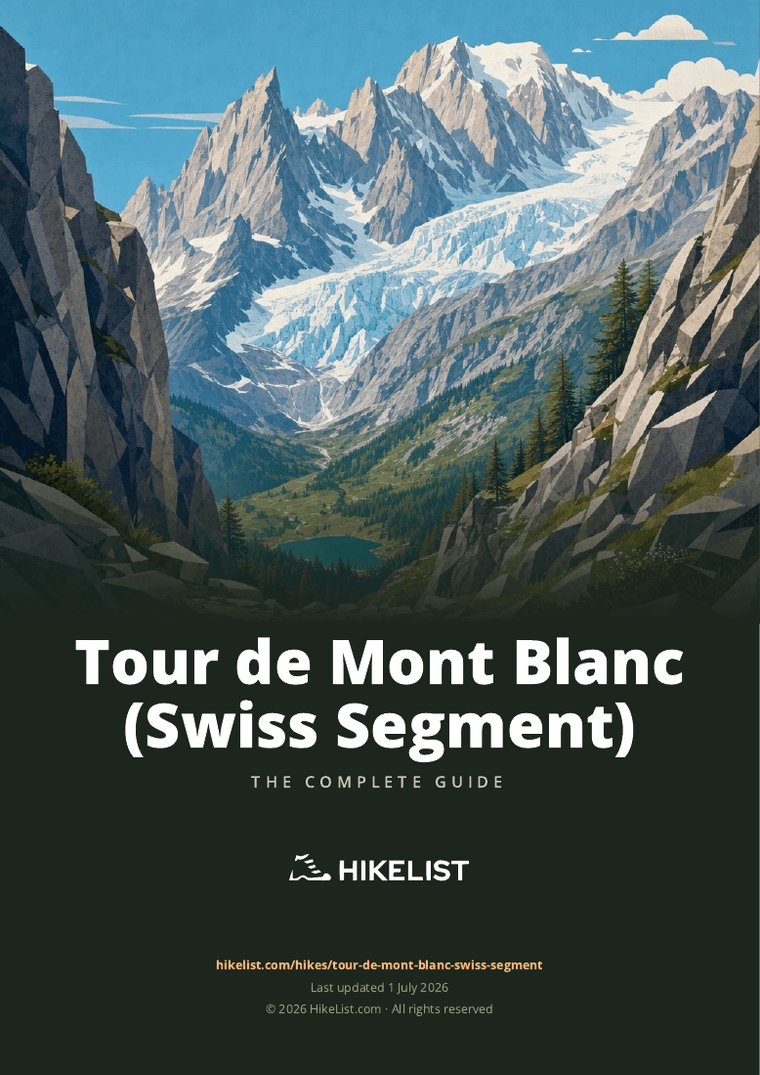
Tour de Mont Blanc (Swiss Segment)
How would you rate Tour de Mont Blanc (Swiss Segment)?
Tap a star to share your experience and help other hikers.
Tour de Mont Blanc Swiss Segment: Val Ferret to Col de Balme
HikeList Score
Tour de Mont Blanc (Swiss Segment) scored 86/100 on HikeList's trail-quality metrics.
See score breakdownHide breakdown
- Ideal length 70
- Balanced challenge 80
- Scenery & wildness 88
- Varied terrain 100
- Accommodation 92
- Food & support 88
- Path quality 98
- Season flexibility 76
Computed from length, challenge, scenery & wildness, terrain variety, accommodation, food & support, path quality and season flexibility.
The Tour de Mont Blanc Swiss segment is a roughly 45 km, 3-day, hard section of the TMB through Valais in Switzerland. It runs from the Grand Col Ferret on the Italy–Switzerland border to the Col de Balme on the Swiss–French border, via La Fouly, Champex-Lac and Trient. Expect red-and-white GR waymarking, sustained mountain days, steep cols and several thousand metres of cumulative climbing. It suits fit hikers already comfortable with Alpine terrain and variable weather.
Route Overview
Walked in the classic anticlockwise TMB direction, the Swiss segment starts at the Grand Col Ferret, descends into the Swiss Val Ferret, then passes La Fouly, Praz-de-Fort, Issert and Orsieres before climbing to Champex-Lac. From Champex the standard route crosses the Bovine alp to Trient; in settled conditions, strong hikers may choose the harder Fenetre d’Arpette variant. The segment finishes by climbing from Trient to the Col de Balme, where the TMB enters France above the Chamonix valley. It is a point-to-point section of the larger TMB loop. For other Swiss multi-day mountain routes, compare the Alpine Pass Route (Route 6), Bernina Trek or Aletsch Glacier UNESCO Trail.
TMB history and the Swiss Valais section
The Tour du Mont Blanc traces its lineage to Horace-Bénédict de Saussure, the Geneva scientist generally credited with the first circuit of the Mont Blanc massif in 1767. Today the TMB is a waymarked GR long-distance path. The Ultra-Trail du Mont-Blanc, an annual mountain ultramarathon, follows essentially the same circuit and passes through the Swiss villages of the Val Ferret, Champex and Trient.
Notable highlights
- Grand Col Ferret (2,537 m): The pass forms the Italy–Switzerland border and is the gateway into the Swiss Val Ferret. It gives the Swiss segment a high, exposed start.
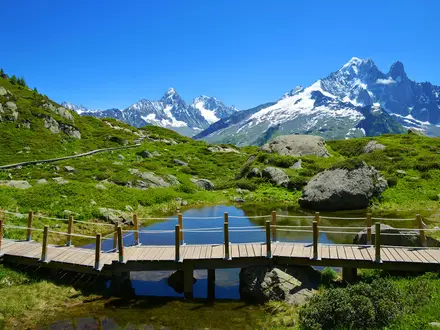
- Champex-Lac (roughly 1,466 m): A lakeside resort village nicknamed “Little Canada”, with a small alpine lake and the Flore-Alpe alpine botanical garden. It is a key overnight stop before the Champex–Trient stage.
- Bovine route (about 1,987 m): The standard TMB crossing from Champex to Trient goes over the Bovine alp. It is lower than the Fenetre d’Arpette variant but still a strenuous mountain day with views across the Rhone valley.
- Fenetre d’Arpette (2,665 m): A rocky notch and the hardest TMB variant, with close views of the Trient Glacier. Attempt it only in stable weather and when snow conditions allow.
- Trient Glacier: The glacier hangs above the Trient valley, with blue crevasses visible from the Fenetre d’Arpette descent. It is the main reason many strong hikers choose the high variant.
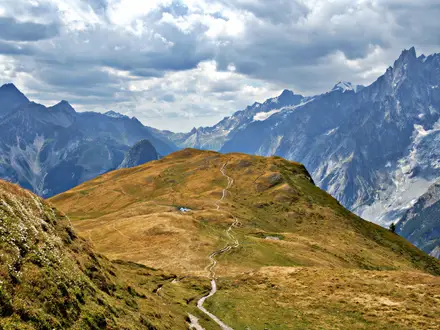
- Col de Balme (2,191 m): The Swiss–French border pass marks the end of this segment. It gives the classic first or last full panorama of Mont Blanc and the Chamonix valley on the TMB.
Challenges to expect
This is a hard Alpine section, not a valley walk. Daily ascents are roughly 600–1,200 m, with mixed surfaces from gravel tracks and farm roads to rocky trail and boulder ground. The Fenetre d’Arpette is rough, steep and can hold snow patches into July. Weather can change quickly on the cols, and refuges or village accommodation should be booked ahead in high season.
HikeList Score
Tour de Mont Blanc (Swiss Segment) scored 86/100 on HikeList's trail-quality metrics.
See score breakdownHide breakdown
- Ideal length 70
- Balanced challenge 80
- Scenery & wildness 88
- Varied terrain 100
- Accommodation 92
- Food & support 88
- Path quality 98
- Season flexibility 76
Computed from length, challenge, scenery & wildness, terrain variety, accommodation, food & support, path quality and season flexibility.
 Switzerland
Show more data Show less
- Mountainous
- Forest
- Alpine Meadows
- Valley
- Rocky
- Gravel
- Farm Roads
- Boulder
- Huts
- Dormitories
- Gites
- Hotels
- Guesthouses
- Campsites
- Bivouac Options
- Family Friendly
- Pet Friendly
- Restrooms
- Water Sources
- Campsites
- Shelters
Download Our Full Guide to Tour de Mont Blanc (Swiss Segment) FREE!
Get our comprehensive guide to this hike for free. Save it for later reading or print out at home.
Photos from hikers
Taken on the trail by people who've reviewed Tour de Mont Blanc (Swiss Segment).
Tour de Mont Blanc (Swiss Segment): The Complete Guide
The Swiss segment of the Tour du Mont Blanc is a compact, demanding three-day crossing of Valais from the Grand Col Ferret to the Col de Balme. It links high border passes, the pastoral Swiss Val Ferret, Champex-Lac and Trient in one of the most varied sections of the wider TMB.
The route begins high on the Italy–Switzerland border, then drops through larch forest, alpine pasture and traditional hamlets such as La Fouly, Praz-de-Fort and Issert. Champex-Lac gives the first proper village pause, with its lake, accommodation and onward choice of routes.
Between Champex and Trient, the character of the walk changes sharply depending on conditions and ability. The standard route crosses the lower Alpe Bovine, while the Fenêtre d’Arpette variant climbs to 2,665 m over rough boulder ground for close views of the Glacier du Trient.
This is not a gentle valley walk. Expect sustained Alpine days, 600–1,200 m of climbing, rocky paths, exposed cols, fast-changing weather and possible lingering snow on the highest ground into early summer.
This guide covers the stages, day planning, accommodation, food, transport, terrain choices and common mistakes on the Swiss TMB segment.
Stage-by-Stage Guide
Stage 1: Grand Col Ferret to Champex-Lac
Approx. distance: 15 km
Main places: Grand Col Ferret, La Fouly, Praz-de-Fort, Issert, Orsières, Champex-Lac
This stage starts high, exposed and already in serious mountain terrain at the Grand Col Ferret, the 2,537 m pass on the Italy–Switzerland border. From the pass the route drops into the Swiss Val Ferret, trading the open border ridge for alpine pasture, larch forest and traditional Valais hamlets.
The first priority is the descent. Expect rocky mountain path near the pass, then easier tracks, farm roads and valley paths as the route loses height towards La Fouly and the settlements lower in the Val Ferret. In early summer, snow can still affect high ground, so the start should not be treated as a simple valley approach.
La Fouly is the first significant service point in Switzerland and a logical place for food, water and transport connections if needed. Further down the valley the route passes through or near Praz-de-Fort, Issert and Orsières before climbing towards Champex-Lac, so the day has a clear change in character: a long descent through the Val Ferret followed by a rise to the lakeside resort.
Champex-Lac, at about 1,466 m, is the overnight target. It has a wider choice of accommodation than the smaller hamlets, including hotels, guesthouses, dormitory-style options and camping nearby, but beds should be booked well ahead for July and August. The Jardin botanique alpin Flore-Alpe and the lake make Champex-Lac a worthwhile stop, but late arrivals should prioritise checking in, drying kit and preparing for the harder second stage.
Food and water planning is straightforward by Alpine standards, but not something to leave to chance. La Fouly and Champex-Lac are the main dependable service points; smaller places may have limited or seasonal options. Carry enough water and snacks to cover the full stage, especially if starting early or walking outside the busiest summer weeks.
There is no railway on the trail itself. Orsières is the rail terminus below Champex on the Martigny–Orsières line, and CarPostal buses serve La Fouly, the Val Ferret and Champex-Lac. Timetables and connections should be checked before travelling, especially if using this stage as a start or exit point rather than as part of the full TMB.
Navigation is generally on the red-and-white GR / TMB waymarking, with village and valley junctions requiring more attention than the open pass. The main risk is underestimating the stage because it begins with a descent: the climb to Champex-Lac still comes after several hours on foot. In poor visibility on the Grand Col Ferret, use map, compass or GPS as a backup to the waymarks.
Stage 2: Champex-Lac to Trient
Approx. distance: 16 km
Main places: Champex-Lac, Alpe Bovine or Fenêtre d'Arpette, Col de la Forclaz, Trient
This is the key decision day of the Swiss segment. From Champex-Lac to Trient there are two recognised TMB options: the standard lower route over Alpe Bovine, or the much harder high variant through the Fenêtre d'Arpette.
The Alpe Bovine route is the standard and more forgiving line. It crosses wooded alp and reaches about 1,987 m, with broad views across the Rhône valley towards Martigny. It is the sensible choice in bad weather, poor visibility, lingering snow or when legs are tired from previous stages.
The Fenêtre d'Arpette variant is a serious Alpine crossing and should only be chosen by strong, experienced walkers in settled conditions. It climbs to 2,665 m, making it the high point of this Swiss segment and the joint-highest point of the whole Tour du Mont Blanc. The terrain is rocky and bouldery, with close views of the Glacier du Trient, but snow can linger into July and the descent demands concentration.
For most walkers, the day should be planned around conditions rather than ambition. If the weather is unstable, visibility is poor or snow conditions are uncertain, take the Bovine route. The Fenêtre d'Arpette is not a bad-weather alternative and should not be treated as a normal hill path.
Both options finish by reaching the Trient side of the crossing, with the Col de la Forclaz as an important waypoint on or near the route. The Col de la Forclaz is a road pass with a landmark hotel and transport access, while Trient lies lower in the valley at about 1,300 m. Accommodation is available in Trient and at the Col de la Forclaz, including gîte-style and hotel options, but advance booking is strongly recommended in the main TMB season.
Food and water should be organised before leaving Champex-Lac. The Col de la Forclaz may provide services, but opening times and meal availability should be checked before relying on it. On the Fenêtre d'Arpette variant, carry all food and enough water for a long, exposed mountain day, as there should be no assumption of dependable services between Champex-Lac and the Trient side.
Public transport is useful at both ends of the stage. CarPostal buses serve Champex-Lac, the Col de la Forclaz and Trient, giving practical escape or adjustment options if the weather turns or a rest day is needed. Timetables should be checked before travelling, as mountain bus services can be seasonal or infrequent.
Navigation is more consequential on this stage than on the valley sections. The Bovine route is lower and more sheltered, but still needs care at junctions through forest, pasture and farm tracks. The Fenêtre d'Arpette involves rougher ground where waymarks can be harder to follow in mist or snow patches, so a proper map and reliable navigation backup are essential.
The main hazards are exposure, rapid weather change, rocky footing and lingering snow on the high variant. The Fenêtre d'Arpette should be avoided in thunderstorms, low cloud, fresh snow or icy conditions. On the Bovine route, mud and slippery forest path can still slow progress after rain, but the consequences are generally lower than on the high variant.
Stage 3: Trient to Col de Balme
Approx. distance: 15 km
Main places: Trient, Les Herbagères, Col de Balme
The final Swiss stage climbs from Trient back to the frontier ridge. It is a shorter-looking day on paper, but it still involves a sustained ascent through pasture and forest towards Les Herbagères and the Col de Balme.
The path character is a mix of village departure, wooded climbing and open mountain pasture. As height is gained the route becomes more exposed to wind and weather, with the Col de Balme at 2,191 m forming the Switzerland–France border and the end of the Swiss segment. In clear conditions this is the stage that delivers the classic view towards Mont Blanc and the Chamonix valley.
Trient is the place to start with full bottles and food for the day. Do not rely on finding services on the climb or at the pass unless current opening is checked before setting off. Weather at the Col de Balme can feel very different from the valley, so keep waterproofs, warm layers, gloves and hat accessible rather than buried in the pack.
There is accommodation in Trient for those breaking the route before the climb, and further options off the Swiss segment after descending into the French side. The Col de Balme itself should be treated primarily as a high pass and route junction, not as a guaranteed overnight stop. If finishing the Swiss segment here, onward accommodation should be arranged either back in the Trient area or after descending towards Le Tour, Vallorcine or the Chamonix valley.
Public transport does not remove the need to descend from the pass. From the Col de Balme, walkers typically leave the Swiss segment by descending into France towards Le Tour or Vallorcine, with access to the Mont-Blanc Express for Chamonix, or by returning towards Trient for Swiss-side bus links. Exact connections should be checked before travelling.
Navigation follows TMB / GR waymarking, but attention is needed in forest, at pasture junctions and near the border where multiple paths can converge. In clear weather the pass is an obvious objective; in cloud, it becomes a navigation exercise rather than a scenic stroll. Carry a map or offline mapping and avoid depending solely on signposts in poor visibility.
The main warnings are the sustained climb, exposure near the col and fast-changing mountain weather. Early-season snow can affect high passes, and strong wind or low cloud can make the border ridge feel severe even in summer. This is not a difficult technical stage in normal conditions, but it remains an Alpine mountain day and should be treated accordingly.
Recommended Itinerary
Standard 3-day itinerary
This is the normal way to walk the Swiss segment as a self-contained TMB section. It keeps each day within the established stage pattern, with village accommodation at Champex-Lac and Trient, and leaves the key route-choice day between Champex and Trient flexible for weather and snow conditions.
| Day | From | To | Approx. distance | Why this stage makes sense | Services/accommodation notes |
|---|---|---|---|---|---|
| 1 | Grand Col Ferret | Champex-Lac | ~15 km | Starts with the high border crossing into Switzerland, then drops through the Swiss Val Ferret via La Fouly, Praz-de-Fort, Issert and the Orsières valley before climbing towards Champex-Lac. It is a logical first Swiss stage because it finishes at a proper resort village rather than leaving the walker in the valley. | La Fouly is the main intermediate service point and a useful place to stop, break the day or use bus connections. Champex-Lac has hotels, guesthouses, gîtes and campsites, but beds should be booked well ahead in July–August. Orsières is the rail terminus below Champex; bus and rail times should be checked before travelling. |
| 2 | Champex-Lac | Trient | ~16 km | The crux planning day. The standard TMB line crosses the lower Alpe Bovine, which is the sensible choice in poor weather, uncertain snow or low visibility. Strong walkers may take the Fenêtre d'Arpette variant in settled conditions; this reaches 2,665 m and is the hardest option on the Swiss segment. | Start early and decide the route before leaving Champex-Lac. Trient and the nearby Col de la Forclaz have accommodation options, but capacity is limited in peak TMB season. The Fenêtre d'Arpette should not be treated as a routine bad-weather alternative; take the Bovine route if conditions are doubtful. |
| 3 | Trient | Col de Balme | ~15 km | A final sustained climb through pasture and forest towards Les Herbagères and the Col de Balme, ending the Swiss segment on the Switzerland–France border. The pass gives the onward link towards Le Tour and the Chamonix valley, or a return option back towards Trient. | The route finishes on a high pass rather than in a major service village. Plan the onward descent and the night’s accommodation before setting out, either towards Le Tour/Vallorcine and the Chamonix valley or back on the Swiss side. Current transport times should be checked before travelling. |
Slower variant: 4 days
A slower schedule suits walkers starting late from the Italian side, those carrying heavier packs, or anyone wanting more margin around transport and weather. The most obvious split is to stop in La Fouly after descending from the Grand Col Ferret, then continue to Champex-Lac the following day.
| Day | From | To | Approx. distance | Why this stage makes sense | Services/accommodation notes |
|---|---|---|---|---|---|
| 1 | Grand Col Ferret | La Fouly | Check official mapping before booking | Shortens the exposed high-start day and avoids pushing on to Champex-Lac after a late arrival at the pass. | La Fouly has village accommodation and bus links in the Val Ferret. Book ahead in high season. |
| 2 | La Fouly | Champex-Lac | Check official mapping before booking | Gives more time for the Val Ferret hamlets and the climb towards Champex-Lac without combining everything into one long first day. | Champex-Lac is the best overnight base before choosing between Alpe Bovine and Fenêtre d'Arpette. |
| 3 | Champex-Lac | Trient | ~16 km | Keeps the major Champex–Trient crossing as a full day, which is important if considering the Fenêtre d'Arpette variant. | Choose Alpe Bovine in poor weather or if snow remains on the high variant. Trient and Col de la Forclaz accommodation should be booked in advance. |
| 4 | Trient | Col de Balme | ~15 km | Leaves the final climb to the border as its own day, with more time to manage onward descent to France or return to the Swiss side. | Arrange the off-segment finish before leaving Trient. This should be checked before travelling. |
Faster variant: 2 days
A 2-day crossing is only for very fit, experienced mountain walkers with light packs, stable weather and early starts. It usually means combining the first two standard stages into one very long day from the Grand Col Ferret to Trient, then walking from Trient to the Col de Balme on day two.
| Day | From | To | Approx. distance | Why this stage makes sense | Services/accommodation notes |
|---|---|---|---|---|---|
| 1 | Grand Col Ferret | Trient | ~31 km | Combines the descent through the Val Ferret, the passage through Champex-Lac and the Champex–Trient crossing into one hard Alpine day. This is a demanding option and is more sensible via the lower Alpe Bovine route than via the Fenêtre d'Arpette. | Requires a very early start and a booked bed in Trient or at the Col de la Forclaz. Do not rely on making transport connections after such a long mountain day without checking timetables first. |
| 2 | Trient | Col de Balme | ~15 km | Completes the Swiss segment with the climb to the France–Switzerland border. | Plan the descent to Le Tour/Vallorcine or back towards Trient in advance. This should be checked before travelling. |
Planning the Route
Allow three walking days, not a rushed long weekend
The Swiss segment is most cleanly planned as three mountain stages: Grand Col Ferret to Champex-Lac, Champex-Lac to Trient, and Trient to the Col de Balme. This structure fits the natural overnight points and avoids trying to force long Alpine days around limited village accommodation and transport.
Strong walkers can move faster, but there is little practical benefit in rushing this section. The terrain is slow in places, the weather can change quickly, and the Champex–Trient day needs a proper decision between the lower Bovine route and the much harder Fenêtre d'Arpette variant.
If walking only the Swiss segment, remember that both ends are high border passes rather than convenient transport hubs. Reaching the Grand Col Ferret and leaving the Col de Balme add planning time and, in most cases, extra walking or connecting transport.
How the stages fit together
| Stage | Practical planning notes |
|---|---|
| Grand Col Ferret to Champex-Lac | The day begins high and exposed at the Italy–Switzerland border before dropping into the Swiss Val Ferret. La Fouly, Praz-de-Fort, Issert and Orsières sit on the approach towards Champex-Lac, but accommodation should still be booked around the intended stopping point rather than assumed on arrival. |
| Champex-Lac to Trient | This is the key route-choice day. The standard TMB crosses Alpe Bovine and is the sensible option in poor weather. The Fenêtre d'Arpette is higher, rockier and more serious, with boulder ground and possible snow into July; take it only in settled conditions and with enough time, fitness and visibility. |
| Trient to Col de Balme | The final Swiss stage climbs through pasture and forest towards Les Herbagères and the Col de Balme. The mapped segment ends at the border pass, but onward logistics require either continuing into France towards Le Tour / the Chamonix valley or descending back towards Trient. |
Choosing between Bovine and Fenêtre d'Arpette
The Champex-Lac to Trient crossing is the main planning decision on this section. The lower, standard route over Alpe Bovine is still a proper mountain day, but it avoids the highest and roughest ground and is the better choice when cloud, wind, thunderstorms or snow make the high variant unsafe.
The Fenêtre d'Arpette reaches 2,665 m and is the high point only if this variant is taken. It is widely treated as one of the toughest parts of the whole TMB, with rocky ground, boulder fields and close views of the Glacier du Trient. In doubtful conditions, plan for Bovine rather than treating Arpette as the default.
Accommodation drives the itinerary
The route is naturally dictated by the established TMB overnight stops: La Fouly, Champex-Lac, Trient and the Col de la Forclaz, with other village options along the Val Ferret approach. Beds in huts, gîtes, guesthouses and small hotels fill quickly in July and August, so the walking plan should be built around confirmed accommodation rather than adjusted casually day by day.
Opening periods vary, with many mountain and TMB services operating roughly from mid-June to late September. This should be checked before travelling, especially for early-season or late-season trips.
Camping may be possible at established campsites, but do not assume that wild camping or hut grounds are available without checking local rules and the individual site arrangements. Any campsite requirements should be checked before travelling.
Food, water and resupply
This is not a remote wilderness traverse, but it is still an Alpine route where the next village may be several hours away. Plan to carry lunch, snacks and enough water for each full stage, particularly on the Champex–Trient crossing and the climb to the Col de Balme.
Use La Fouly, Champex-Lac, Trient and the Col de la Forclaz as the main planning points for meals and supplies. Do not rely on every hamlet or alp having open services on the day; opening hours and seasonal operation should be checked before travelling.
Transport and section hiking
Section hiking is practical, but it is more complex than a lowland trail because neither the Grand Col Ferret nor the Col de Balme is a railway station. Orsières is the rail terminus below Champex, with rail links via Martigny, and CarPostal buses serve La Fouly, Champex-Lac, the Val Ferret, the Col de la Forclaz and Trient.
For the start, plan access via the Italian side around Courmayeur or via the Swiss Val Ferret, depending on the wider itinerary. For the finish, most walkers either continue down into France towards Le Tour and the Chamonix valley, or descend back towards Trient. Current rail and postbus times should be checked before travelling.
Shortening the route is easiest by using the valley transport network around La Fouly, Orsières, Champex-Lac, the Col de la Forclaz and Trient. Shortening the high-pass sections themselves is less straightforward, so poor-weather alternatives should be planned before setting out rather than improvised late in the day.
Navigation, weather and safety planning
The Swiss TMB is waymarked with red-and-white GR / TMB balisage, but navigation should not rely on paint marks alone. Carry suitable mapping for the Val Ferret, Champex and Trient area, such as the relevant Swisstopo 1:50,000 sheets, plus a reliable offline navigation backup.
Snow can linger on high cols into early summer, especially around the Fenêtre d'Arpette. Low cloud can also make the route choice above Champex more serious, and thunderstorms are a real concern on exposed cols such as the Grand Col Ferret and Col de Balme.
The most important planning priorities are accommodation, weather windows, the Champex–Trient variant decision, and transport at both ends. Diversion notices, snow conditions, hut openings and bus times should all be checked before travelling.
Towns, Villages and Overnight Stops
The Swiss segment is easiest to plan around three main overnight bases: La Fouly or Champex-Lac on the Val Ferret side, Champex-Lac, and Trient or the Col de la Forclaz before the final climb to the Col de Balme. Beds on the Tour du Mont Blanc are in high demand in July and August, so book accommodation before fixing transport.
| Place | Best use for hikers | Overnight suitability | Transport notes |
|---|---|---|---|
| Grand Col Ferret | High border pass and entry into Switzerland | Not a practical village stop | Reached via Courmayeur/Italy or by bus access into the Val Ferret; details should be checked before travelling |
| La Fouly | First real Swiss village after the pass | Good stop if splitting the Swiss arc or starting below the pass | Served by CarPostal postbus in the Val Ferret |
| Praz-de-Fort / Issert | Small Valais hamlets on the descent towards Champex | Passage points rather than core overnight bases | Local bus options should be checked before travelling |
| Orsières | Valley transport hub below Champex | Useful access/exit base rather than a classic high-route night | Rail terminus of the Martigny–Orsières line; postbus links serve the area |
| Champex-Lac | Main lakeside overnight stop | Excellent and logical overnight base | Served by postbus connections via Orsières |
| Col de la Forclaz | Road pass above Trient | Useful alternative to Trient if accommodation is full or logistics fit | Postbus link to Trient and onward valley connections |
| Trient | Main stop before the Col de Balme day | Excellent and logical overnight base | Served by postbus; also useful for dropping out towards the valley |
| Les Herbagères | High waypoint on the final climb | Not a normal overnight stop | Treat as a mountain waypoint, not a service centre |
| Col de Balme | Border pass and end of the Swiss segment | Not a village stop | Descend to Le Tour/Vallorcine in France or back towards Trient |
Grand Col Ferret
Grand Col Ferret is the high Italy–Switzerland border pass where the anticlockwise TMB enters the Swiss Val Ferret. It is a dramatic start point, but it is not a village or a practical place to base an overnight plan unless using accommodation on the Italian side before the pass.
For most walkers, the key decision is how to reach the pass or the upper Val Ferret without overloading the first day. Access is possible via Courmayeur/Italy or by bus up the Val Ferret, but current timetables and seasonal operation should be checked before travelling.
There should be no assumption of food, shops or last-minute shelter at the pass. Start the day with enough food, water and bad-weather clothing for a high, exposed crossing and a long descent into Switzerland.
La Fouly
La Fouly sits at about 1,600 m in the Swiss Val Ferret, below the descent from Grand Col Ferret. It is the first significant Swiss village on this segment and a useful place to start, finish or break the route if the full Grand Col Ferret to Champex-Lac stage feels too long.
Accommodation is part of the mixed TMB pattern here: village beds, gîtes, small hotels and camping options in the valley. Exact openings, prices and meal arrangements vary by season and should be checked before booking.
La Fouly is also one of the better service points in the Val Ferret because it is a recognised TMB stop and has CarPostal postbus access. If starting the Swiss segment from La Fouly rather than from Grand Col Ferret, the first day becomes less exposed and easier to fit around public transport.
Praz-de-Fort
Praz-de-Fort is one of the traditional Valais hamlets passed in the Swiss Val Ferret between La Fouly and the climb towards Champex-Lac. It is best treated as a route waypoint rather than a primary overnight base for the classic three-day Swiss segment.
Do not rely on Praz-de-Fort for a full resupply unless current services have been checked in advance. Small hamlets on this section are useful for orientation and atmosphere, but the dependable overnight planning points are La Fouly, Champex-Lac, Trient and the Col de la Forclaz.
Issert
Issert is another small hamlet on the Val Ferret approach to Champex-Lac. It matters because it marks the transition from the valley settlements towards the climb up to the lake resort.
For accommodation and food planning, Issert should be treated cautiously unless a specific booking has been made. Walkers carrying only a light day’s food should plan around the larger stops, not assume that every hamlet will have open services.
Orsières
Orsières sits on the valley floor below Champex and is the rail terminus of the Martigny–Orsières line. Martigny is on the main Simplon line and also links with the Chamonix–Martigny Mont-Blanc Express, making Orsières the most important Swiss-side public transport hub for this segment.
It is not usually the most natural overnight stop for walkers following the high TMB line through Champex-Lac, but it is extremely useful for joining, leaving or shortening the route. Postbuses serve Champex-Lac, La Fouly, the Val Ferret, Trient and the Col de la Forclaz from this wider network.
Use Orsières when the priority is transport reliability rather than mountain atmosphere. Current rail and postbus times should be checked before travelling, especially if trying to connect with accommodation check-in or an onward train.
Champex-Lac
Champex-Lac, at about 1,466 m, is the main overnight stop between the Val Ferret and Trient. It sits by a small alpine lake and has the broadest practical role on the Swiss segment: accommodation base, food stop, transport link and decision point for the next day’s route.
This is where walkers choose between the standard TMB route over Alpe Bovine and the harder Fenêtre d’Arpette variant. That decision should be made according to weather, snow conditions, fitness and daylight, not simply because the high variant is famous.
Accommodation is available in the village in the usual TMB mix of hotels, guesthouses, gîtes, dormitories and campsites. July and August beds can fill quickly, so Champex-Lac should be booked early, particularly if walking on a fixed schedule.
Food and local services are better here than in the smaller Val Ferret hamlets, but opening hours still vary by season. If leaving early for Fenêtre d’Arpette, organise breakfast, packed lunch and any resupply the night before.
Alpe Bovine
Alpe Bovine is not a village, but it is the key waypoint on the standard Champex-Lac to Trient crossing. At about 1,987 m, it is the lower and more sheltered choice compared with Fenêtre d’Arpette and is the sensible route in poor weather.
Do not plan Alpe Bovine as an overnight stop. Treat it as part of the mountain day between Champex-Lac and Trient or the Col de la Forclaz, with food, water and layers carried from the valley.
Fenêtre d’Arpette
Fenêtre d’Arpette is the high variant between Champex-Lac and Trient and reaches 2,665 m, the joint-highest point of the whole TMB. It is a rocky mountain notch above the Val d’Arpette, with boulder ground and close views towards the Glacier du Trient.
This is not an overnight stop and has no role in accommodation planning except that it makes the Champex–Trient day much more demanding. It should only be attempted by strong walkers in settled weather and suitable snow conditions; snow can linger here into July.
If there is doubt, take the standard Alpe Bovine route and keep the overnight plan unchanged. The destination for the day remains Trient or the Col de la Forclaz.
Col de la Forclaz
The Col de la Forclaz is a road pass at 1,527 m above Trient and an important TMB waypoint on the Champex–Trient stage. It has accommodation at the pass, including the landmark hotel, and can be a practical alternative overnight stop if Trient is full or if the day’s logistics work better there.
It is also useful because postbuses serve the pass and connect it with Trient and the wider valley transport network. That makes it a good place to end a stage, bail out in poor weather or rejoin the route without descending fully into Trient.
Food and opening arrangements at road-pass accommodation should be checked before relying on them. In high season, book ahead rather than arriving late and hoping for a bed.
Trient
Trient, at about 1,300 m, is the main overnight base before the final climb to the Col de Balme. It is a classic TMB village stop and the most straightforward place to sleep after the Champex crossing, whether arriving via Alpe Bovine or Fenêtre d’Arpette.
Accommodation includes the usual TMB-style mix of dormitory and village options, with campsites also part of the wider accommodation pattern on this Swiss segment. Book well ahead in July and August, as Trient is a bottleneck for walkers moving between Switzerland and France.
Trient is served by postbus, making it useful for access, exit or weather-related changes. If the next day’s conditions look poor, transport options via Trient or the Col de la Forclaz should be checked before setting off.
There is no need to overcomplicate the final stage from a logistics point of view: Trient is the best place to organise breakfast, packed food and an early start for the climb towards Les Herbagères and the Col de Balme.
Les Herbagères
Les Herbagères, at about 2,033 m, is a high waypoint on the final Swiss climb from Trient towards the Col de Balme. It is useful for judging progress on the last day, but it should not be treated as a service stop.
Carry what is needed from Trient or the Col de la Forclaz. Any seasonal mountain-farm or refreshment possibilities in this area should be checked before travelling and should not be central to the day’s plan.
Col de Balme
The Col de Balme, at 2,191 m, is the Switzerland–France border pass where this Swiss segment ends and the TMB drops towards the Chamonix valley. It is a pass, not a village, so it is better treated as a finish point for the walking line rather than an overnight base.
From here, walkers usually leave the Swiss segment by descending to Le Tour or Vallorcine in France, with onward access to the Mont-Blanc Express and Chamonix valley. Another option is to descend back towards Trient if weather or logistics make the French side less practical.
Do not leave transport decisions until the top of the pass. Work out the descent, onward rail or bus connection, and accommodation plan before leaving Trient, especially late in the day or outside peak summer services.
Le Tour / Chamonix Valley
Le Tour and the wider Chamonix valley are off the Swiss segment, but they are the natural onward destination after crossing the Col de Balme into France. Vallorcine is on the Mont-Blanc Express route to Chamonix, making this side useful for onward travel after completing the Swiss arc.
Accommodation and food planning here belongs to the French side of the TMB rather than the Swiss section. If ending the hike at the Col de Balme, make sure the descent route and onward transport from Le Tour or Vallorcine are planned before the final day begins.
Getting to the Start
The Swiss segment starts at the Grand Col Ferret, a high pass on the Italy–Switzerland border. It is not a town trailhead: most walkers reach it either on foot as part of the full anticlockwise Tour du Mont Blanc from Italy, or by using valley transport and then walking up to the pass before continuing into Switzerland.
For section-hikers, the key planning point is that the public-transport hub is Orsières, not the col itself. Build in enough time for the final mountain approach, and check all bus and train times against the current season before committing to accommodation.
By train
The nearest useful railway station for the Swiss-side approach is Orsières, the terminus of the Martigny–Orsières line. Martigny is on the main Simplon line and also connects with the Chamonix–Martigny Mont-Blanc Express, making it the main rail gateway for reaching the Val Ferret and Champex area.
From Orsières, continue by postbus towards La Fouly and the Swiss Val Ferret. The railway does not reach the Grand Col Ferret, so the last section to the start is a mountain approach on foot from the valley side, unless arriving over the pass from Italy as part of the full TMB.
Rail and bus connections in the Valais valleys can be well coordinated, but frequency varies by season and time of day. This should be checked before travelling, especially if arriving late in the afternoon or planning to reach accommodation the same evening.
By bus
Swiss CarPostal postbuses serve La Fouly, Champex-Lac, the Val Ferret, Col de la Forclaz and Trient. For the start, the most relevant Swiss-side service is the postbus link from Orsières into the Val Ferret / La Fouly area.
A bus will not remove the need to walk to the Grand Col Ferret. If starting the segment exactly at the border pass, allow for the climb from the valley access point before beginning the descent into the Swiss Val Ferret and onward towards Champex-Lac.
If bus times do not line up with rail arrivals, a taxi may be needed from Orsières or the valley villages. Availability, booking requirements and cost should be checked before travelling.
By car
Driving is awkward for this section because the route is point-to-point and finishes at the Col de Balme on the Switzerland–France border, with onward descent usually towards Le Tour / the Chamonix valley or back towards Trient. Leaving a car near the start creates a return-transfer problem at the end of the walk.
Do not plan around parking at the Grand Col Ferret itself. Treat the col as a mountain pass reached on foot from the Swiss Val Ferret or from the Italian side near Courmayeur.
If using a car, the more practical approach is to park in a valley base such as Orsières, La Fouly, Champex-Lac, Trient or on the Italian approach, then use public transport or taxis to make the route work. Long-stay parking rules, charges and availability should be checked before travelling.
From the nearest airport
There is no airport close to the Grand Col Ferret. Choose flights around the best onward connection to one of the main access gateways: Martigny and Orsières for the Swiss-side approach, Chamonix for the Mont-Blanc Express connection to Martigny, or Courmayeur if joining the route from the Italian side.
The onward journey will still involve rail, postbus and a final walk to the pass. Airport-to-trail transfers, seasonal coach options and late-arrival feasibility should be checked before booking flights.
Where to stay before starting
For a Swiss-side start, La Fouly is the most logical village base in the Val Ferret, with mixed Alpine accommodation including small hotels, guesthouses, gîtes, refuges and camping in the wider route area. Staying there keeps you close to the valley approach to the Grand Col Ferret, but you still need to factor in the climb to the pass before beginning the official Swiss segment.
Orsières is useful if arriving by train late in the day and continuing by postbus the next morning. Champex-Lac has more of a resort feel and is on the first stage’s destination side, so it is better for revised itineraries than for a strict Grand Col Ferret start.
Walkers arriving from Italy commonly approach via Courmayeur and the Italian Val Ferret before crossing the Grand Col Ferret into Switzerland. Accommodation and transport on that side should be booked and checked separately.
Beds on the Tour du Mont Blanc corridor fill quickly in July and August. Book accommodation well ahead and avoid planning the first day around a tight same-day connection to a high pass.
Getting Home from the Finish
The Swiss segment finishes high at the Col de Balme, not at a transport hub. Plan the exit as part of the final walking day: from the pass you either descend into France towards Le Tour / Vallorcine and the Chamonix valley, or drop back into Switzerland towards Trient.
| Exit choice | Best for | Main onward link |
|---|---|---|
| Descend to Le Tour / Vallorcine | Continuing into France, Chamonix-based accommodation, onward travel by the Mont-Blanc Express | Mont-Blanc Express towards Chamonix or Martigny |
| Descend back to Trient | Staying on the Swiss side, returning towards Valais, avoiding a late crossing into France | CarPostal bus links from Trient / Col de la Forclaz, then rail via Martigny |
By train
There is no railway at the Col de Balme itself. For rail travel after finishing, descend to the Le Tour / Vallorcine side of the pass and use the Mont-Blanc Express, which links the Chamonix valley with Martigny.
Martigny is the key Swiss rail hub for this end of the route. It sits on the main Simplon line and also connects with the Chamonix–Martigny Mont-Blanc Express, making it the practical rail interchange for onward travel within Switzerland or back towards the wider TMB transport network.
If finishing late, do not assume a same-evening rail connection will still be available after the descent. Train times, seasonal patterns and the last departures should be checked before travelling.
By bus
On the Swiss side, CarPostal buses serve Trient and the Col de la Forclaz. This is the main public-transport option if you descend from the Col de Balme back into Switzerland rather than continuing down to the Chamonix valley.
Services in Alpine valleys are timetable-dependent, and late-day options can be limited. Check current CarPostal times before committing to a final-day plan, especially if the weather, snow conditions or fatigue may slow the climb from Trient to the Col de Balme.
By car/taxi
Do not plan a pick-up from the Col de Balme itself. Arrange any car or taxi collection from a road-accessible point after descending — typically Trient / Col de la Forclaz on the Swiss side, or the Le Tour / Vallorcine side if exiting into France.
A taxi can be useful if the final descent runs later than expected or if bus times do not line up with onward trains. Book ahead where possible, as availability in small Alpine villages should not be assumed at the end of the day.
From the nearest airport
The finish is not close to an airport in any practical walking sense. The usual approach is to descend to either the Chamonix valley or Trient, then continue by rail, bus, coach transfer or taxi towards the chosen departure airport.
Airport connections are highly dependent on the side of the pass you descend to and the season. If flying out the same day, allow a generous buffer; in many cases it is more sensible to stay overnight after finishing and travel the next morning. This should be checked before travelling.
Where to stay at the finish
There is no need to sleep at the Col de Balme itself, and it is not a practical place to end the day unless you are immediately continuing over the border and descending. The sensible overnight choices are below the pass: Trient or the Col de la Forclaz on the Swiss side, or the Le Tour / Chamonix valley side in France.
If the weather is poor, legs are tired, or the Fenêtre d'Arpette was taken the previous day, staying in Trient before the final climb can also make sense. In July and August, beds across the TMB corridor fill quickly, so accommodation at Trient, Col de la Forclaz and the Chamonix-side finish area should be booked well ahead.
Which Direction Should You Walk?
The standard and most practical direction for this Swiss segment is anticlockwise, from the Grand Col Ferret to the Col de Balme. This is the direction followed by most walkers on the full Tour du Mont Blanc, as the route enters Switzerland from Italy at the Grand Col Ferret, passes through the Val Ferret, Champex-Lac and Trient, then leaves Switzerland for France at the Col de Balme.
Walking in this direction keeps the Swiss section aligned with the normal TMB flow, which matters for accommodation, trail rhythm and route-finding. Refuges, gîtes and village stops in places such as La Fouly, Champex-Lac and Trient are used to walkers moving this way, especially in July and August.
Standard direction: Grand Col Ferret to Col de Balme
The anticlockwise direction gives the most satisfying progression. You begin high on the Italy–Switzerland border at the Grand Col Ferret, descend into the quieter Swiss Val Ferret, then move through the valley villages towards Champex-Lac before taking on the main Champex–Trient crossing.
The route then finishes with a final climb from Trient towards Les Herbagères and the Col de Balme. Ending on the Switzerland–France border above the Chamonix valley gives a strong psychological finish, with the classic Mont Blanc and Chamonix panorama at the point where the TMB leaves Switzerland.
The climbing is still hard in this direction, with sustained Alpine days and a significant final ascent to the Col de Balme. However, the effort is well distributed across the three stages, and the hardest decision — Alpe Bovine versus Fenêtre d'Arpette — comes in the middle of the segment rather than immediately at the start.
For logistics, this direction works best if you are already walking the full TMB from Italy. Standalone walkers can also reach the Swiss Val Ferret area by public transport links serving La Fouly and nearby valley villages, but reaching the exact start at the Grand Col Ferret involves an Alpine approach. Current CarPostal, rail and cross-border access details should be checked before travelling.
Reverse direction: Col de Balme to Grand Col Ferret
Walking eastwards from the Col de Balme to the Grand Col Ferret is possible, but it is less common for TMB walkers. It may suit hikers starting from the Chamonix side who want to enter Switzerland over the Col de Balme, then continue towards Champex-Lac and the Val Ferret.
The main drawback is that the route’s scenic climax comes early. You get the Chamonix and Mont Blanc views at the beginning, then finish at the Grand Col Ferret, where onward travel still requires descending towards Italy or back into the Swiss Val Ferret.
The physical difficulty does not disappear in reverse. The Champex–Trient crossing remains a serious mountain day whichever way it is walked, and the Fenêtre d'Arpette variant is still only suitable in settled weather and good snow conditions. If conditions are poor, the lower Alpe Bovine route remains the sensible option in either direction.
Reverse logistics can also be more awkward if the hike is treated as a self-contained Swiss segment. The Col de Balme finish/start requires access via Le Tour, Vallorcine or Trient, while the Grand Col Ferret end still leaves you on a high border pass rather than at a railhead. Exact bus and rail connections should be checked before booking accommodation.
Recommendation
For almost all hikers, the best direction is Grand Col Ferret to Col de Balme. It follows the traditional anticlockwise TMB direction, fits the natural accommodation flow through La Fouly, Champex-Lac and Trient, saves the Col de Balme panorama for the finish, and gives the Swiss segment a clear sense of progression from Italy towards France.
Walk it in reverse only if your wider itinerary or transport plan makes the Chamonix side the more practical starting point.
Accommodation Along the Route
Accommodation on the Swiss segment is practical but needs advance planning. The main overnight bases are La Fouly, Champex-Lac, Trient and the Col de la Forclaz, with a mix of Alpine huts/refuges, dormitory-style gîtes, small hotels, guesthouses and campsites.
The route works well for inn-to-inn walkers if beds are booked early and the classic stops are available. It is not a section to leave until arrival in July and August: the Tour du Mont Blanc is busy, village capacity is finite, and dormitory beds can fill fast across the main season.
Best overnight stops
For the classic three-stage Swiss crossing, the key nights are usually Champex-Lac and Trient or, depending on availability and stage preference, the Col de la Forclaz. Champex-Lac is the strongest overnight hub on the Swiss section, while Trient is more limited and should be booked as soon as the walking dates are fixed.
La Fouly is useful if you are breaking the descent from the Grand Col Ferret, joining or leaving the route in the Val Ferret, or building in a shorter first day. It is also a sensible buffer stop if weather, transport or late arrival makes a full Grand Col Ferret to Champex-Lac day unrealistic.
Praz-de-Fort and Issert are small Val Ferret hamlets rather than major accommodation hubs. Do not rely on them as overnight stops unless a specific bed has been booked.
| Place | Accommodation level | Best for | Notes |
|---|---|---|---|
| Grand Col Ferret | None | Start point only | A high border pass, not a practical overnight base. Plan your previous night and access carefully before starting the Swiss segment. |
| La Fouly | Good | Shorter stages, Val Ferret stopover, late starts after crossing the pass | Has the most useful accommodation choice before Champex-Lac, including Alpine-style village options and campsites. Book ahead in peak TMB season. |
| Praz-de-Fort | Limited | Emergency flexibility only | Small hamlet on the valley route. Use only with a specific booking; most walkers continue towards Champex-Lac. |
| Issert | Limited | Emergency flexibility only | Another small on-route hamlet before the climb to Champex-Lac. Do not assume easy walk-up availability. |
| Orsières | Limited | Transport fallback | Valley-floor rail terminus below Champex. Useful for access or recovery logistics rather than as a standard TMB overnight stop. Accommodation should be checked before travelling. |
| Champex-Lac | Good | Main first-night stop; rest or resupply-style pause | The strongest and most flexible overnight base on the Swiss segment, with hotels, guesthouses, gîtes and campsites. Also the decision point for the Bovine route or Fenêtre d'Arpette variant. |
| Col de la Forclaz | Limited | Alternative to Trient; shortening or reshaping the Champex–Trient day | Road pass above Trient with accommodation and postbus access. Useful when Trient is full or when stages need adjusting. |
| Trient | Limited | Main second-night stop before the Col de Balme | A key TMB village but with more limited capacity than Champex-Lac. Book early, especially for July–August and weekends. |
| Les Herbagères | None | Day route waypoint | Pasture area on the climb towards the Col de Balme, not an overnight planning base. |
| Col de Balme | None | Finish point of the Swiss segment | A high border pass. Plan to descend either towards Le Tour/Vallorcine in France or back towards Trient for onward transport and accommodation. |
Booking strategy
Book Champex-Lac and Trient first, then shape the rest of the itinerary around those confirmations. If Trient is full, the Col de la Forclaz can be a useful alternative, but it changes the end of the Champex day and the start of the final climb towards the Col de Balme.
In high season, assume shared rooms and dormitories may sell out well ahead of time. Refuge and gîte opening seasons commonly run around mid-June to late September, but exact dates vary each year and should be checked before travelling.
Weekends can add pressure at the easier-access stops, especially Champex-Lac and the Col de la Forclaz. A midweek itinerary is often simpler to book, but the TMB is popular throughout the main summer window.
Camping and budget options
Campsites are part of the accommodation mix on this segment, particularly in the valley and village areas. Use established campsites and check opening dates, reservation requirements and facilities before relying on them.
Do not assume that camping removes the need to book. In poor weather, or after a hard day over the Fenêtre d'Arpette, many walkers will want an indoor bed, and those beds may already be full.
Transfers, baggage and awkward gaps
Postbuses serve La Fouly, Champex-Lac, the Val Ferret, the Col de la Forclaz and Trient, so public transport can help if accommodation forces a slightly uneven itinerary. Orsières is the rail terminus below Champex and is useful for joining, leaving or resetting the route.
Luggage transfer should not be assumed between every stop unless it has been arranged in advance with an operator or accommodation provider. This should be checked before travelling.
Private taxi transfers can help with awkward accommodation gaps, but availability, prices and operating times vary. Do not build a tight mountain itinerary around an unconfirmed taxi transfer; arrange it before committing to the accommodation plan.
Camping and Wild Camping
Camping can work on the Swiss segment of the Tour du Mont Blanc, but it needs more planning than simply carrying a tent and stopping where convenient. The practical approach is to use official campsites or other recognised camping accommodation on or near the route, and to check current opening dates and pitch availability before travelling.
This is not a route where wild camping should be treated as the default. The Swiss section passes through working Alpine pasture, villages, forest, road passes and high cols, with land ownership, commune rules and protected-area restrictions varying locally. If a night outside an official campsite is being considered, the rules must be checked locally in advance and permission obtained where required.
Official camping options
Campsites form part of the accommodation mix on the Swiss TMB, alongside refuges, gîtes, hotels and guesthouses. The most practical places to look are the main overnight areas used by TMB walkers: La Fouly and the Val Ferret, Champex-Lac, Trient and the Col de la Forclaz area.
Exact campsite opening dates, booking requirements and whether tents are accepted should be checked before travelling. July and August are the busiest TMB months, and camping pitches can fill just as village beds do.
| Route section | Camping practicality |
|---|---|
| Grand Col Ferret to La Fouly / Val Ferret | Best treated as a descent to organised accommodation in the valley rather than a high-camp stage. The Grand Col Ferret is exposed and unsuitable as a casual camping objective. |
| La Fouly / Val Ferret to Champex-Lac | The most realistic part of the Swiss segment for campsite-based planning, as the route passes through settled valley terrain before reaching Champex-Lac. Check current campsite options locally. |
| Champex-Lac to Trient | Plan to camp only at recognised places at either end of the stage. The Bovine route crosses alp and forest; the Fenêtre d'Arpette variant is rocky, high and exposed, and is not a sensible camping section. |
| Trient to Col de Balme | Do not rely on camping at the finish pass. The Col de Balme is a high border col; most walkers continue down to Le Tour / the Chamonix valley or return towards Trient for transport or accommodation. |
Wild camping: legal and practical reality
Wild-camping rules in Switzerland are local rather than simple and uniform. On this route, that means rules can depend on the commune, landowner, protected status, altitude, proximity to huts or settlements, and current fire or environmental restrictions. This should be checked before travelling.
In practical terms, the Swiss TMB is a poor route for informal camping. Much of the lower ground is private or agricultural land, including hay meadows and grazing pasture, while the higher ground is exposed to fast-changing Alpine weather. The Fenêtre d'Arpette, Grand Col Ferret and Col de Balme should be treated as mountain crossings, not overnight camping targets.
Never pitch in meadows being cut for hay, in livestock pasture, beside farm buildings, close to huts or houses, on lake shores where camping is prohibited, or where signs restrict access. If permission is not clear, use an official campsite or booked accommodation instead.
Does this route suit camping?
Camping is possible, but it makes a hard three-day Alpine section harder. Carrying a tent, sleeping system, stove and extra food adds weight on days that already include long climbs, rocky paths and exposed cols.
For most independent hikers, the best camping strategy is a hybrid one: book official campsites where available, and use huts, gîtes or village accommodation where camping is awkward. This is especially sensible on the Champex-Lac to Trient day, where the choice between the lower Alpe Bovine route and the harder Fenêtre d'Arpette variant should be based on weather, snow and fitness rather than on finding a place to pitch.
Water and cooking
Water is generally easiest to manage in the villages and serviced overnight stops: La Fouly, Champex-Lac, Trient and the Col de la Forclaz area. On the high sections, do not assume that water will be available exactly when needed, especially on the Fenêtre d'Arpette variant or near exposed cols.
Carry enough water for the full mountain stage and refill only from reliable sources. Untreated mountain water should be filtered, boiled or treated if there is any doubt, particularly below grazing areas.
Use a stove only where permitted and avoid open fires. Fire restrictions can apply in dry periods, and open fires are inappropriate in forest, pasture and near settlements unless explicitly allowed.
Leave No Trace on the Swiss TMB
Keep camping impact minimal, even at official sites. Pack out all rubbish, avoid washing directly in streams or lakes, and keep soap, food waste and toilet waste well away from water sources.
Respect livestock and farm infrastructure: close gates, do not disturb animals, and keep clear of barns, hay meadows and working alp buildings. The Swiss Val Ferret, Champex-Lac and Trient areas are lived-in landscapes as well as mountain walking country.
If conditions deteriorate, prioritise safety over a camping plan. Snow can linger on high cols into early summer, the Fenêtre d'Arpette can be serious in poor weather, and storms can make exposed passes unsafe. In those conditions, take the lower Bovine route where appropriate and use established accommodation rather than trying to camp high.
Food, Water and Resupply
Food planning on the Swiss segment is straightforward if accommodation is booked with meals, but it is not a route to improvise day by day in high season. The reliable places to plan around are the villages and overnight stops: La Fouly, Champex-Lac, Trient and the Col de la Forclaz. Smaller hamlets such as Praz-de-Fort and Issert should not be treated as dependable resupply points.
Opening hours in Valais villages can be limited, seasonal and affected by Sundays or public holidays. If relying on a shop, café, hotel meal or packed lunch from accommodation, this should be checked before travelling. Carry at least one emergency meal or substantial spare snacks in case a planned lunch stop is closed or weather forces a slower day.
Food availability by stage
| Section | Food availability | Water availability | Notes |
|---|---|---|---|
| Grand Col Ferret to Champex-Lac | Best planned from packed food carried from the previous night or picked up in La Fouly/Champex-Lac. La Fouly is the main serviced village on the descent; Praz-de-Fort and Issert should not be relied on for food. | Refill in villages and at accommodation. Natural water may be present in the Val Ferret, but should be treated or filtered if used. | Start with lunch already sorted unless a specific La Fouly stop has been checked. The long descent from the pass is exposed at first, then lower and more settled through the valley. |
| Champex-Lac to Trient via Alpe Bovine | Food is easiest at Champex-Lac before leaving and at Trient or the Col de la Forclaz near the end of the stage. Any intermediate refreshment should be treated as seasonal and checked in advance. | Refill before leaving Champex-Lac and again at Trient/Col de la Forclaz. Carry enough for the crossing, especially in warm weather. | The Bovine route is the lower, standard option but still has a long gap between dependable services. Take a packed lunch. |
| Champex-Lac to Trient via Fenêtre d'Arpette | No dependable food resupply should be expected on the high variant between Champex-Lac and Trient. | Refill before departure and carry enough for the full mountain crossing. Natural streams or meltwater should not be relied on without treatment, and glacial water can be silty. | This is the hardest food-and-water day if taking the variant. Carry a full lunch, high-energy snacks and spare calories in case boulder ground, snow or weather slows progress. |
| Trient to Col de Balme | Food should be arranged before leaving Trient. Do not rely on finding supplies before the border pass unless a specific seasonal option has been checked. | Refill in Trient. Carry enough water for the climb to the Col de Balme and onward descent to Le Tour/Vallorcine or back towards Trient. | The Swiss segment ends at the pass, not in a full-service village. Plan the onward descent and next food stop before setting off. |
How much to carry
For most walkers, the safest pattern is to carry a full day’s hill food from each overnight stop: breakfast sorted at accommodation, a packed lunch, steady snacks and an emergency reserve. This is particularly important for the Champex-Lac to Trient stage, where both the Bovine route and the Fenêtre d'Arpette variant have long stretches away from dependable services.
Packed lunches are commonly the simplest solution when staying in huts, gîtes, hotels or guesthouses, but they should be requested in advance rather than assumed. If self-catering or camping, plan resupply around the larger overnight villages and check shop hours before arrival.
Water strategy
Begin each stage with filled bottles or a bladder. A practical minimum for cool conditions is usually around 1.5–2 litres, with more needed in hot weather, for slower parties, or on the Fenêtre d'Arpette where progress over rocky and boulder ground can take longer than expected.
Village taps and accommodation refills are the best water sources. Natural water in alpine pasture, near livestock, or below glacial ground should be filtered, treated or avoided. Do not assume every stream marked or seen on a map will be usable late in the season.
Closures and timing
The Swiss TMB season is concentrated between roughly mid-June and late September, and many services are seasonal. Even during the main season, kitchens, small shops and hotel cafés may keep rural hours, close between service periods, or be limited on Sundays. Check food availability when booking each night’s accommodation, especially in Trient and at the Col de la Forclaz.
Terrain, Conditions and Difficulty in Practice
This is a hard Alpine walking section, not a gentle valley route. The waymarking is generally straightforward red-and-white GR / TMB balisage, but the ground, height gain and weather exposure make the Swiss segment physically demanding over three consecutive days.
Surfaces vary from gravel tracks and farm roads in the Val Ferret and around villages to narrow mountain path, forest trail, rocky cols and boulder ground. The hardest terrain is on the Fenêtre d'Arpette variant between Champex-Lac and Trient; the standard Alpe Bovine route is lower and less severe, but still involves a real mountain crossing.
What the ground is like
| Section | Typical terrain | Practical difficulty |
|---|---|---|
| Grand Col Ferret to La Fouly / Val Ferret | High pass descent, alpine pasture, larch forest, gravel and mountain path | A long descent from 2,537 m; knees and footing matter, especially if wet or snowy early in the season |
| Val Ferret to Champex-Lac | Valley walking through hamlets, forest and meadow, with some farm-road or track sections | Less technical than the cols, but still a full day once the climb to Champex-Lac is included |
| Champex-Lac to Trient via Alpe Bovine | Woodland, alp pasture, mountain path, lower crossing around 1,987 m | The sensible poor-weather option; still sustained and not a low-level stroll |
| Champex-Lac to Trient via Fenêtre d'Arpette | Rocky mountain path, boulder fields, high notch at 2,665 m, glacier-side terrain | The toughest option on this Swiss segment and widely treated as one of the hardest parts of the full TMB |
| Trient to Col de Balme | Forest and pasture climbing to Les Herbagères, then higher open ground to the border pass | A steady final climb to 2,191 m, exposed near the col in bad weather |
Climbs, descents and fatigue
The Swiss segment packs roughly 2,500 m of ascent into about 45 km. Each day can involve 600–1,200 m of climbing, so the difficulty is cumulative rather than limited to one obvious obstacle.
The first day starts high at the Grand Col Ferret and immediately commits you to a long descent into the Swiss Val Ferret before continuing towards Champex-Lac. Descents on rocky or loose trail can be as tiring as climbs, especially with a multi-day pack.
The Champex-Lac to Trient day is the main decision point. The Alpe Bovine route is the lower standard TMB line and is the better choice in poor weather, tired legs or uncertain snow conditions. The Fenêtre d'Arpette variant is much more serious: higher, rockier, slower, more exposed to weather, and only suitable for strong walkers in settled conditions.
Fenêtre d'Arpette versus Alpe Bovine
Do not treat the Fenêtre d'Arpette as simply a scenic alternative. At 2,665 m it is the high point of this route only if that variant is taken, and it involves boulder fields and a steep, rocky crossing above the Val d'Arpette with close views of the Glacier du Trient.
Snow can linger on the Fenêtre d'Arpette into July. If there is lingering snow, poor visibility, strong wind, storms or uncertainty about the condition of the pass, the lower Alpe Bovine route is the safer and more practical choice. Current conditions should be checked before travelling and again locally before committing to the variant.
Exposure and weather
The main exposed places are the high cols: Grand Col Ferret, Fenêtre d'Arpette if taken, and Col de Balme. These are open Alpine passes where wind, cloud and sudden weather changes can make navigation and temperature management much harder than the map distance suggests.
In clear weather the waymarked path is generally manageable for fit mountain walkers. In cloud, rain or fresh snow, the same ground becomes slower, colder and less forgiving, especially on rocky descents and boulder sections.
Mud, wet ground and snow
This is not primarily a boggy route, but forest paths, meadow sections and pasture tracks can become muddy after rain. Wet rock and damp roots in wooded sections can also slow progress, particularly on descents.
Snow is the bigger seasonal issue. Early summer conditions can affect the high cols, with the Fenêtre d'Arpette the main concern because of its altitude and rocky approach. Later in the season, the route is usually more straightforward underfoot, but autumn brings shorter days and colder conditions at height.
Pasture, farms and valley sections
Much of the Swiss arc passes through pastoral Valais terrain: alpine meadows, farm tracks, larch forest and traditional hamlets such as La Fouly, Praz-de-Fort and Issert. These sections feel gentler than the cols, but they still form part of a mountain route and should not be underestimated when carrying overnight gear.
Expect working alpine pasture rather than manicured parkland. Keep to the waymarked line, respect fences and gates where encountered, and allow livestock plenty of space if animals are present on the alp.
What makes it easier or harder in practice
The route is made easier by clear TMB waymarking, regular villages, and the option to choose the lower Alpe Bovine route instead of the Fenêtre d'Arpette. Accommodation in La Fouly, Champex-Lac, Trient and around the Col de la Forclaz also means the Swiss section can be walked with a hut or guesthouse pack rather than full camping weight.
It is made harder by the altitude, repeated climbing, rocky surfaces, exposed passes and the need to make good weather decisions. The “family-friendly” impression sometimes attached to parts of the TMB should be treated with caution here: this Swiss segment is best suited to fit, experienced mountain hikers who are comfortable on rough Alpine trail.
Weather and Best Time to Walk
The Swiss segment of the Tour du Mont Blanc is a summer and early autumn mountain walk, not a year-round trail. The key constraints are snow on the high cols, fast-changing Alpine weather, and the opening season for huts, gîtes and village accommodation.
For most walkers, the safest planning window is the normal TMB season, roughly from mid-June to late September. This should be checked before travelling, especially for refuge opening dates, transport times and any route diversions.
Best months
July and August are the main season. Trails are usually more settled than in early summer, accommodation is open, and postbus links are most useful for walkers moving between La Fouly, Champex-Lac, Trient and the Col de la Forclaz. The trade-off is pressure on beds: huts, gîtes and hotels in La Fouly, Champex-Lac and Trient should be booked well ahead.
Late June and early July can still feel early on the high ground. Snow can linger on the Grand Col Ferret, the Col de Balme and especially the Fenêtre d'Arpette, which can hold snow into July. The Bovine route between Champex-Lac and Trient is the more sensible option if there is snow, poor visibility or unstable weather.
September can be an excellent time for experienced walkers who want quieter trails, but the margin for error is smaller. Days are shorter, weather windows can be colder, and some accommodation or services may begin to close towards the end of the season. This should be checked before travelling.
Weather hazards that matter on this section
This is a high Alpine route with exposed passes at the Grand Col Ferret and Col de Balme, plus the optional Fenêtre d'Arpette at 2,665 m. Wind, low cloud, rain and sudden storms can turn otherwise straightforward waymarked trail into a serious navigation and hypothermia problem.
Fog or low cloud is particularly important on the higher crossings. The red-and-white GR / TMB waymarking is good, but rocky ground, pasture tracks and boulder fields are much harder to follow when visibility drops.
Rain affects the route quickly. Farm roads and gravel tracks are manageable, but rocky mountain path and boulder ground become slower and more tiring, especially on the Fenêtre d'Arpette variant and on descents into Trient.
Snow and the Fenêtre d'Arpette decision
The Fenêtre d'Arpette is the weather-critical choice on this segment. It is the highest and hardest option, crossing rocky and boulder terrain above Champex-Lac with close views of the Glacier du Trient, and should only be attempted by strong walkers in settled weather and good snow conditions.
If there is lingering snow, cloud on the notch, rain, storms in the forecast or any doubt about conditions, take the standard Alpe Bovine route instead. Bovine is lower, wooded in parts, and the sensible Champex-Lac to Trient crossing in poor weather.
Heat, daylight and daily timing
Even though this is not a lowland hot-weather route, summer heat can still matter on long climbs with 600–1,200 m of ascent. Start early, carry enough water between services, and avoid committing to the high variants late in the day.
Daylight is generous in midsummer but noticeably shorter by September. The three classic stages are not long on paper, but the combination of ascent, descent, rocky terrain and weather exposure means late starts can create unnecessary risk.
Accommodation season and crowding
Accommodation availability is part of the weather plan. Huts, gîtes, small hotels and campsites generally operate around the main TMB season, typically mid-June to late September, but exact dates vary and should be checked before booking travel.
July and August are the peak booking months. Do not rely on turning up in La Fouly, Champex-Lac, Trient or at the Col de la Forclaz without a reservation during high season.
Winter and off-season walking
This segment is not a realistic normal hiking route in winter. The Grand Col Ferret, Col de Balme and Fenêtre d'Arpette are high mountain terrain where snow, avalanche conditions, closed accommodation and limited services change the nature of the journey completely.
Outside the usual walking season, treat the route as an Alpine mountaineering or ski-touring environment rather than a waymarked long-distance hike. Conditions, access and transport should be checked before travelling.
Safety Notes
This is a hard Alpine section, not a valley stroll. The main safety issues are altitude, weather exposure, rocky ground, lingering snow on high cols, and the decision between the lower Alpe Bovine route and the much tougher Fenêtre d'Arpette variant.
Emergency planning
Save the local emergency number before setting off each day. The pan-European emergency number is 112, but mountain rescue and medical arrangements should be checked before travelling, especially if relying on a non-Swiss phone or travel insurance provider.
Do not assume continuous mobile reception on the high cols, in forested sections, or around the Fenêtre d'Arpette boulder fields. Carry offline mapping, a paper map or guidebook, and enough battery capacity to navigate if the weather closes in.
Weather and exposure
The Grand Col Ferret, Fenêtre d'Arpette and Col de Balme are exposed places where wind, cold rain, cloud and poor visibility can arrive quickly. Start early, check the mountain forecast each morning, and be prepared to turn back or take the lower option if conditions deteriorate.
Snow can linger on the high cols into early summer, especially around the Fenêtre d'Arpette. The Arpette variant should only be attempted in settled weather and good snow conditions; in doubt, take the standard Alpe Bovine route between Champex-Lac and Trient.
Carry waterproofs, warm layers, gloves or a hat even in summer, and sun protection for clear days. The route moves between warm valleys and high, windy passes, so temperature swings can be sharp.
Fenêtre d'Arpette
The Fenêtre d'Arpette is the most serious ground on this Swiss segment. It reaches 2,665 m, crosses rocky and boulder terrain, and is widely treated as the toughest variant on the TMB.
Do not treat it as a scenic shortcut. Avoid it in poor visibility, storms, fresh snow, hard old snow, or if the group is tired after previous stages. The lower Alpe Bovine route is the safer and more sensible choice in bad weather.
Navigation and route choice
The Swiss TMB is waymarked with red-and-white GR / TMB balisage, but waymarks are not a substitute for navigation. Cloud on the cols and confusing path junctions around variants can make route-finding harder than expected.
Check the next day’s route, accommodation, transport options and any diversion notices before leaving La Fouly, Champex-Lac or Trient. This is especially important if changing plans between the Bovine and Arpette routes.
Livestock, farms and village approaches
The Val Ferret and the approaches to Alpe Bovine and Les Herbagères pass through alpine pasture, farm tracks and grazing areas. Give livestock plenty of space, move calmly, close gates where required, and avoid walking directly between animals and their young.
Dogs are not automatically suitable for this route despite any general pet-friendly labelling. Rocky cols, livestock areas, heat, long descents and public-transport logistics all need careful checking before travelling.
Roads, tracks and transport exits
Most of the route is mountain path, gravel track or farm road, but there are village approaches and road-pass areas such as Col de la Forclaz where traffic awareness matters. Keep to signed paths and verges, and be visible in poor weather or low light.
Postbus links serve places including La Fouly, Champex-Lac, Col de la Forclaz and Trient, which can be useful if plans change. Timetables should be checked before travelling and again locally, as missing the last connection can turn a short escape into a long road walk.
Water, heat and fatigue
Do not rely on every stream, farm tap or mountain building for safe drinking water. Carry enough water for the full stage, especially on hot days and on the higher crossings where effort is sustained.
The route includes repeated 600–1,200 m climbing days and long descents on rocky ground. Fatigue increases the chance of slips late in the day, so keep a realistic pace and avoid committing to the Fenêtre d'Arpette if already tired.
Solo hiking
Solo hikers should leave a clear plan with someone reliable, including the intended route variant for the Champex-Lac to Trient stage. Check in after arrival, and do not rely on meeting other walkers as a safety system.
Carry the essentials to manage an unplanned delay: warm clothing, waterproofs, food, water, head torch, first-aid basics, offline navigation and a charged phone. On this route, being able to wait safely in bad weather is as important as being able to keep moving.
Gear Recommendations
This is a short segment by distance, but it is not a light gear walk. The Swiss TMB crosses high, exposed Alpine terrain, with rocky paths, boulder ground on the Fenêtre d'Arpette variant, and weather that can change quickly between the Val Ferret, Champex-Lac, Trient and the border cols.
Footwear
Wear proper mountain footwear with reliable grip. The route includes gravel tracks and pasture paths, but also rocky mountain trail, steep descents and, on the Fenêtre d'Arpette, rough boulder terrain where a stiffer sole and good edging are valuable.
Light trail shoes can work for strong, experienced hikers in settled summer conditions, especially on the standard Alpe Bovine route. For most walkers, lightweight boots or robust approach-style hiking shoes are the safer choice, particularly if carrying a multi-day pack or crossing early-season snow patches.
Waterproofs and Warm Layers
Pack full waterproof protection: jacket and trousers. The Grand Col Ferret, Fenêtre d'Arpette and Col de Balme are all high, exposed places where wind and rain can become serious quickly.
Carry a warm mid-layer or insulated jacket even in summer. A hat and gloves are sensible for early starts, cold wind on the passes and any delay on the higher ground.
Navigation
The Swiss segment is waymarked with red-and-white GR / TMB markings, but navigation still matters. Mist, snow patches, diversions or tiredness can make junctions harder to read, particularly between Champex-Lac and Trient where the standard Alpe Bovine route and the Fenêtre d'Arpette variant diverge.
Carry offline mapping on a phone and a separate power bank. A paper map is also recommended; Swisstopo 1:50,000 mapping covering the Val Ferret, Champex and Trient area is the appropriate scale for planning and backup navigation. The Cicerone Tour du Mont Blanc guidebook is a useful route companion for the wider TMB.
Water and Food
Carry enough water for a full mountain stage, not just the next village. A capacity of around 1.5–2 litres suits many walkers in normal conditions, with more needed in hot weather or for the Fenêtre d'Arpette day.
Do not rely on frequent food stops between overnight villages. Buy lunch supplies before leaving La Fouly, Champex-Lac, Trient or your accommodation, and carry high-energy snacks for the long climbs and descents.
Trekking Poles
Trekking poles are strongly recommended. They help on the long descent from the Grand Col Ferret into the Val Ferret, reduce knee strain on the Champex–Trient crossing, and add stability on loose or rocky ground.
They are especially useful on the Fenêtre d'Arpette variant, although they should not be a substitute for sure-footedness on boulders or snow.
Snow and Early-Season Extras
Snow can linger on the high cols into early summer, and the Fenêtre d'Arpette can hold snow into July. If snow conditions are uncertain, the lower Alpe Bovine route is the sensible choice.
Microspikes, an ice axe or other snow equipment should only be considered by hikers who know how to use them. Current snow conditions and route advice should be checked before travelling.
Sun, Heat and Insects
Carry sunglasses, sun cream and a brimmed cap or sun hat. The climbs to the Grand Col Ferret, Fenêtre d'Arpette and Col de Balme can be very exposed in clear weather, with limited shade above the forests and pastures.
Insect repellent is worth packing for valley evenings, forested sections and campsite use, though insects are not the defining difficulty of this route.
For Inn-to-Inn Hikers
Keep the pack compact but mountain-ready. A hut or guesthouse itinerary reduces the need for camping weight, but it does not reduce the need for waterproofs, warm layers, navigation, head torch, first-aid basics and food for the day.
For dormitory or refuge-style accommodation, check whether a sleeping liner is required before travelling. Also carry lightweight camp shoes or sandals if preferred for hut evenings, but avoid adding unnecessary comfort weight.
For Campers
Camping gear must be suitable for cool Alpine nights and wet weather. Use a reliable shelter, warm sleeping bag or quilt, insulated mat and dry bags or pack liner to protect sleeping kit.
Campsites exist along the wider accommodation mix, but openings, booking requirements and any local camping rules should be checked before travelling. Do not assume stove fuel or specialist camping supplies will be easy to buy on the segment.
For Fast or Section Hikers
A lighter pack is possible if using buses, village accommodation or walking only one stage, but the safety kit should not be stripped back too far. Waterproofs, insulation, offline navigation, water, food, a head torch and a small power bank still belong in the pack.
Fast hikers taking the Fenêtre d'Arpette should be particularly cautious: speed does not remove the need for stable footwear, warm clothing and a realistic decision point if weather, snow or visibility deteriorates.
Budget and Costs
Budgeting for this section should be done in Swiss francs (CHF). Switzerland is one of the more expensive parts of the Tour du Mont Blanc, and the main cost is accommodation rather than trail access.
Prices for huts, hotels, campsites, public transport and luggage services change by season and by operator, so confirm current prices before booking. This is especially important for July–August, when TMB beds in La Fouly, Champex-Lac, Trient and around the Col de la Forclaz fill quickly.
Main cost drivers
| Cost item | What affects the price | Practical planning note |
|---|---|---|
| Accommodation | Dormitory/refuge bed, gîte, guesthouse, small hotel or campsite | Dormitories and campsites are the budget options; private rooms in Champex-Lac and other village stops cost more and should be booked early. |
| Meals | Whether dinner and breakfast are included, packed lunches, cafés and village resupply | Check whether accommodation is room-only, bed and breakfast, or half-board before comparing prices. |
| Transport | Access via Courmayeur/Val Ferret or Orsières, and exit via Trient or Le Tour/Vallorcine | Rail and CarPostal services are useful, but fares and timetables should be checked before travelling. |
| Taxis | Transfers between valley villages, trailheads or accommodation | Useful for missed buses, poor weather bail-outs or awkward starts, but agree the fare before travel. |
| Camping | Campsite fees, food, and carrying extra kit | Cheaper than hotels, but only viable if using official campsites and if the extra weight suits the Alpine stages. |
| Luggage transfer | Operator coverage, number of bags and overnight stops | Only book if the service specifically covers the Swiss TMB villages on your itinerary. This should be checked before travelling. |
| Guided or self-guided package | Accommodation standard, baggage, meals, maps, support and transport | More expensive than independent walking, but can simplify bookings on a busy TMB section. Compare exactly what is included. |
Budget approach
The lowest-cost way to walk the Swiss segment is to use campsites or dormitory-style accommodation, carry simple lunches, and rely on public transport rather than taxis. This works best for walkers who are flexible about facilities and who book early enough to secure cheaper beds.
Budget hikers should still avoid underestimating food costs. Village resupply is possible along the route corridor, but opening times and availability vary, so do not rely on late-evening shopping after a long mountain day. Carry enough food for the day before leaving each overnight stop.
Camping can reduce accommodation costs, but it adds weight on a hard Alpine section with sustained climbing. Use established campsites rather than assuming wild camping is acceptable; local rules and site opening dates should be checked before travelling.
Mid-range approach
A typical mid-range plan uses a mix of gîtes, refuges, guesthouses and simple hotel rooms, often with dinner and breakfast included where available. This is usually the most practical balance for independent TMB walkers: lighter packs, reliable meals, and no need to descend off-route each night.
For cost comparison, check whether each booking includes sheets, dinner, breakfast and a packed lunch option. Two places with similar bed prices can differ significantly once meals are added.
Public transport keeps the mid-range budget under control. Orsières is the rail terminus below Champex, while CarPostal services serve places such as La Fouly, Champex-Lac, the Val Ferret, the Col de la Forclaz and Trient. Timetables and fares should be checked before travelling.
Comfortable approach
A more comfortable plan uses private rooms, small hotels or higher-standard guesthouses where available, particularly around Champex-Lac, Trient or the Col de la Forclaz. This reduces dormitory time but increases the need to book early, as private rooms on the TMB sell out quickly in high season.
Comfort-focused walkers may also use taxis, luggage transfer or a self-guided package to reduce logistical friction. These services can be useful if connecting to the route from Courmayeur, Orsières or the Chamonix valley, or if carrying a heavy pack over the Fenêtre d'Arpette is undesirable.
Check package inclusions carefully. Some arrangements include accommodation booking only, while others may add luggage transfer, meals, route notes and local support. Transport to the Grand Col Ferret start and from the Col de Balme finish may still be separate.
Transport costs to allow for
There is no railway on the Swiss segment itself. Access and exit costs depend on whether you approach from the Italian side via Courmayeur and the Val Ferret, from the Swiss side via Orsières, or leave by descending to Le Tour/Vallorcine or back towards Trient.
Allow for some combination of rail, CarPostal bus and possibly local taxi. Public transport is usually the cheapest option, but mountain bus timetables can be seasonal and may not fit every walking schedule. This should be checked before travelling.
Where not to cut costs
Do not save money by booking accommodation too late and hoping to improvise in July or August. The Swiss TMB villages have limited beds relative to demand, and a missed booking can force expensive transport or a long detour.
Do not rely on the Fenêtre d'Arpette as a fixed plan if conditions are poor. The Bovine route is the lower, more sensible alternative in bad weather, and changing route choice should not require extra spending if accommodation is already booked in Trient or nearby.
Finally, keep a contingency allowance for weather delays, transport changes or a taxi if a stage has to be shortened. On a hard Alpine section, a small reserve is part of safe planning rather than a luxury.
Luggage Transfer, Guided Tours and Support Services
The Swiss segment sits inside the wider Tour du Mont Blanc support network, but it is still a hard Alpine crossing rather than a fully serviced lowland trail. Support is easiest to arrange as part of a full TMB booking or a pre-planned self-guided package; arranging baggage moves for only the three Swiss stages is possible in principle, but details vary and should be checked before travelling.
Luggage transfer
Luggage transfer is most useful if staying in village accommodation at places such as La Fouly, Champex-Lac, Trient or the Col de la Forclaz. It allows you to walk with a daypack while a main bag is moved between road-accessible overnight stops.
Do not assume luggage can be delivered to the high passes themselves. The Grand Col Ferret and Col de Balme are mountain border passes, so any baggage plan should be built around accommodation in accessible valleys and villages, not around the exact start and finish points on the ridge.
For this section, the key practical points are:
| Support option | Best for | Planning notes |
|---|---|---|
| Luggage transfer between booked accommodation | Walkers wanting to reduce pack weight on the three Swiss stages | Arrange before arrival. Check whether your exact overnight stops are covered, especially if staying outside the main villages. |
| Self-guided package with baggage | Independent walkers who want accommodation and bag moves organised together | Typically suits the full TMB or a longer multi-day itinerary better than a short standalone Swiss section. Check what is included before booking. |
| Carrying all kit | Experienced hikers using huts, gîtes or campsites and keeping costs down | Often the simplest option for a three-day traverse, provided pack weight stays realistic for Alpine climbs and descents. |
Even with luggage transfer, carry waterproofs, warm layers, food, water, navigation, headtorch and essential medication each day. Weather can change quickly on the Grand Col Ferret, the Fenêtre d'Arpette and the Col de Balme, and the bag will not be available until the overnight stop.
Self-guided walking holidays
Self-guided operators commonly package the Tour du Mont Blanc with pre-booked accommodation, route notes or app-based navigation, and optional luggage transfer. For the Swiss arc, this can remove the hardest administrative tasks: securing beds in busy places such as Champex-Lac and Trient, coordinating bag moves, and linking the section with the Italian or French parts of the TMB.
This option suits walkers who are comfortable hiking independently but do not want to manage every booking themselves. It is also useful if the Swiss segment forms part of a longer TMB itinerary, where bed availability and transport links need to line up across France, Italy and Switzerland.
Check carefully whether the itinerary uses the standard Alpe Bovine route or includes the Fenêtre d'Arpette variant. The Fenêtre d'Arpette is a serious high-level option with rocky and boulder terrain, and may hold snow into July; a good self-guided itinerary should leave room to take the lower Bovine route in poor weather or uncertain conditions.
Guided options
A guided trip is most valuable for walkers who want support with Alpine judgement rather than basic wayfinding. The TMB is waymarked, but the Swiss section includes exposed cols, steep descents, rocky ground and a major route choice between Champex-Lac and Trient.
A guide can help with pacing, weather decisions, snow assessment and group management, particularly on the Fenêtre d'Arpette. Strong independent mountain hikers may not need a guide on the standard Bovine route in settled summer conditions, but less experienced walkers should treat this section with respect.
Guided TMB itineraries often run as full-circuit or multi-stage trips rather than just the Swiss three-day segment. Dates, group size, included accommodation, luggage arrangements and route variants should be checked before booking.
Taxis, buses and practical support
There is no railway on the Swiss segment itself, but public transport is a useful back-up. Orsières is the rail terminus below Champex-Lac, and postbuses serve La Fouly, Champex-Lac, the Val Ferret, the Col de la Forclaz and Trient. This makes it possible to shorten a day, leave the route, or reposition to accommodation if the weather turns.
Taxi transfers can be useful for early starts, missed bus connections, accommodation away from the trail, or a decision to avoid a high crossing. They should be booked ahead where possible, especially in the busy July–August TMB season and in smaller villages where availability may be limited.
At the end of the Swiss segment, plan the exit before setting off. From the Col de Balme, most walkers descend either towards Le Tour and the Chamonix valley in France, or back towards Trient depending on the wider itinerary and transport plan. Current bus, rail and lift connections should be checked before travelling.
What to book ahead
Book accommodation first, then arrange luggage transfer or guided support around those fixed overnight stops. Beds in huts, gîtes, guesthouses and small hotels fill quickly in the main TMB season, and baggage services generally depend on having clear drop-off addresses.
Before committing to any support package, check:
- whether luggage transfer covers La Fouly, Champex-Lac, Trient and/or the Col de la Forclaz;
- whether the service is available on the exact walking dates;
- maximum bag weight and labelling requirements;
- whether the itinerary uses Alpe Bovine or the Fenêtre d'Arpette;
- cancellation or rerouting arrangements in bad weather;
- current prices, as Swiss transport and accommodation costs can change seasonally.
For many fit hikers, the most robust plan is simple: book beds early, carry a disciplined pack, keep the Bovine route as the bad-weather option, and use postbus links or taxis only as contingency support.
Shorter Hikes and Best Sections
The Swiss TMB section is short enough to walk in three full mountain days, but it also breaks down well into bus-to-bus day walks and two-day sections. The main planning point is to avoid treating the high variants as casual shortcuts: the Fenêtre d'Arpette is a serious rocky crossing, while the Alpe Bovine route is the safer lower option in poor weather.
| Best for | Start and end | Approx. distance | Why choose it | Transport notes |
|---|---|---|---|---|
| Best single mountain day | Trient to Col de Balme | ~15 km on the Swiss segment | A strong final-stage day with pasture, forest, Les Herbagères and the border pass panorama towards Mont Blanc and the Chamonix valley. | Postbuses serve Trient and the Col de la Forclaz area. From Col de Balme, descend off the Swiss segment towards Le Tour or Vallorcine for onward links in the Chamonix valley; current connections should be checked before travelling. |
| Best weekend section | Champex-Lac to Col de Balme, overnighting around Trient or Col de la Forclaz | ~31 km over 2 days | This gives the most complete short version: the Champex–Trient crossing, then the climb to the French border at Col de Balme. Choose Alpe Bovine for the standard route, or Fenêtre d'Arpette only in settled weather and good snow conditions. | Champex-Lac, Trient and the Col de la Forclaz are served by CarPostal services. Orsières is the rail terminus below Champex for connections towards Martigny. |
| Best 3-day / 3–5 day section | Grand Col Ferret to Col de Balme | ~45 km over 3 days | With three days available, it makes most sense to walk the whole Swiss arc rather than cut it down: Val Ferret, Champex-Lac, the Bovine or Arpette crossing, Trient and Col de Balme all fit naturally into the classic stage pattern. | Reach the start via Courmayeur/Italy or by bus up the Val Ferret. Finish by descending to Le Tour/Vallorcine in France or by returning towards Trient; onward rail and bus times should be checked before travelling. |
| Best for high-Alpine scenery | Champex-Lac to Trient via Fenêtre d'Arpette | ~16 km | The hardest and most dramatic option, with boulder ground, the joint-highest point of the TMB at 2,665 m and close views of the Glacier du Trient. It is not the sensible choice in cloud, storms or lingering snow. | Champex-Lac and Trient have bus access. If conditions are doubtful, take the lower Alpe Bovine route instead. |
| Best lower-level taste of the Swiss TMB | La Fouly to Champex-Lac via the Val Ferret villages | Around 15 km | A gentler introduction than the high cols, passing through the pastoral Swiss Val Ferret corridor with La Fouly, Praz-de-Fort, Issert and the climb towards Champex-Lac. It is still a mountain walking day, not a flat beginner stroll. | CarPostal services run in the Val Ferret and to Champex-Lac, with rail access at Orsières below Champex. Exact bus stops and times should be checked before travelling. |
| Best for public transport | Champex-Lac to Trient via Alpe Bovine and Col de la Forclaz | ~16 km | The standard Champex–Trient crossing is the most practical bus-to-bus mountain day, with the road pass at Col de la Forclaz giving an additional escape or pick-up point. | CarPostal serves Champex-Lac, Col de la Forclaz and Trient. Orsières provides the nearest rail connection on the Swiss side. |
| Best for villages and accommodation | La Fouly to Champex-Lac | Around 15 km | This is the best section for walkers who want beds, food stops and village logistics rather than a remote hut-to-hut feel. It links the Val Ferret villages with the lakeside resort of Champex-Lac. | La Fouly and Champex-Lac are connected by postbus services, with Orsières as the rail gateway. Beds in July and August should be booked well ahead. |
| Best for camping logistics | La Fouly to Champex-Lac, or Champex-Lac to Trient | ~15–16 km per stage | Camping works best when planned around valley and village facilities rather than high wild camps. The route has campsites in the wider village accommodation mix, but opening dates, pitch availability and local rules change. | Use CarPostal links to La Fouly, Champex-Lac, Col de la Forclaz and Trient. Campsite locations and regulations should be checked before travelling. |
For less experienced walkers, the safest short sample is the Val Ferret and Champex side rather than the Fenêtre d'Arpette or the Col de Balme stage. Strong hikers wanting one memorable day should prioritise either the Fenêtre d'Arpette in good conditions or the Trient–Col de Balme climb for the classic border-pass finish.
Highlights and Points of Interest
Grand Col Ferret — high border start
The Grand Col Ferret (2,537 m) is the dramatic entry point into Switzerland for walkers travelling anticlockwise on the TMB. It forms the Italy–Switzerland border and is often the highest point reached on the standard, non-variant TMB route.
It is worth taking time here only in settled conditions: the pass is high, exposed and weather can change quickly. From the col, the route drops into the Swiss Val Ferret, shifting quickly from border-pass terrain into pasture, larch forest and valley walking.
Swiss Val Ferret — pasture, forest and Valais hamlets
The descent through the Swiss Val Ferret is the gentlest scenic section of this Swiss arc. La Fouly, Praz-de-Fort and Issert give the day a more lived-in Valais character than the higher cols, with traditional hamlets, alpine meadows and forest replacing the rockier terrain above.
This is the best part of the route for walkers who want to slow down without adding technical difficulty. La Fouly is also the natural place to pause after the descent from the Grand Col Ferret before continuing towards Champex-Lac.
Champex-Lac — lake, forest and alpine plants
Champex-Lac, at about 1,466 m, is the most obvious place on this section to spend extra time. The small lake, chalet setting and surrounding forest give it a very different feel from the high passes either side.
The Jardin botanique alpin Flore-Alpe, founded in 1927, is the main local-interest stop. It contains thousands of alpine plant species and is a worthwhile visit for walkers interested in mountain flora; opening times should be checked before travelling.
Champex to Trient — the key scenic choice
The stage from Champex-Lac to Trient has two very different highlights. The standard route crosses Alpe Bovine; the harder variant crosses the Fenêtre d'Arpette.
| Option | Main interest | When it makes sense |
|---|---|---|
| Alpe Bovine (~1,987 m) | Wooded alp, pasture and wide views across the Rhône valley towards Martigny | The sensible choice in poor weather, low cloud, fatigue or uncertain snow conditions |
| Fenêtre d'Arpette (2,665 m) | Rocky notch, boulder fields and close views of the Glacier du Trient | Only for strong walkers in settled weather and good snow conditions |
The Fenêtre d'Arpette is the joint-highest point of the whole Tour du Mont Blanc and the most serious highlight on the Swiss segment. It is not just a scenic alternative: it is widely regarded as the toughest section of the TMB, with rocky ground and snow possible into July.
Glacier du Trient and the Bisse du Trient
For walkers taking the Fenêtre d'Arpette variant, the Glacier du Trient is the dominant natural feature of the day. Its blue seracs and crevasses hang above the Trient valley and give the descent from the notch its most memorable views.
The Bisse du Trient water-channel path runs beneath the glacier area, adding a distinctive Valais mountain feature to the route. In poor visibility or unstable conditions, the lower Bovine crossing is the more practical choice.
Col de la Forclaz and Trient
The Col de la Forclaz (1,527 m) is a road pass above Trient and a useful landmark on the Champex–Trient day. Its landmark hotel and postbus link make it one of the more practical waypoints on this part of the TMB.
Trient itself sits below the high ground at about 1,300 m and is the staging point before the final climb to the Col de Balme. It is also one of the Swiss villages associated with the wider TMB and the Ultra-Trail du Mont-Blanc route.
Les Herbagères and Col de Balme — final border panorama
The final Swiss climb passes pasture and forest towards Les Herbagères before reaching the Col de Balme (2,191 m). This is the Switzerland–France border and the natural high finish to the Swiss segment.
In clear weather, the Col de Balme gives the classic panorama over Mont Blanc and the Chamonix valley. It is one of the best places on the route to linger before descending off the Swiss section towards Le Tour or back towards Trient.
Where to spend extra time
- Champex-Lac is the strongest choice for an extra half-day or rest stop, especially for the lake and Flore-Alpe botanical garden.
- La Fouly and the Swiss Val Ferret suit walkers who want a quieter pastoral pause after the Grand Col Ferret.
- Fenêtre d'Arpette is the standout mountain viewpoint, but only when conditions and fitness make it a safe choice.
- Col de Balme is the best final-view stop if the weather is clear; in cloud or strong wind it is an exposed pass rather than a lingering place.
Common Mistakes and Planning Tips
| Common mistake | Better plan |
|---|---|
| Treating the Swiss segment as an easy valley walk | Plan for three hard Alpine days, with roughly 2,500 m of total ascent, rocky ground, exposed cols and weather that can change quickly. The Val Ferret descent feels gentler, but the Grand Col Ferret, Fenêtre d'Arpette option and Col de Balme are still high mountain terrain. |
| Leaving accommodation too late | Book La Fouly, Champex-Lac, Trient, Col de la Forclaz and nearby hut/gîte beds well ahead for July and August. TMB accommodation fills quickly, and a missed booking can force an awkward transport link or a much longer day. |
| Assuming the Fenêtre d'Arpette is the normal route | Decide between Alpe Bovine and Fenêtre d'Arpette as a safety decision, not as a sightseeing choice. Alpe Bovine is the lower standard route; Fenêtre d'Arpette reaches 2,665 m, crosses rough boulder ground, can hold snow into July and should only be used by strong walkers in settled conditions. |
| Misreading the route's high point | The 2,665 m high point only applies if taking the Fenêtre d'Arpette variant. On the standard Bovine route, the highest point of this Swiss segment is the Grand Col Ferret at 2,537 m. |
| Starting without a realistic exit plan | There is no railway on the segment itself. Orsières is the rail terminus below Champex, while postbuses serve places including La Fouly, Champex-Lac, the Val Ferret, Col de la Forclaz and Trient; timetables should be checked before travelling. |
| Forgetting that the finish is a pass, not a town | The Swiss section ends at the Col de Balme on the Switzerland–France border. To leave the route, plan the descent in advance: either towards Le Tour/Vallorcine for the Mont-Blanc Express to Chamonix, or back down towards Trient. |
| Relying only on TMB waymarks | The route is waymarked with red-and-white GR/TMB balisage, but cloud, snow patches, diversions and tiredness can make navigation less obvious on high ground. Carry reliable mapping for the Swiss side, such as the relevant Swisstopo sheets, plus an offline map or current GPX. |
| Using an old GPX without checking diversions | The TMB is a heavily used Alpine route and temporary changes can occur. Check current TMB diversion notices before setting off, especially before committing to the Champex–Trient crossing. |
| Planning over-long stages to save a night | The classic Swiss segment already gives three substantial days: Grand Col Ferret to Champex-Lac, Champex-Lac to Trient, and Trient to Col de Balme. Combining stages leaves little margin for weather, transport delays, snow conditions or a slower-than-expected crossing of the Fenêtre d'Arpette. |
| Underestimating the first day because much of it descends | The drop from the Grand Col Ferret into the Swiss Val Ferret is a big mountain descent before the route continues through La Fouly, Praz-de-Fort, Issert and on towards Champex-Lac. Long descents on rocky or gravelly ground can be hard on knees and feet, especially with a multi-day pack. |
| Assuming every hamlet has full services | La Fouly, Champex-Lac and Trient are the key overnight planning points, but small places such as Praz-de-Fort and Issert should not be treated as guaranteed resupply stops. Carry enough food for the day and check current shop, café and accommodation opening before travelling. |
| Not carrying enough for exposed sections | Do not leave Champex-Lac or Trient relying on frequent services on the high crossings. Carry the food, water and spare layers needed to be self-sufficient between villages and passes; exact refill options and seasonal openings should be checked before travelling. |
| Ignoring forecast differences between valley and pass | Weather in Champex-Lac, La Fouly or Trient can be misleadingly mild compared with the Grand Col Ferret, Fenêtre d'Arpette or Col de Balme. Check mountain forecasts, wind and snow conditions before committing to exposed ground. |
| Treating page tags such as family-friendly or pet-friendly too casually | This is a hard Alpine section suited to fit, experienced mountain walkers. The Fenêtre d'Arpette in particular is not an appropriate objective for beginners, poor weather, uncertain snow conditions or walkers uncomfortable on boulder fields. |
| Forgetting Swiss logistics and costs | The Swiss section is in Valais/Wallis, so costs are in Swiss francs. Budget and book accordingly, and confirm current accommodation prices, postbus fares and rail connections before committing to the itinerary. |
Final Advice
The Swiss segment of the Tour du Mont Blanc is best suited to fit, experienced mountain walkers who want a short but serious Alpine section rather than the full 9–14 day circuit. It works well as a three-day point-to-point hike, with enough height gain, border passes and village logistics to feel like a complete journey in its own right.
The main planning priority is accommodation. La Fouly, Champex-Lac, Trient and the Col de la Forclaz have the key overnight options for this section, but beds on the TMB fill quickly in July and August. Book early, and check opening dates before travelling, especially outside the core summer season.
The route choice between Champex-Lac and Trient is the biggest on-trail decision. Alpe Bovine is the safer standard route in poor weather, while the Fenêtre d'Arpette is a much harder high variant over rocky and boulder-strewn ground, with snow possible into July. Treat the Arpette as an optional mountaineering-style hiking day, not as the default.
The most rewarding part for many walkers is the contrast: the long descent into the Swiss Val Ferret, the lake and forest setting of Champex-Lac, then the high exit over the Col de Balme with the Mont Blanc and Chamonix valley panorama ahead. If conditions are settled and the walker is strong enough, the Fenêtre d'Arpette adds the most dramatic terrain of the section.
As a standalone section hike, this route is very practical because public transport links reach the valleys around Orsières, La Fouly, Champex-Lac, Trient and the Col de la Forclaz, while the finish can be linked out via Le Tour or Vallorcine on the French side. Timetables should be checked before travelling, especially when relying on postbuses at the start or end of a walking day.
Do not underestimate the route because it is only around 45 km. The Swiss TMB crosses high, exposed Alpine ground, involves sustained climbing over three consecutive days and can change character quickly in bad weather. Carry proper mountain clothing, navigation, food and water capacity, and be ready to switch to the lower Bovine route or use transport if conditions turn.
Enter Switzerland at the Grand Col Ferret, descend into the Swiss Val Ferret and pass through La Fouly before continuing down-valley through Praz-de-Fort, Issert and Orsieres, then climbing to Champex-Lac. The La Fouly to Champex-Lac component is approximately 15 km.
From Champex-Lac, take the standard TMB route over the Bovine alp to Trient, or in stable conditions choose the harder Fenetre d’Arpette variant. The high variant reaches 2,665 m and gives close views of the Trient Glacier.
Climb from Trient towards the Col de Balme, the 2,191 m pass on the Swiss–French border. This is the final Swiss climb before the TMB crosses into France above the Chamonix valley.
Reviews
How would you rate Tour de Mont Blanc (Swiss Segment)?
Tap a star to start your review — you could be the first.